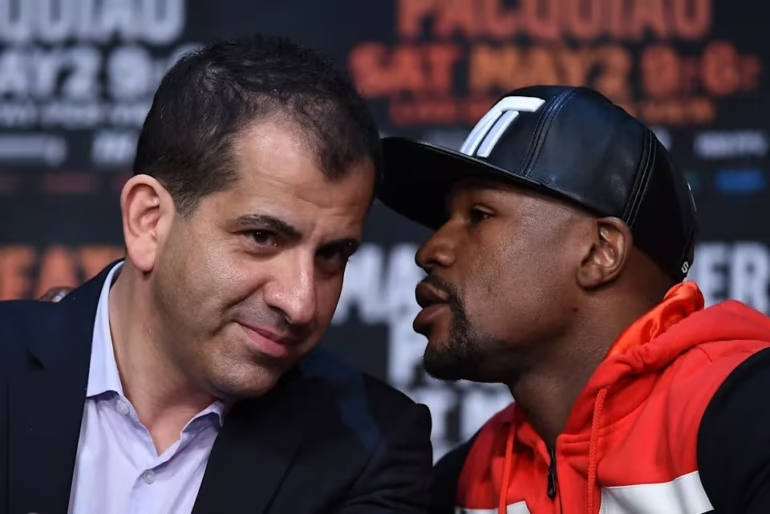
For nearly two decades, the brand of Floyd Mayweather Jr. was synonymous with a specific kind of invincibility—one that existed as much in the ledger as it did in the ring. He wasn’t just a boxer; he was a sovereign wealth fund in a pair of trunks. His relationship with Showtime was the cornerstone of this empire, a partnership that transformed the “Money” persona from a nickname into a business model. It was a union built on the premise that Mayweather was the house, and the house never loses.
But the $340 million lawsuit filed by Mayweather in early February 2026 against Showtime and former executive Stephen Espinoza marks a jarring fracture in that narrative. The man who once stood on podiums showering the crowd with cash is now alleging he was the victim of a sophisticated, years-long financial fraud. The contrast is stark: the ultimate insider, the master of the “checkmate,” is claiming he was an outsider in his own deals. This isn’t just a contractual dispute; it is a profound pivot from a legacy of total control to a public admission of vulnerability. It signals the end of the “Money Mayweather” era as a symbol of flawless execution and the beginning of a messy, litigious struggle to reclaim a narrative that may have already slipped away.
The Architect of Autonomy
To understand the weight of this lawsuit, one must look back at the positioning that allowed Mayweather to command the cultural zeitgeist. In the early 2000s, Mayweather was “Pretty Boy Floyd,” a dazzling technician under the Top Rank banner. However, the real transformation occurred in 2006 when he paid $750,000 to buy out his contract. It was the foundational myth of his career: he bet on himself to achieve a level of autonomy previously unseen in combat sports.
By the time he signed his landmark six-fight deal with Showtime and CBS in 2013—a deal worth over $200 million—Mayweather had successfully branded himself as the ultimate disruptor. He was the athlete-as-CEO, the man who had decoded the matrix of pay-per-view. Every press conference was a masterclass in symbolism, featuring private jets and a relentless insistence that he was the one pulling the strings. Showtime wasn’t just a broadcaster; they were the megaphone for his myth of total self-sovereignty.
However, the mid-period of this partnership began to show the cracks of over-saturation. Following the “Fight of the Century” against Manny Pacquiao in 2015, Mayweather’s public identity shifted toward the “exhibition” phase. His 2017 crossover bout with Conor McGregor was less a sporting event and more a billion-dollar piece of performance art. While the checks remained massive, the narrative was no longer about defending a title; it was about maintaining a lifestyle. The current lawsuit alleges that during this later period, the very partners who helped build his “Money” image were secretly diverting his earnings, creating a “web of deception” that allegedly cost him hundreds of millions.
The Fracture and the Fallout
The lawsuit’s core allegation—that Showtime and Espinoza facilitated a scheme where funds were diverted to Mayweather’s longtime advisor Al Haymon—has sent shockwaves through the industry. According to reports from TMZ Sports and The Ring, Mayweather claims that a “significant portion of his career earnings” were misappropriated. The legal filing describes a betrayal that feels personal, alleging that Espinoza, once seen as Mayweather’s closest corporate ally, used his position to funnel payments into accounts Mayweather did not control.
The reaction from the boxing world has been a mix of skepticism and “I told you so.” Peer reactions have been telling; 50 Cent, a former friend turned rival, took to social media to mock Mayweather, suggesting his failure to read his own contracts led to the $340 million loss. Media framing has been equally complex. While Sports Illustrated and The Sporting News have focused on the financial intricacies, the broader cultural conversation has centered on the potential fallibility of the “Money” brand. For years, Mayweather’s relevance was tied to the idea that he was smarter than the system. To sue for fraud is to admit that he was, in fact, played by it.
The Strategy of Betrayal
In the legal filings, Mayweather’s team doesn’t just argue over math; they argue over control. The suit suggests a period where Mayweather felt he was losing his grip on the machinery of his own career. A pivotal moment occurred after he switched management teams in 2024, bringing in Richard Schaefer to review his books. When Schaefer requested accounting records, Mayweather alleges Showtime told them the documents were “lost in a flood” or otherwise inaccessible.
Implicit in this lawsuit is an admission of misplaced trust. Mayweather, who famously trusted only his “Money Team” inner circle, is now claiming that the corporate suits he invited into that circle were the ones who ultimately compromised his empire. His attorney, Bobby Samini, explicitly acknowledged the motivation for the legal fight, stating that Mayweather is taking this to the courtroom to “recover what he rightfully earned.” For Mayweather, this appears to be a mix of financial recovery and a desperate need to re-establish his status as the smartest man in the room.

Beyond the Ring: The Culture of the Grift
Zooming out, the Mayweather-Showtime collapse is a microcosm of a larger cultural shift in how we perceive power and partnership. We are currently living in an era where “legacy” is increasingly being traded for “relevance,” and where the lines between a business partner and a predator are blurred.
- Relevance vs. Legacy: For Mayweather, the lawsuit is a bid for continued relevance. In a post-retirement world where he is no longer the active center of the boxing universe, a high-stakes legal battle keeps his name in the headlines. However, it risks tarnishing his legacy. The Mayweather of 2013 was a god of commerce; the Mayweather of 2026 is a litigant.
- Authenticity vs. Performance: The “Money” persona was always a performance, but it was a performance backed by the perceived reality of his bank account. When that reality is legally challenged, the performance collapses. Whether it’s the closure of Showtime Sports in late 2023 or the downfall of other industry giants, there is a growing cynicism toward “untouchable” figures.
- The Contested Nature of Authority: Today, cultural authority is no longer granted by a clean win-loss record. It is contested in the courts. Mayweather’s lawsuit is an attempt to use his massive platform to exert pressure on Paramount, which has vehemently denied the claims as “baseless.” It is a fight for the remains of a dying era of premium cable boxing.
Conclusion: The Cost of the Crown
As the legal proceedings move forward, the question remains: what does Floyd Mayweather want? If he wins, he secures a windfall that further solidifies his financial status amidst rumors of financial pressure. But in the process, he has permanently altered the public’s understanding of his career. The invincible champion has revealed himself to be a man who can be deceived.
In today’s hyper-connected, skeptical landscape, the “Money” branding feels like a relic of a simpler time—a time when we believed that a single individual could truly master the complexities of global media and finance through sheer force of will. Mayweather’s lawsuit against Showtime is more than a legal maneuver; it is a confession that the house always wins, even when you think you own the house. Whether this strategy carries weight in a changing environment depends on the outcome in court, but the cultural damage is already done. The myth of the “Perfect 50-0” business record has been broken.