The Architect and the Anomaly: Seattle’s Defensive Masterclass and the Fragility of the Modern Prototype
The trajectory of the modern NFL superstar is often written in ink before the first snap is even taken. For Drake Maye, the narrative was one of “magical” ascension—a season defined by poise, a runner-up finish in the MVP race, and the heavy mantle of being the savior for a New England Patriots franchise still haunted by the ghost of its own dynastic past. But on a Sunday in Seattle, that narrative met a brutal, physical contradiction. The contrast was stark: Maye, the graceful architect of the Patriots’ revival, transformed into a flustered figure, clenching the ball with a hesitancy that bordered on paralysis. Across from him stood Mike Macdonald, the cerebral coordinator-turned-head-coach whose defense didn’t just win a game; it dismantled an identity.
This wasn’t merely a loss; it was a cultural collision. In a league that increasingly prioritizes the “system-proof” quarterback—the mobile, hyper-aware talent who can transcend any scheme—Seattle provided a sobering reminder that the system still holds the ultimate power of veto. The “Super Romp” was a clinical execution of modern defensive philosophy, proving that even the most “magical” individual campaigns can be reduced to static when confronted by a superior collective architecture.
The Rise of the New Prototype
The early stages of Drake Maye’s tenure in New England were marked by a sense of inevitability. Following the departure of Tom Brady and the subsequent identity crisis of the Mac Jones era, Maye arrived as the antithesis of the rigid pocket passer. He represented the “modern prototype”: a blend of size, arm talent, and escapability that allowed the Patriots to play a more fluid, improvisational brand of football. His early statements weren’t made in press conferences, but on the field, where he routinely turned broken plays into highlights, earning comparisons to the league’s elite tier of dual-threat playmakers.
By mid-season, Maye had solidified his position as the centerpiece of a cultural shift in Foxborough. The Patriots were no longer just the “Do Your Job” factory; they were a team that relied on the individual brilliance of a young signal-caller. This was the “magical campaign” referenced by observers—a period where Maye’s talent seemed to mask the deficiencies of a rebuilding roster. However, beneath the surface, there were moments of ambiguity. Struggles against complex blitz packages and a tendency to hold the ball too long hinted at a vulnerability that was largely ignored in favor of the larger, more marketable story of a franchise reborn.
The Seattle Sunder
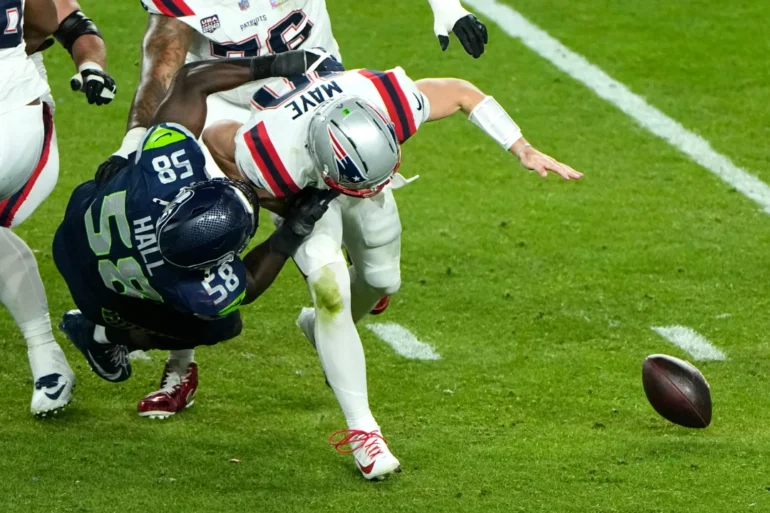
The recent events in Seattle crystallized those vulnerabilities into a definitive crisis. From the opening whistle, Mike Macdonald’s defense operated with a level of psychological aggression that the Patriots were unprepared for. It began with the defensive back pressures—specifically from Devon Witherspoon—that didn’t just sack Maye but “discombobulated” the entire Patriots’ blocking scheme.
The reaction from the sporting world was instantaneous and incisive. Analysts at ESPN and The Ringer noted that Maye looked “flustered” by Macdonald’s post-snap rotations. The media framing shifted overnight from celebrating Maye’s MVP candidacy to questioning his ability to process information under duress. This wasn’t just a bad game; it was a blueprint for how to neutralize the league’s newest star. The industry response highlighted a growing consensus: Maye’s “magical” ability to improvise becomes a liability when the defense refuses to let the play break down on the quarterback’s terms.
The “evidence” of this shift was found in the statistics that masked the reality of the game. While Maye finished with nearly 300 yards and two touchdowns, the “overwhelming majority” of that production came in “garbage time.” In the first half, when the game was still a contest, he managed a paltry 48 passing yards. This disparity points to a strategic admission—perhaps unintentional—by the Patriots’ coaching staff. They were unable to protect their star from a defense that was “coming from seemingly every angle.”
The Power of the Collective
When we zoom out, the Seattle-New England game reveals a profound tension in current sports culture: the worship of the individual versus the power of the institution. We live in an era of “player empowerment” and “brand building,” where a single athlete like Drake Maye can become a franchise’s entire cultural footprint. The NFL has leaned into this, marketing its young quarterbacks as superhuman protagonists in a weekly drama.
However, Mike Macdonald’s Seahawks represent a return to the “architectural” model of success. Seattle’s defense didn’t rely on a single superstar to stop Maye; they relied on “depth.” Sacks came from Derick Hall, Byron Murphy II, and the rookie Rylie Mills. The game ended not with a Maye comeback, but with Uchenna Nwosu returning an interception for a touchdown. This reflects a broader cultural pattern: the realization that in high-stakes environments—whether in sports, tech, or media—individual “magic” is often a fragile commodity compared to a well-integrated, adaptive system.
The Seahawks’ “Super Romp” was an act of cultural deconstruction. They took the “MVP runner-up” and showed that his brilliance was contingent on variables he could not control. This speaks to the modern media ecosystem’s obsession with “authenticity” versus “performance.” Was Maye’s early-season success an “authentic” reflection of his ceiling, or was it a “performance” enabled by a league that hadn’t yet solved the Macdonald puzzle?
The Weight of the Prototype
As we look at the wreckage of the Patriots’ performance, we have to ask whether the “modern prototype” identity still carries weight in an environment that is rapidly evolving to counter it. For years, the NFL was dominated by the idea that a great quarterback could overcome anything. But as defensive coordinators like Macdonald become the new “rock stars” of the coaching world, that dynamic is shifting.
Maye’s struggle under pressure wasn’t just a failure of technique; it was a failure of a specific type of cultural authority. He arrived in Seattle with the “relevance” of an MVP frontrunner and left with the “legacy” of a player who “panicked at times.” The shift from “magical” to “wayward” happened in the span of four quarters, illustrating just how quickly cultural authority can be contested and lost in the modern age.
In the end, the party in Seattle was a celebration of the collective over the individual. It was a reminder that while we love the story of the lone hero, the most enduring power often belongs to those who build the systems that the heroes must navigate. Drake Maye is still a formidable talent, but after Sunday, the “magical” veneer has been stripped away, replaced by a much more complex and demanding reality. He is no longer the savior; he is a player searching for a way to survive the machines that are built to break him.