In the early 1990s, the battle lines of American culture were drawn with permanent markers. On one side stood the Nashville traditionalists, men in starched denim who viewed “crossing over” as a form of spiritual treason. On the other was the burgeoning world of alternative rock and hip-hop, genres defined by a rejection of the mainstream artifice that country music seemed to embody. In the center of this tension was Garth Brooks, a man who was simultaneously the biggest star in the world and an outsider to the high-culture elite. He was the artist who brought arena-rock pyrotechnics and wireless headsets to the Grand Ole Opry, a disruption that earned him 162 million album sales but also a reputation as a populist provocateur who had permanently “pop-ified” the genre.
Fast forward to the announcement of Summerfest 2026, and the tension has shifted from whether country music belongs in the mainstream to whether the mainstream even exists without it. The festival’s lineup—featuring Brooks alongside Post Malone, Megan Moroney, and Jelly Roll—isn’t just a concert schedule; it is a manifesto for a post-genre era.
What we are witnessing is not the “death” of country or the “selling out” of pop, but a Great Convergence. The shift reflects a broader cultural pattern where authenticity is no longer tied to a specific sound or geography, but to a perceived sincerity that transcends the old silos of the industry.
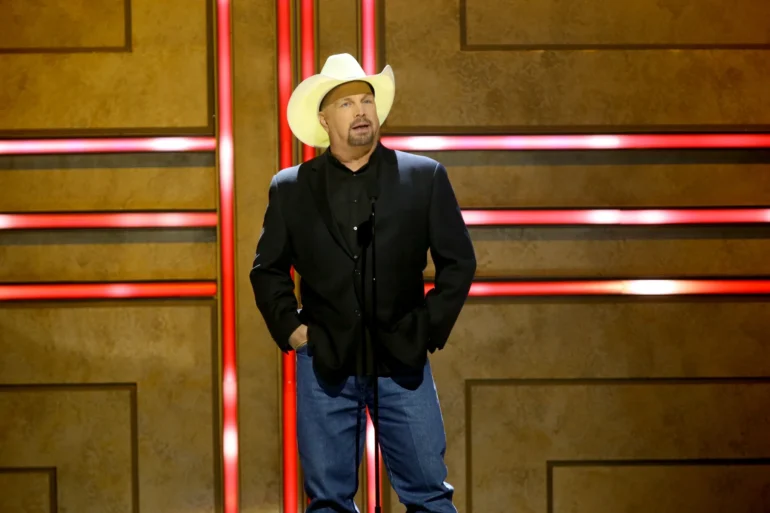
Garth Brooks will kick off Summerfest 2026 in Milwaukee, marking his first appearance at the legendary “World’s Largest Music Festival.” Photo: GarthBrooks.com / Official Press.
The Timeline of a Transformation
The journey to this moment began in 1989. When Brooks released his self-titled debut, he was a traditionalist. Tracks like “Much Too Young (To Feel This Damn Old)” were nods to the George Strait school of neo-traditionalism. But by 1991’s Ropin’ the Wind, the first country album to ever debut at No. 1 on the Billboard 200, the mask was slipping. Brooks was covering Billy Joel and citing James Taylor as his primary influence. He wasn’t just a country singer; he was an arena-rock star who happened to wear a Stetson.
This mid-period was defined by a restless search for identity. Most famously, 1999 saw the birth of Chris Gaines, a fictional Australian rock persona that was widely mocked at the time as a vanity project. In retrospect, Gaines was a canary in the coal mine—an early, clumsy attempt to signal that a country artist could occupy different sonic spaces.
The recent “Post Malone era” of country music has finally provided the framework that Brooks lacked in 1999. In 2024, Malone’s album F-1 Trillion debuted at No. 1, featuring collaborations with everyone from Dolly Parton to Morgan Wallen. When Malone covered Brooks’ signature anthem “Friends in Low Places” at the Ryman Auditorium, it wasn’t seen as a gimmick. It was a coronation. The “pop star” was seeking legitimacy in the “country star’s” house, and the “country star” was finally being recognized as the blueprint for the modern global entertainer.
Conflict, Reactions, and the Credibility Wars
This convergence hasn’t happened without friction. For decades, Nashville operated as a closed-loop system. The “bro-country” era of the 2010s was largely seen as a regression—a shallow aesthetic of trucks and beer that lacked the narrative depth of the genre’s pioneers. This led to a predictable backlash: a “moral panic” among purists who felt the genre was being diluted by hip-hop beats and snap-tracks.
However, the industry response to artists like Post Malone and Megan Moroney has been markedly different. Moroney, dubbed the “Emo Cowgirl” by Rolling Stone, uses the aesthetics of country to tell stories of Gen-Z heartbreak that feel more like a Taylor Swift record than a Patsy Cline one. The media framing has shifted from “Is this country?” to “How does this redefine country?”
The “controversy” is no longer about the music itself, but about the gatekeeping. When Beyoncé released Cowboy Carter in early 2024, it forced a reckoning with the genre’s racial and cultural origins. The backlash from some corners of country radio only served to highlight how desperate the old guard was to maintain a monopoly on “authenticity.” The success of Cowboy Carter and Malone’s F-1 Trillion proved that the audience was far ahead of the industry. The public didn’t want a wall; they wanted a bigger table.
Evidence of Strategy: Sincerity as the New Provocation
The subjects of this transformation have been surprisingly candid about their motivations. Garth Brooks has long maintained that he is a creature of the “live” experience. In a recent interview, he noted that the main ingredient of country music is “sincerity.” He has pivoted from being a disruptor to being the elder statesman of “the nice guy” brand. By welcoming artists like Jelly Roll into his orbit, Brooks is signaling that his legacy isn’t tied to a specific sound, but to a specific feeling of community.
Post Malone, similarly, has used transparency as a shield. “When I turn 30, I’m becoming a country/folk singer,” he tweeted in 2015. By explicitly stating his intention years before it was commercially viable, he bypassed the “carpetbagger” narrative. His transition wasn’t seen as a strategic pivot to save a fading career, but as the fulfillment of a long-held personal truth. In an era of manufactured “viral moments,” this kind of long-game authenticity is the ultimate currency.

Cultural Analysis: Relevance vs. Legacy
Zooming out, the Brooks-Malone-Moroney axis at Summerfest 2026 reveals a fundamental truth about our current cultural moment: The era of the “subculture” is over. In the 20th century, your musical taste was a badge of tribal identity. You were a “country fan” or a “rap fan.” Today, thanks to the algorithmic flattened landscape of Spotify and TikTok, young listeners don’t see genres; they see “vibes.”
- Relevance vs. Legacy: For an artist like Garth Brooks, relevance is no longer about hitting No. 1 on the radio—it’s about being the “godfather” to the new generation. By headlining festivals like Summerfest alongside Post Malone, he ensures that his catalog remains “cool” by association.
- Authenticity vs. Performance: We are seeing a move away from the “tough guy” or “outlaw” trope in country toward a more vulnerable, “emo” sensibility. Megan Moroney and Jelly Roll represent a shift where emotional honesty is the primary metric of authenticity.
- The Power of the Hybrid: Cultural authority is now gained through the ability to traverse multiple worlds. Post Malone can perform at Stagecoach one weekend and headline a hip-hop festival the next. This fluidity is the new hallmark of the “Superstar.”
The Verdict: A Changing Environment
As we look toward the 2026 festival season, the question isn’t whether Garth Brooks still “carries weight.” His status as the RIAA’s best-selling solo artist remains untouchable. The question is whether the structure he helped build—the arena-country spectacle—can survive in a world where the “arena” is now a digital, borderless space.
The Great Convergence suggests that the future of music isn’t country, pop, or hip-hop; it’s a synthesis of all three, held together by the glue of Americana storytelling. Garth Brooks was the first to realize that you could play a rock show in a cowboy hat. Post Malone realized you could be a rapper with a country heart. Megan Moroney realized you could be a pageant queen with a broken soul.
In this new landscape, the “outsider” has become the center. The controversy of the 90s—that Garth Brooks wasn’t “country enough”—now looks like a quaint relic of a bygone age. Today, the only thing that isn’t “country enough” is a closed mind. As the gates of Nashville continue to swing open, the music that emerges is louder, weirder, and more inclusive than ever before. And for the first time in his thirty-year career, Garth Brooks finally looks like he’s exactly where he belongs.