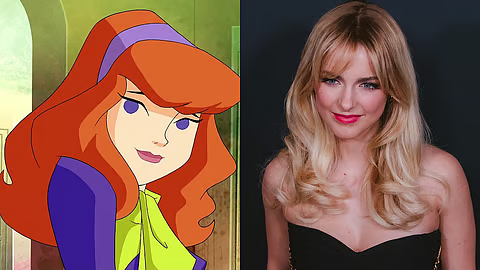
It has just been announced that McKenna Grace has been cast to play Daphne in Netflix’s upcoming live-action adaptation of Scooby-Doo. However, the news sparked harsh backlash over social media. Some expressed frustration over the fact that an unknown should have been cast over someone as popular as McKenna Grace. However, others are expressing frustration over the lack of outrage around such a famous redhead being played by a blonde actress.
This has led many to bring up the hypocrisy around “gingercide” allegations, which is a term that was created by users on X to highlight the “erasure” of red-haired characters, mainly when the actor that was cast is a person of color. However, after the casting of McKenna Grace, there have been no such allegations, bringing up the question, where are the erasure cries when a White blonde actress is cast as Daphne?

Hair Color, or Something Deeper?
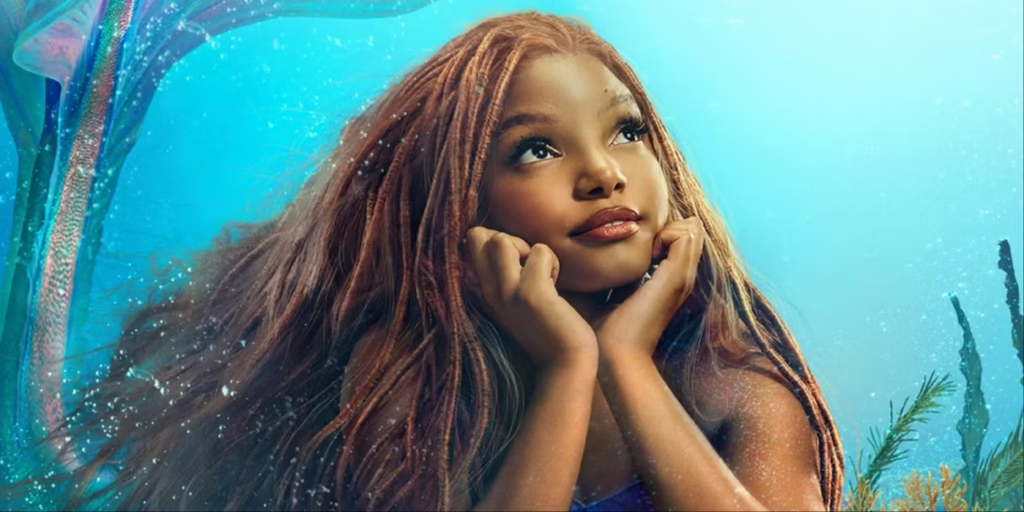
Why does the hair color of characters only matter when the actor is a person of color? We saw this dynamic most vividly with Halle Bailey, who received so much backlash following her casting as Ariel in Disney’s live-action version of The Little Mermaid. Although Bailey’s hair in the film was red (though a more realistic shade), many online argued that her casting was “redhead erasure” despite her hair being red in the film. This led many to believe that this critique was rooted more in racism than hair color.
Social Commentary
The entire topic of “Gingercide” works as social commentary. It reveals how often the argument of “faithfulness to the source material” is used selectively. There is little to no outrage when a White actress who is not naturally redheaded gets a part like Daphne. But when a Black actress is chosen to portray a redhead, even if she has red hair in the adaptation, suddenly all people petition for more loyalty to the source material.
Who Gets Policed—and Who Doesn’t
The core concern is not hair. When Halle was cast for the role of Ariel, she received countless death threats, but when McKenna Grace gets cast, there is no such outrage.
White actresses get freedom. Their skill is appreciated, and they are shown grace even if they don’t look exactly like the character because they could dye their hair or wear wigs, and even though actors of color can do the same thing, they bear the responsibility of representing whole groups as they take on roles that stray from typical adaptations.

Wanting adaptations to align with the source material is not inherently wrong. However, the point of adaptations is to expose new audiences to a property they wouldn’t have otherwise known or grown to love it.
Moving Beyond Performative Outrage
All in all, the discourse around McKenna Grace’s casting is not to say that she doesn’t have what it takes to be a good Daphne on screen. In fact, I believe that she will do fairly well in the role. However, the reaction to her casting points to how even in 2026, we have people who are uncomfortable with seeing people of color on their screens playing leading roles.
All I can hope is that if there is ever another instance when an actor of color is cast to play a character who is red-haired, the conversation will be around their ability and skill, like the current discourse around McKenna Grace, and not just the fact that they were the “wrong hair color.”