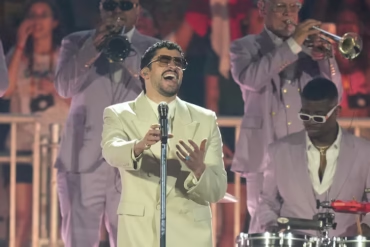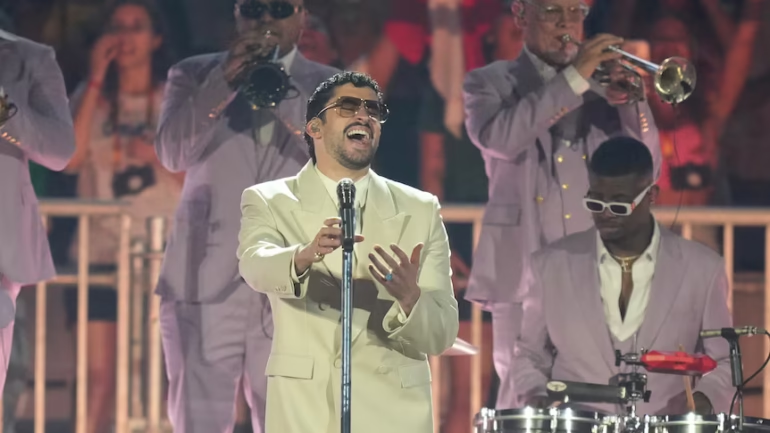
Bad Bunny’s recent sold-out shows in Sydney, Australia, attracting nearly 90,000 fans to ENGIE Stadium and setting a new attendance record, would seem, on the surface, to be a straightforward victory lap for a global music phenomenon. It’s a testament to his undeniable charisma and the expansive reach of his music. Yet, these milestones, particularly in a market where Spanish is not widely spoken, as noted by Rolling Stone Australia, compel a deeper look. This isn’t merely about record-breaking; it’s about a fundamental shift in cultural power dynamics, where language and geography are becoming increasingly fluid barriers in the creation and consumption of global superstardom. Bad Bunny’s journey from a rising Latin artist to a bona fide international headliner, capable of shattering attendance records in Australia, exemplifies a broader cultural evolution driven by digital connectivity, a redefinition of authenticity, and a strategic mastery of the modern media landscape.
To understand the present, one must recall the past. Benito Antonio Martínez Ocasio, known to the world as Bad Bunny, emerged from Puerto Rico not just as a musician but as a potent symbol of Caribbean identity and a voice for marginalized communities. His early work, characterized by its raw energy and genre-bending sound, often intertwined with social commentary and unapologetic expressions of his roots. From his distinctive fashion choices that challenged gender norms to lyrics that spoke to societal issues, Bad Bunny cultivated an image of raw, unfiltered authenticity. His early positioning was that of an artist deeply connected to his culture, using his platform to amplify Puerto Rican experiences and advocate for its causes, such as during the 2019 protests against then-Governor Ricardo Rosselló, where he played a pivotal role in galvanizing public action. This period cemented his reputation as an artist with a message, one who was unafraid to engage with the political and social realities of his homeland.
The trajectory of his career, however, has been marked by a series of deliberate evolutions that have broadened his appeal while, for some, raising questions about his core identity. While his commitment to his Puerto Rican heritage remains evident, his global ambitions have seen him navigate the complexities of mainstream international markets. The transition wasn’t immediate; it was a gradual expansion that saw him collaborate with a diverse range of artists, from Cardi B and Drake to J Balvin and Rosalía, effectively bridging linguistic and cultural divides. His 2022 album, *Un Verano Sin Ti*, became a cultural touchstone, topping charts worldwide and solidifying his status as a global phenomenon. This period marked a significant shift from being a beloved Latin artist to a dominant force in the global music industry, demonstrated by his groundbreaking achievement of earning his first-ever solo Number One on the Billboard Hot 100 earlier this year. The recent Australian tour, a continent far removed from his cultural origins and linguistic base, represents the crystallization of this expansive reach, where his music and persona transcend geographical and linguistic barriers, drawing massive, record-breaking crowds.
This unprecedented global success has, predictably, elicited varied reactions. For legions of fans, Bad Bunny’s ascendance is a triumphant vindication of Latin music and culture on a global stage. They celebrate his ability to remain true to his roots while achieving unparalleled commercial success, seeing him as a symbol of pride and representation. However, this broad appeal has also led to discussions and, at times, critiques. Some have questioned whether his global commercialization might dilute the raw, politically charged messages that defined his earlier work, or if his appeal is more performative than substantive. The sheer scale of his success in non-Spanish speaking markets, like Australia, has sparked conversations about the universal nature of his artistry versus the strategic packaging of his image for a global audience. The media, while largely celebratory, frames his achievements through the lens of historic milestones, amplifying his global impact and reinforcing his narrative as a trailblazer. This constant spotlight, while beneficial for his career, also intensifies scrutiny on every aspect of his public persona and artistic output.
Bad Bunny himself has offered glimpses into the motivations behind his strategic evolution. While not one for lengthy autobiographical confessions, his actions and occasional statements speak volumes. His embrace of provocative fashion, his willingness to experiment with diverse musical styles, and his strategic collaborations all suggest a keen awareness of how to capture and maintain attention in a crowded global marketplace. The sheer scale of his tours, the record-breaking attendances, and his consistent chart dominance are not accidental. They are the result of a meticulously crafted strategy that leverages his undeniable talent with a sophisticated understanding of cultural trends and media engagement. His approach appears to be one of calculated provocation and performative authenticity, where he embodies a persona that is both deeply personal and universally relatable. This isn’t to say his passion is not genuine, but rather that its presentation is honed for maximum impact. As he prepares for further international legs of his World’s Hottest Tour, and upcoming performances in Tokyo as part of Spotify’s Billions Club Live series, his ambition is palpable – to conquer every corner of the globe, solidifying his legacy not just as a musician, but as a cultural icon.

What Bad Bunny’s meteoric rise reveals about our current cultural moment is profound. It underscores the diminishing power of traditional gatekeepers and the ascendancy of artists who can forge direct connections with global audiences through digital platforms. His success challenges the notion that language or nationality are insurmountable barriers to mainstream appeal, demonstrating that a compelling persona, authentic expression (even if curated), and a universally resonant artistic vision can transcend these boundaries. This era is defined by a complex interplay between authenticity and performance. Bad Bunny’s ability to maintain a strong cultural identity while achieving universal stardom highlights a modern paradigm where artists are not just musicians but also brand managers, cultural commentators, and architects of their own narratives. The pursuit of relevance, in this context, often takes precedence over legacy, with artists constantly innovating and adapting to remain at the forefront of cultural discourse. Power, attention, and influence are the currencies of the modern media ecosystem, and Bad Bunny has proven exceptionally adept at accumulating them, not through conventional means, but by embracing his unique identity and projecting it onto a global stage. His journey is a masterclass in navigating the attention economy, turning cultural distinctiveness into a global commodity.
As Bad Bunny continues to break records and expand his global footprint, the question remains: to what extent can this carefully constructed persona, this blend of raw talent and strategic performance, sustain its weight in an ever-evolving cultural landscape? His ability to connect with audiences across diverse backgrounds is undeniable, evidenced by the historic turnout in Sydney and his widespread critical acclaim. However, the long-term implications of this global strategy on his artistic legacy and cultural impact are yet to be fully determined. Is he a revolutionary force dismantling linguistic and geographical barriers, or a masterful strategist who has harnessed the power of global media to achieve unprecedented commercial success? Perhaps he is both. In today’s hyper-connected world, Bad Bunny has redefined what it means to be a global superstar, demonstrating that cultural authority can be built not by conforming to existing norms, but by boldly asserting one’s own identity and vision. His continued success will be a crucial barometer for understanding the future of global music and the ever-shifting definition of cultural influence.