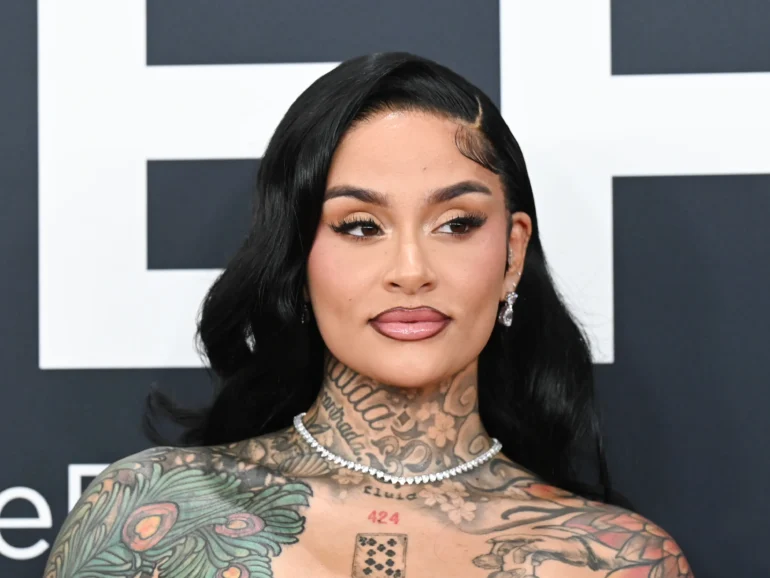

In a now-viral video, the Oakland singer said there’s nothing anyone can say to convince her that artificial intelligence belongs at the center of music creation,
adding that she doesn’t respect the idea of a fully AI-generated artist taking up space in an industry where human musicians have sacrificed their entire lives to be heard.The flashpoint of her frustration is Xania Monet – a photorealistic AI gospel/R&B singer whose songs, generated with the help of the AI music platform Suno,
have landed on multiple Billboard charts and earned a reported $3 million deal with Hallwood Media.
Behind the avatar is Mississippi poet and designer Telisha “Nikki” Jones, who writes the lyrics and uses AI tools to transform her poems into full productions.
For some, Xania represents a new, empowering way to make music. For others, she’s a symbol of an industry willing to trade human craft for algorithm-friendly content.
Kehlani’s quote — that simply prompting AI is “not writing a song” — captures the tension at the center of one of the biggest debates in music right now.
Meet Xania Monet: The AI Artist Redrawing the Map
Xania Monet is not a human performer in the traditional sense. She’s a meticulously designed digital persona with a smooth, R&B-leaning voice and a catalog
of inspirational songs that sit comfortably alongside contemporary gospel and adult R&B.
According to reporting on her rise, Xania was created by Telisha “Nikki” Jones, a 31-year-old poet from Mississippi who began experimenting with AI only months ago.
Jones feeds her original poems and stories into Suno, an AI music platform that can generate melodies, arrangements, and synthesized vocals from text prompts.
She then iterates through hundreds of versions until a song feels emotionally right and commercially ready.
The results have been undeniable on paper. Xania’s track “How Was I Supposed to Know?” became the first AI-generated song to enter a Billboard radio airplay chart,
appearing on Adult R&B Airplay and Hot R&B Songs, while her single “Let Go, Let God” climbed near the top of Hot Gospel Songs.
As streams surged, a bidding war reportedly pushed offers into seven-figure territory before Hallwood Media secured a deal worth around $3 million.
For Jones and her team, Xania is proof that a creator without traditional vocal chops or industry connections can now build a charting artist with a laptop,
a catalog of poems, and smart use of technology.
Why Kehlani Says “Prompting the AI” Isn’t Songwriting

In her video response, Kehlani zeroed in on a core concern: authorship.
She pointed out that AI can now write lyrics, generate melodies, sing the entire song, and even build the beat — all without a human musician ever stepping into a studio.
When an AI-fronted act receives a multimillion-dollar deal on the back of that process, she argued, it feels like a slap in the face to the writers and performers
who spent years mastering song structure, storytelling, and stagecraft.
Her critique isn’t simply that AI exists, but that it can be used by labels and tech companies to bypass the messy, expensive, deeply human part of artist development.
In an industry where many working musicians are barely scraping by, watching an AI avatar leapfrog straight to prime billing — with no touring fatigue,
no vocal strain, no artist burnout — looks less like innovation and more like cost-cutting.
Kehlani also linked AI’s rise to a broader pattern of creative extraction.
Most generative systems are trained on vast amounts of human-made music, often pulled from the open web or licensing deals that don’t directly compensate the individual creators whose work becomes the raw material.
If AI artists then dominate playlists and label rosters, the original human source material risks being further devalued.
The Woman Behind the Avatar: Telisha “Nikki” Jones Speaks

Jones, for her part, has pushed back on the idea that she is “doing none of the work.”
In interviews, she emphasizes that Xania’s songs are rooted in her own life experiences, particularly grief and spirituality, and that she still spends long hours refining prompts,
adjusting arrangements, and curating every element of the project.
She describes Xania as an extension of herself — a vessel for her poetry and imagination rather than a faceless corporate experiment.
Jones has also highlighted that she is a Black woman creating a Black female avatar, countering accusations that Xania represents a form of “digital blackface”
engineered by outsiders to profit off Black aesthetics.
Jones’ stance raises uncomfortable but important questions:
If a marginalized creator uses AI to bypass traditional gatekeepers and build a career on her own terms, is that empowerment, exploitation, or something in between?
And how should we weigh her agency against the broader structural risks that bother artists like Kehlani?
Transmuting Emotion vs. Generating Output

At the heart of Kehlani’s critique is a romantic but widely held definition of songwriting:
the deliberate process of shaping melody, lyrics, harmony, and structure to carry a specific emotional truth.
Songwriters obsess over pre-chorus lift, syllable stress, rhyme schemes, and chord progressions because they know tiny decisions can make the difference between a forgettable demo and a timeless record.
Generative AI, by contrast, specializes in pattern imitation.
It ingests mountains of existing music, identifies statistical relationships between sounds and structures, and then spits out new combinations that feel familiar enough to pass as “a song.”
It can be dazzlingly effective — especially when guided by a skilled human prompter — but it doesn’t have a childhood, a heartbreak, or a faith journey to draw from.
That doesn’t automatically make AI-assisted music inferior, but it does reframe what we’re actually listening to.
Are we hearing the distilled voice of a songwriter’s lived experience, or a cleverly steered remix of everything the algorithm has ever ingested?
What Xania Monet Means for Human Songwriters
Xania’s success lands at a fragile moment for working musicians. Streaming payouts remain notoriously low, touring costs are rising, and many mid-tier artists depend on sync licensing,
merch, and brand deals to survive. An AI avatar who never gets tired, never asks for better splits, and can release a new song every day presents an irresistible proposition for some investors.

For human songwriters, several pressure points emerge:
- Competition for attention: Playlists and algorithmic recommendations don’t care whether a song is sung by a person or an avatar. If AI content is cheaper to produce at scale, it can flood the ecosystem.
- Devaluation of craft: If audiences and executives are conditioned to see songwriting as “typing a vibe into a box,” the perceived value of long-term craft may shrink.
- Ghost labor & training data: Many AI systems are trained on uncredited human work. Without strong copyright and compensation frameworks, the people who built the sonic language of popular music risk being cut out of future profits.
- New gatekeepers: AI doesn’t eliminate middlemen; it creates new ones. Model owners, platform founders, and label-tech alliances may become the new power brokers deciding which synthetic voices rise.
At the same time, some musicians see opportunity. Used thoughtfully, AI can handle demos, arrangement experiments, reference tracks, and sound design that would otherwise be cost-prohibitive.
The difference is whether AI is treated as a collaborator that expands human possibility — or a replacement that renders human talent optional.
Finding a Future Where Technology Serves the Song
Whether you side more with Kehlani’s skepticism or Jones’ optimism, it’s clear that AI in music isn’t going anywhere.
The question is what norms the industry will build around it in the next few years. Some possibilities already being floated include:
- Strict transparency labels on AI-generated or AI-assisted songs, so fans know how the music was made.
- Fair-use and licensing frameworks that require AI companies to pay into funds that support the artists whose work trains their models.
- New credit categories in metadata (e.g., “AI production engine,” “prompt writer”) so the humans behind the prompts receive recognition and royalties.
- Ethical guidelines for avatars, particularly around race, gender, and cultural aesthetics, to prevent digital versions of long-standing exploitative practices.
What’s certain is that artists are no longer quietly accepting AI’s spread.
From Kehlani and SZA speaking out about the cultural and environmental costs of generative tech:
to local venues banning AI-designed posters in favor of human graphic artists, the creative community is drawing new lines.
Kehlani vs. Xania Isn’t a Feud — It’s a Fork in the Road
It’s tempting to frame this as a personal clash between a human star and a digital upstart, but the stakes are much bigger.
Xania Monet is one early example of what happens when AI and music business incentives collide; Kehlani’s reaction is the voice of a generation of artists
who fear their life’s work being turned into training data for their replacements.
In the end, the future of music may come down to a simple question:
Will we use technology to deepen the connection between artists and listeners, or to mass-produce content that feels good enough to skip to the next track?
Kehlani’s warning, and Xania’s success, are both signals.
How fans, labels, lawmakers, and creators respond to those signals will decide whether AI becomes a powerful instrument in the band — or the headliner that pushes everyone else off the stage.