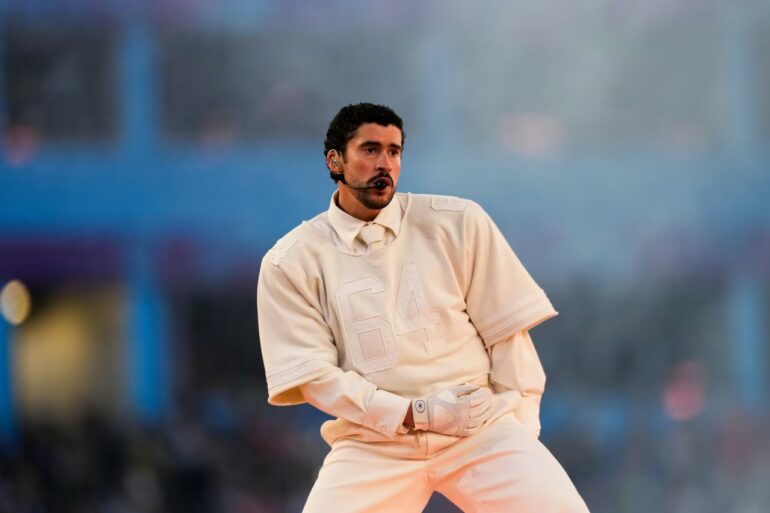
There was a time, not long ago, when the Super Bowl halftime show served as a meticulously curated time capsule of legacy Americana—a stage reserved for the safe, the established, and the monolingual. It was the land of Up with People, then the land of Prince and Springsteen. But as the lights dimmed and the opening chords of “Monaco” reverberated through the stadium, the silhouette center stage didn’t belong to a classic rock icon or a pop star singing in English. It belonged to Benito Antonio Martínez Ocasio.
The contrast is jarring when measured against the NFL’s conservative history. For decades, the league operated as a bastion of traditionalism, often hesitant to engage with the political or the overtly “other.” Yet, under the guidance of Jay-Z and Roc Nation, the halftime show has been surgically extracted from its comfort zone and transplanted into the heart of the global zeitgeist. By selecting Bad Bunny as the definitive headliner, the NFL didn’t just book a musical act; it acknowledged a tectonic shift in the American demographic and cultural fabric. In a climate where ICE raids and aggressive border rhetoric dominate the news cycle, seeing a Puerto Rican artist command the most-watched stage in the world is more than a concert—it is a reclamation of space.
The Evolution of the Global Icon
The trajectory of Bad Bunny is a masterclass in staying local to go global. In 2017, he was a supermarket bagger in Vega Baja, uploading tracks to SoundCloud that pulsed with the raw, unpolished energy of Latin trap. His early reputation was built on a defiant refusal to conform; he wore neon nail polish, challenged toxic masculinity, and insisted on singing exclusively in Spanish. This was “El Conejo Malo” in his purest form—a niche disruptor who seemed destined for the Latin charts but perhaps too “alt” for the American mainstream.
The mid-period shift occurred around 2020. His appearance during the Shakira and Jennifer Lopez halftime show was a brief, high-voltage teaser. It was a moment of ambiguity: was he a guest in someone else’s house, or was he measuring the floor plan? Shortly after, the release of YHLQMDLG (Yo Hago Lo Que Me Da La Gana) signaled a total rejection of the “crossover” blueprint. Unlike predecessors who felt the need to record English-language albums to court the Billboard Hot 100, Bad Bunny stayed his ground.
By the time Un Verano Sin Ti became the first all-Spanish album to be nominated for Album of the Year at the Grammys, the narrative had crystallized. He wasn’t chasing American approval; he was forcing America to learn his language. The Super Bowl performance is the final stage of this evolution—a transition from a regional superstar to the undisputed face of modern music.
A Night of Raving Reactions and Cultural Friction
As the performance unfolded, social media became a digital mosh pit of celebration. On X (formerly Twitter), the sentiment was overwhelming. “Bad Bunny isn’t just performing; he’s hosting a vigil for the old guard,” one viral tweet read. Another fan noted, “To see Benito up there while the news is talking about mass deportations… that’s the real resistance. Music doesn’t have borders even if the land does.”
Industry peers were equally vocal. From Cardi B to J Balvin, the consensus was clear: this was a win for the entire diaspora. However, the performance wasn’t without its detractors. Predictable pockets of the internet grumbled about “not being able to understand the lyrics,” a critique that feels increasingly prehistoric in an era where K-pop and Reggaeton dominate global streaming numbers. Media framing by outlets like Variety highlighted the “unapologetic Latinidad” of the set, noting that the inclusion of salsa legends and Caribbean iconography was a deliberate middle finger to the “melting pot” theory of assimilation.
The Strategy of the Stage
Bad Bunny has never been shy about the intentionality behind his moves. In his Rolling Stone cover story, he implicitly acknowledged that his career is a series of strategic provocations. “I’m not doing this for the numbers,” he stated, “I’m doing this so that the kid in Puerto Rico knows he doesn’t have to change who he is to be heard.”
His collaboration with Roc Nation and the NFL is the ultimate power move. By taking the halftime gig, he leveraged the league’s massive reach to broadcast a message of visibility. It wasn’t just about “attention-seeking”; it was about control. Control over the narrative of what an “American” looks like in 2026. The performance featured a heavy presence of people of color—dancers, musicians, and guest performers—creating a visual tableau that directly countered the exclusionary rhetoric found in modern political discourse.
Relevance, Legacy, and the Modern Ecosystem
Zooming out, this Super Bowl moment reveals a profound truth about our current cultural moment: the center of gravity has shifted. In the past, “relevance” was granted by traditional gatekeepers. Today, cultural authority is gained through community and authenticity. Bad Bunny’s success proves that the most specific, localized art often carries the most universal weight.
We are witnessing a contest for the soul of American entertainment. On one side, there is a push for a sanitized, monolithic past; on the other, there is the reality of a multi-hyphenate, multi-ethnic future. This performance was a flashpoint in that struggle. It addressed the tension between relevance and legacy, suggesting that legacy is no longer about staying power in a museum, but about the ability to move a crowd that has been historically ignored.
In a climate where the presence of immigrants and people of color is often treated as a “problem” to be solved by agencies like ICE, the Super Bowl stage offered a counter-narrative of excellence and indispensability. It argued that you cannot extract the labor and the culture of these communities while denying them their humanity.
The Weight of the Crown
As the final fireworks erupted over the stadium, the question remained: does this positioning still carry weight in a changing environment? Some critics argue that the Super Bowl is the ultimate corporate co-optation—that by performing, Bad Bunny has become part of the very machine he once critiqued.
However, looking at the joy on the faces of the fans in the front row and the “raves” echoing across the internet, it’s hard to see this as anything other than a victory. Bad Bunny’s strategy—rooted in pride, language, and a refusal to bow—has forced the largest stage in the world to adapt to him, rather than the other way around. In the modern media ecosystem, that is the ultimate form of influence. Whether this heralds a permanent change in how the NFL views its audience or remains a singular anomaly is yet to be seen. But for one night, the message was unmistakable: the future is here, it’s vibrant, and it speaks Spanish.