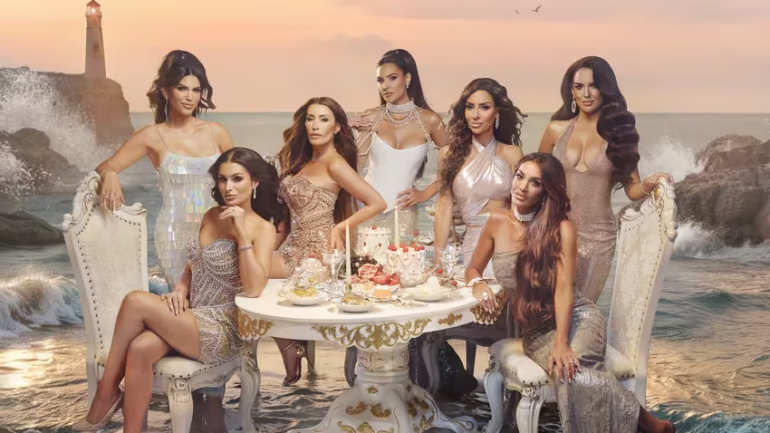
For the last decade, the Real Housewives franchise has drifted steadily toward the surreal. We have watched women in Salt Lake City navigate federal indictments in snowsuits, and we have watched the ultra-wealthy of Dubai argue over unpronounced grievances in empty skyscrapers. The franchise, once a documentary-style look at the grotesque interpersonal politics of the American upper-middle class, had become a carnival of the absurd—polished, produced, and increasingly detached from reality.
But with the announcement of The Real Housewives of Rhode Island (RHORI), which confirmed its April 2026 premiere date this morning, Bravo is signaling a sharp U-turn. Gone is the pursuit of global glamour; in its place is a return to the provincial, the parochial, and the claustrophobic. By planting its flag in the smallest state in the union—a place where “six degrees of separation” is usually just one—the network isn’t just launching a new city. It is attempting to reverse-engineer the raw, family-based volatility that launched the franchise into the stratosphere nearly twenty years ago.
The Pivot to Provincialism
The road to Rhode Island began in May 2025, when Andy Cohen first dropped the news that the Ocean State would be the next expansion. At the time, the reaction was a mix of confusion and skepticism. Rhode Island? The state synonymous with Family Guy, calamari, and Gilded Age ruins? It lacked the glitz of Beverly Hills or the grit of New Jersey—or so it seemed.
However, as details trickled out, the strategy became clear. Cohen described the cast as “Italian with a capital I” and explicitly compared the vibe to “early Jersey,” a dog whistle for fans who miss the table-flipping, thick-accented, blood-is-thicker-than-water drama of the late 2000s. The timeline of the rollout has been deliberate. Following a splashy cast introduction at BravoCon 2025, where the women appeared less like media-trained influencers and more like a local PTA board gone rogue, the narrative shifted. This wasn’t about lifestyle porn; it was about turf wars.
The premiere date announcement this week, accompanied by a trailer featuring Newport’s historic Seaview Terrace and a screaming match on Block Island, crystallized the show’s identity. This is a show about big fish in a very, very small pond.
The Cast: Local Legends and Imported Chaos
The casting of RHORI reflects a tension between the franchise’s past and its present. On one hand, you have the “local legends”—women whose status is derived from their standing within the specific ecosystem of Rhode Island. Rosie DiMare, a former local news anchor turned lifestyle host, represents the classic “big fish” energy. Liz McGraw, the self-proclaimed “cannabis queen” who runs the Slater Center, brings a modern business edge that contrasts sharply with the old-money pretenses of Newport. Then there is Alicia Carmody, who manages her fiancé’s restaurant, “Pizza Mamma,” a detail so perfectly stereotyped it feels written by an AI trained on The Sopranos.
But then, there is the anomaly: Ashley Iaconetti.
The decision to cast Iaconetti, a veteran of The Bachelor franchise, is the show’s most controversial move. It breaks the unspoken “fourth wall” of the Housewives universe, which dictates that while these women may be fame-hungry, they should not be professional reality TV stars prior to their casting. Iaconetti’s inclusion—justified by her marriage to a local business owner and her coffee shop in South Kingstown—suggests that Bravo is no longer trusting the organic chemistry of locals to carry a show. They are injecting a proven chaos agent, a “virus” from another network, to ensure the viral moments land.
The inclusion of Dolores Catania from RHONJ as a “friend of” further cements this interconnected strategy. It’s a marvel or cinematic universe-style tactic: if you can’t build a standalone hit, cross-pollinate it with an existing one.
The Fetishization of the Enclave
Why Rhode Island? And why now?
The answer lies in the cultural shift away from “aspirational” globalism toward “relatable” tribalism. In a post-pandemic world, audiences have grown weary of the rootless, jet-setting influencer aesthetic. There is a hunger for community, even if that community is toxic. Rhode Island offers a unique sociological petri dish: it is a state that functions like a small town. “Everyone knows everyone” isn’t a cliché there; it’s a surveillance state.
In the trailer, cast member Jo-Ellen Tiberi, a “town gossip” from Cranston, notes that secrets in Rhode Island don’t just spread; they suffocate. This dynamic allows for a different kind of conflict. In Beverly Hills, you can ghost a friend and move to a different zip code. In Rhode Island, you will see them at the grocery store, the Dunkin’, and the same Italian restaurant on Federal Hill. The stakes are higher because the exit strategy is non-existent.
This reflects a broader media trend where “authenticity” is measured by how “trapped” the subjects feel. We want to watch people who are bound by geography, family, and reputation—the very things that the digital age promised to liberate us from. RHORI taps into the claustrophobia of the enclave, betting that the pressure cooker of a small state will yield better television than the sprawling emptiness of a large one.

Conclusion: A Regression or a Renaissance?
As The Real Housewives of Rhode Island prepares to launch, it stands as a litmus test for the future of the reality genre. Is this a renaissance of the “classic” era—a return to table flips, family feuds, and distinct regional identities? Or is it a regression, a desperate attempt to mine the past because the future offers no new ideas?
The presence of “Pizza Mamma” theatrics and Bachelor nation refugees suggests a hybrid model: a show that wants the gritty credibility of 2009 with the algorithmic viral potential of 2026. Bravo is betting that the specific, weird, insular energy of Rhode Island can cut through the noise of a saturated market.
Ultimately, the success of RHORI will depend on whether it can convince us that these women truly hate each other—not for the cameras, but because in a state this small, there simply isn’t enough room for two queens. If it succeeds, it may prove that in the age of the metaverse, the most compelling drama is still found in the neighborhood. If it fails, it will be just another clam bake that went cold.