For a moment, Soldier Field felt like it might tear itself out of the frozen ground.
With 18 seconds left in the fourth quarter and the Chicago Bears’ season hanging by a thread, Caleb Williams did something that instantly entered playoff folklore: retreating under pressure on fourth down, drifting back nearly 30 yards, and lofting a desperate, arcing pass that somehow found Cole Kmet in the end zone. A miracle. A gut punch. A reminder that some players don’t shrink when everything is on fire.
If you’re the Los Angeles Rams, that’s the kind of play that breaks teams. If you’re the Bears, it felt like destiny doubling down.
The game was tied. The crowd was feral. The season was alive.
And yet — this is where the truth gets uncomfortable — the Bears didn’t lose this game because the magic disappeared. They lost it because the math never worked in their favor to begin with.
A game Chicago controlled — until it didn’t
From the opening half, this was Bears weather and Bears football. Cold, light snow coating the field, timing routes slowed, offenses dulled. Chicago outgained Los Angeles 210–148 in the first half, held Puka Nacua in check early, and completely erased Davante Adams through two quarters.
Williams was sharp despite the conditions: 155 passing yards and a touchdown before halftime. The Bears weren’t running the ball efficiently, but their quarterback was steady, composed, and dangerous. The Rams, by contrast, looked uncomfortable. A Southern California offense built on rhythm and spacing struggled in the cold, leaning heavily on Matthew Stafford in conditions that didn’t suit him.
At halftime, the game felt exactly like what Chicago wanted: low-scoring, physical, and winnable.
But buried inside that first half was the seed of the loss. Chicago went for it three times on fourth down before the break. Only one conversion stuck — a short touchdown to DJ Moore. The others ended drives. Points were available. Points were declined.
In a playoff game that would ultimately be decided by three points, that choice matters.
The fourth quarter chaos — and the coaching fork in the road
The Rams struck first in the fourth quarter. Kyren Williams punched in a short touchdown to give Los Angeles a 17–10 lead. Chicago responded with a long drive — then stalled at the goal line. Three runs stopped. A fourth-down pass batted away. Turnover on downs.
Again: no points.
When the Rams couldn’t bleed out the clock and were forced to punt at the two-minute warning, a bad kick in the cold gave Chicago midfield position. That’s when the season-defining sequence began.
Williams’ fourth-down heave to Kmet tied the game at 17–17. No flag. No review. Just chaos.
Now came the critical decision: go for two and seize control, or kick the extra point and let overtime decide it.
The Bears chose caution.
It wasn’t indefensible — but it was consequential. Because once you make that choice, you eliminate margin for error.
Overtime proves the point
(ASSOCIATED PRESS)
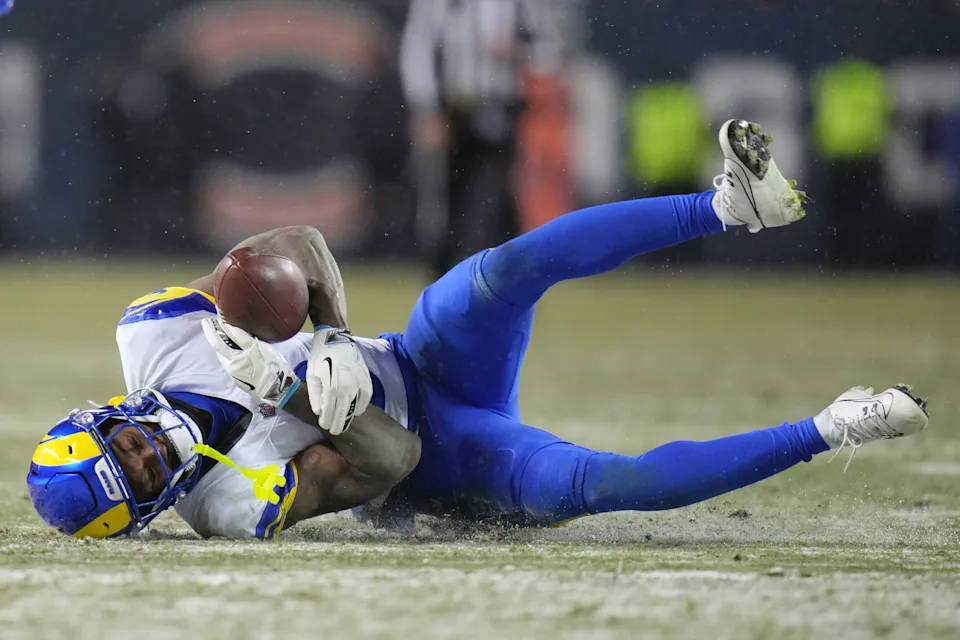
Chicago won the overtime coin toss — and, like the Bills the night before, chose to kick off. The Rams responded conservatively, running three times and punting. Soldier Field roared. The Bears got the ball. The script was still there.
Then the window closed.
Williams attempted a deep throw and was intercepted by Kam Curl just as Chicago approached field-goal range. Williams later said it was a route miscommunication with Moore — a mistake, yes, but one that shouldn’t have been fatal if the Bears had banked points earlier.
That’s when Stafford did what veteran quarterbacks do.
He methodically moved the Rams downfield, converting a massive third-and-6 by hitting Puka Nacua, who dragged defenders into field-goal range. The Rams didn’t need a touchdown. They didn’t need heroics.
They needed three.
Harrison Mevis delivered.
20–17. Season over.

The Rams advanced to the NFC Championship Game in Seattle, where they’ll face the top-seeded Seattle Seahawks for the third time this season — a matchup already defined by late-game chaos and razor-thin margins.
Why this isn’t on Caleb Williams
Let’s be clear: this loss does not belong to Caleb Williams.
He produced one of the most unforgettable playoff highlights in recent NFL history. He played composed football in brutal conditions. He brought the Bears back from the brink — again.
What failed wasn’t execution. It was situational discipline.
Aggression is not the enemy. But aggression without context becomes stubbornness. In playoff football, especially in weather games, points are oxygen. Every time Chicago turned down a field goal, it tightened the noose on its own margin for error.
When overtime arrived, the Bears needed perfection.
They didn’t get it.
The magic didn’t vanish — it was mismanaged
This Bears season was real. The quarterback is real. The belief was real. Soldier Field proved that.
But playoff football doesn’t reward vibes or narratives. It rewards decisions made three hours earlier that don’t feel dramatic in the moment — but decide everything later.
The Bears didn’t lose because the magic ran out.
They lost because they treated points like optional accessories instead of necessities.
And until that changes, Chicago will keep getting heartbreak endings that feel shocking — but aren’t.