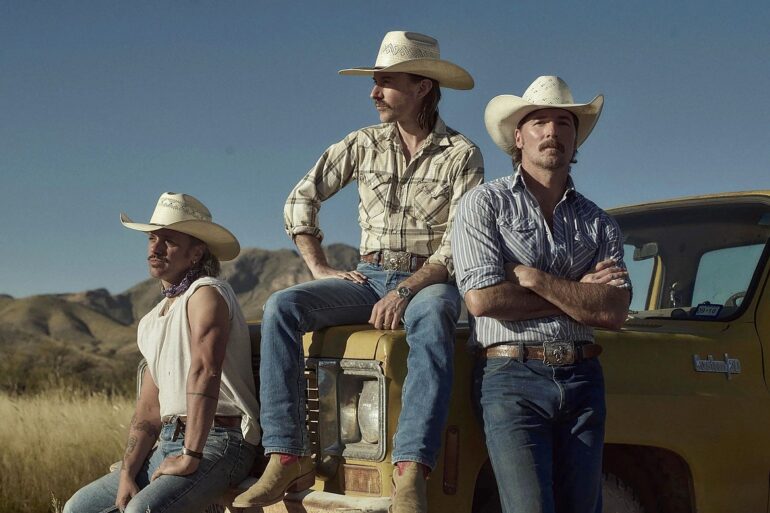
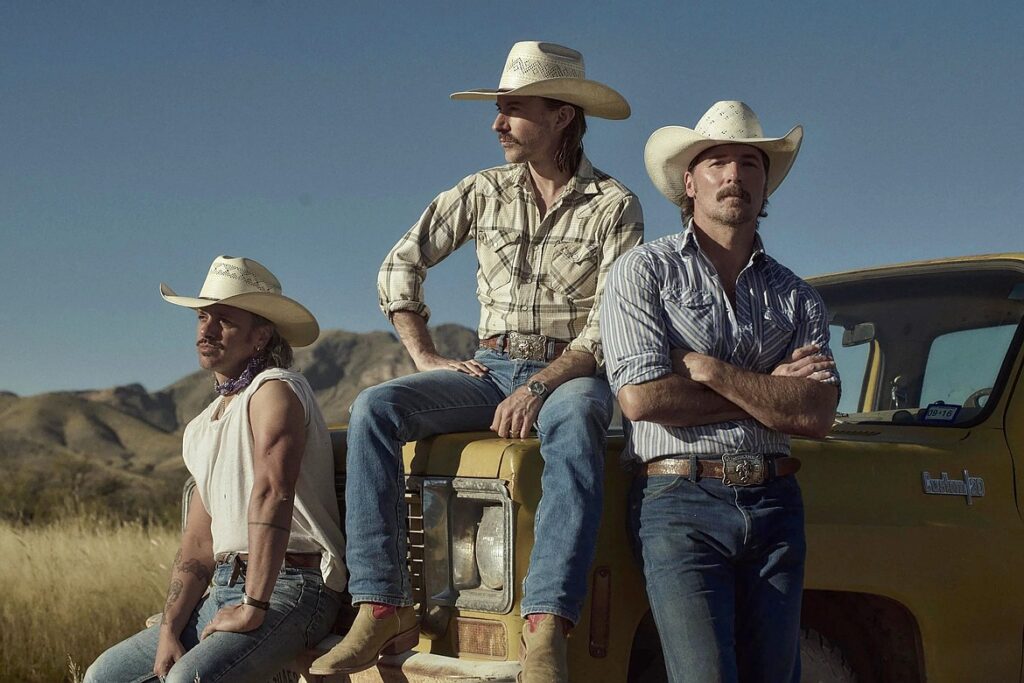
Country band Midland is performing at Festival SandPoint’s 2026 Summer Series.
Ten years ago, if you encountered Mark Wystrach, Jess Carson, and Cameron Duddy, you might have found them in the fashion ateliers of Los Angeles or the indie-film sets of the Pacific Northwest rather than a honky-tonk in Dripping Springs. Wystrach was a signed model and actor; Duddy was an MTV Video Music Award-winning director for pop behemoths like Bruno Mars. Today, they are the faces of Midland, a trio that has become the premier vessel for a very specific, highly curated brand of 1970s “Bakersfield sound” nostalgia. As they prepare to take the stage for the Festival at Sandpoint’s 2026 Summer Series, the band stands as a fascinating case study in the friction between artifice and “real” country music. They have successfully traded the skinny jeans of the West Coast creative class for Nudie-style suits and Stetson hats, sparking a decade-long debate about whether authenticity is something you are born with or something you meticulously design.
The Architected Rise of the Trio
The genesis of Midland is often framed through the lens of a reunion at a friend’s wedding in Jackson Hole, Wyoming, where the three long-time friends rediscovered their shared love for the harmony-laden country-rock of the Eagles and Gary Stewart. This narrative served as the foundation for their 2017 debut, On the Rocks. When their lead single “Drinkin’ Problem” hit the airwaves, it felt like a breath of fresh, cigarette-smoke-filled air in a Nashville landscape then dominated by “Bro-Country” and electronic-influenced trap beats.
However, the industry quickly took note of the band’s “day jobs.” Unlike the grit-and-grind stories of Nashville songwriters who spent decades in blue-collar obscurity, Midland arrived with a fully formed, high-gloss aesthetic. By the time they released Let It Roll in 2019, the shift was complete: they weren’t just musicians; they were characters. They leaned into the iconography of the urban cowboy, utilizing Duddy’s directorial eye to ensure every music video and press photo felt like a vintage postcard unearthed from 1978. This mid-period was defined by a calculated ambiguity—were they a tribute act, a parody, or the genuine article?
The tension crystallized with the release of their documentary The Sonic Ranch and subsequent albums like The Last Resort: Greetings From. By this point, the band had moved past the “newcomer” defense. They were established stars, yet the skepticism regarding their “cosplay” persisted. To their detractors, they were “hipsters in cowboy hats”; to their fans, they were the only ones keeping the traditional flame alive in a sea of pop-country crossover.
The “Costume” Controversy
The backlash against Midland has rarely been about the music itself—which is objectively well-crafted and harmonically sophisticated—but rather the intent behind it. In the traditionalist circles of country music, “authenticity” is the ultimate currency. When Saving Country Music and other purist outlets began digging into the band’s past, the “industry plant” accusations flew. The criticism suggested that Midland was a corporate construct designed to exploit a vintage trend, leveraging their Hollywood connections to bypass the genre’s gatekeepers.
Peers in the industry have offered a mixed bag of reactions. While legends like Dwight Yoakam and George Strait have welcomed them—even bringing them on tour—there remains a palpable chill from the “dirt-under-the-fingernails” faction of Americana. The media framing has frequently oscillated between praising them for “saving” country music and scrutinizing them for “gentrifying” it. This pushback has forced the band into a defensive posture, where they must constantly re-litigate their credentials in every interview.
Strategy or Sincerity?
Midland has not been blind to these critiques. In fact, they have occasionally leaned into the provocation. Cameron Duddy has been candid about the importance of the visual component, essentially admitting that in a modern media ecosystem, the “look” is as vital as the “hook.” In a 2017 interview with Rolling Stone, Wystrach addressed the “authenticity” question head-on, stating, “We’re not trying to be something we’re not. We’re just trying to be the best version of what we love.”
Yet, the admission of strategy is there if you look for it. The band’s meticulous control over their image—from the specific patina on their instruments to the grain of their film-shot videos—suggests a deep understanding of relevance. They recognized that Nashville was starving for a return to the “outlaw” era and filled that void with professional precision. This isn’t necessarily a “fake” move; it is a directorial one. As Duddy has implicitly suggested through his career, art is about the final frame, not just the raw materials used to build it. They are less like coal miners and more like architects of a feeling.
The Modern Currency of Attention
Zooming out, the “Midland Phenomenon” reflects a broader transformation in how cultural authority is gained today. We live in an era where the line between “authentic” and “performative” has blurred to the point of irrelevance. On platforms like Instagram and TikTok, the performance is the reality. Midland understood this before many of their Nashville contemporaries.

Their success argues that in the 2020s, “legacy” is no longer something inherited through lineage or geography; it is something that can be curated. The band reflects a cultural pattern where the “aesthetic” acts as a shorthand for values. By donning the uniform of the 1970s Southwest, they signal a rejection of modern digital sterility. It is a form of retro-futurism where the past is mined to provide a sense of stability in a chaotic present.
Furthermore, Midland’s journey highlights the shifting nature of power in the music industry. They didn’t need the traditional “10-year town” apprenticeship because they already possessed the visual literacy and media savvy required to command attention in a crowded market. They proved that if you can capture the feeling of a subculture with enough technical skill, the question of whether you were “born into it” eventually becomes a footnote.
The View from the Sandpoint Stage
As Midland heads to the Festival at Sandpoint in 2026, they find themselves at a crossroads. The novelty of their arrival has worn off, and the “authenticity” debates of 2017 feel like ancient history. In today’s landscape, they are elder statesmen of the neo-traditionalist movement, standing alongside artists like Jon Pardi and Tyler Childers.
But the question remains: does their strategy still carry weight? As the country music audience grows increasingly fragmented and the “yee-haw agenda” becomes a mainstream fashion staple, Midland’s specific brand of Southwest nostalgia risks becoming background noise. Their challenge now is to prove that there is substance beneath the sequins.
The enduring appeal of Midland lies in the fact that, despite the artifice, the songs work. When the harmonies hit on a cool Idaho night in August, the “modeling career” and the “music video directing” fade into the background. Perhaps the greatest lesson Midland has taught us is that in the modern age, we are all constructing our own narratives. Whether those narratives are “real” matters less than whether they are convincing. For Midland, the performance has become the truth, and as long as the crowd is singing along, the “Rhinestone Paradox” remains their greatest hit.