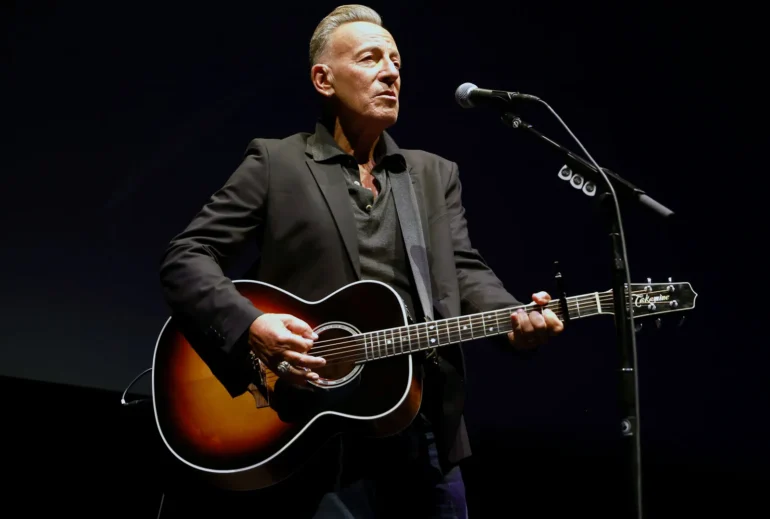
The American rock and roll landscape was once a space of broad, if uneasy, consensus—a place where the “Boss” could represent both the working-man’s struggle and the stadium-sized aspirations of a unified nation. Today, that unity has been replaced by a sharp, polarized friction. When Bruce Springsteen announced his latest tour on February 19, 2026, the reaction from the Trump White House was not a standard political disagreement, but a barrage of calculated, lyrical mockery. This shift highlights a modern cultural reality: the legendary rock star is no longer a neutral symbol of heritage, but a primary target in a war of aesthetic and political dominance.
A Timeline of Friction
The relationship between Springsteen and the political right has evolved from misinterpretation to open hostility over four decades:
- 1984: The Reagan Misstep. During his re-election campaign, Ronald Reagan famously invoked “Born in the U.S.A.” as a song of hope, failing to grasp the track’s biting critique of the Vietnam War and industrial decay.
- The 2000s: Explicit Alignment. Springsteen shifted from broad social commentary to direct political endorsement, most notably with his support for John Kerry in 2004 and Barack Obama in 2008.
- 2016–2020: The Resistance Era. Springsteen became a vocal critic of Donald Trump, describing his presidency as a threat to democracy and participating in podcasts like Renegades: Born in the USA with Obama.
- 2026: The “Loser” Reframe. Upon Springsteen’s latest tour announcement, White House spokesperson Steven Cheung released a statement dismissing the musician as a “loser” whose “Glory Days are behind him,” using the artist’s own catalog to mock his relevance.
Conflict and the Art of the Takedown
The White House response represents a specific evolution in political communication: the use of “fan-service” mockery to delegitimize a cultural icon. By weaving Springsteen’s song titles—”City of Ruins” and “Glory Days”—into a disparaging statement, the administration attempted to turn the artist’s legacy against him.
This tactic triggered immediate and predictable reactions:
- Audience Pushback: Fans viewed the puns as a trivialization of a legendary career, while supporters of the administration celebrated the “trolling” as a successful takedown of a “liberal elite” figure.
- Media Framing: Outlets like Rolling Stone framed the incident as a petty use of government resources, while others saw it as a strategic move to maintain a “counter-culture” edge within the executive branch.
Strategy Over Substance
The motivation behind the White House’s reaction appears to be a calculated pursuit of relevance through provocation. By engaging with a rock star on the level of “puns” and “insults,” the administration bypasses policy debate in favor of a battle for the cultural narrative. Steven Cheung’s insistence that Springsteen is a “loser” reflects a broader strategy of using playground-style rhetoric to define the boundaries of who is considered “truly American”.
Cultural Analysis: Legacy vs. Authority
This situation reveals the precarious state of the “Legacy Artist” in the modern media ecosystem. Springsteen’s cultural authority was built on a foundation of authenticity and longevity, yet that very longevity is now used as a weapon to paint him as out of touch.

Themes defining this moment include:
- Performance as Politics: The White House statement is a performance designed for social media virality, rather than a serious critique of Springsteen’s work.
- Contested Authority: In the past, a rock star’s endorsement carried significant weight. Today, that authority is contested by political figures who utilize the same tools of celebrity—attention and branding—to nullify the influence of their critics.
- The Death of the Sacred Cow: No figure, regardless of their historical contribution to American culture, is immune to the leveling effect of the “comment section” style of governance.
Conclusion
The “Born to Run-On” response from the White House suggests that in 2026, cultural respect is a thing of the past. Springsteen’s current strategy of sticking to his “Working Class Hero” identity continues to carry weight with a dedicated fanbase, but it now exists within a landscape that actively works to subvert it. As political messaging becomes indistinguishable from celebrity gossip, the question is no longer whether an artist’s message is true, but whether it can survive being turned into a punchline