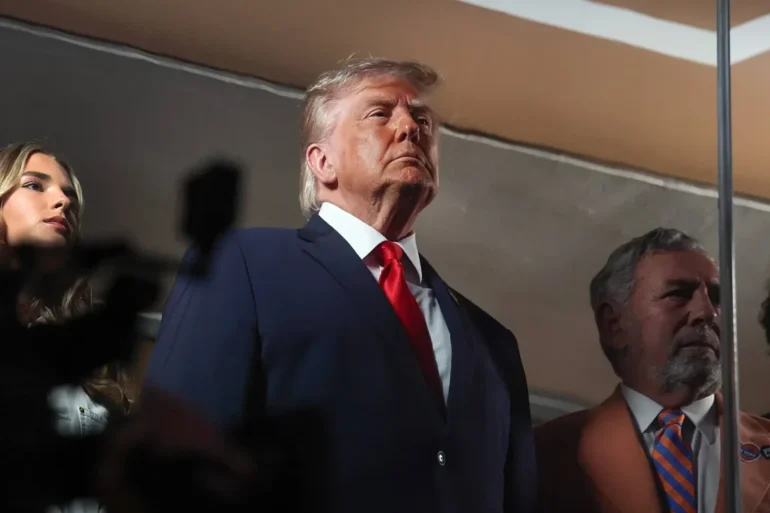
The air at Madison Square Garden crackled with more than just the usual playoff intensity during Game 3 of the NBA Finals on June 8, 2026. Amidst a constellation of celebrities and cultural figures, former President Donald Trump found himself the unexpected focal point of a significant segment of the crowd, enduring a chorus of jeers as he took his seat. This moment, captured by numerous cameras and instantly shared across social media, underscored a peculiar intersection of sports, politics, and public reception.
Trump’s presence at high-profile sporting events has long been a subject of commentary. Once a figure who could command significant attention, his appearances now often serve as a barometer for his current standing with various demographics. The boos that echoed through the arena, far from being a fringe reaction, seemed to represent a widespread sentiment among the New York faithful, many of whom are deeply immersed in the city’s cultural fabric. This was not merely a political statement; it was a cultural one, delivered with the visceral immediacy only live sports can provide.
The timeline of Trump’s public life is replete with instances of both fervent support and vocal opposition. His early reputation was built on a foundation of business acumen and a brash, larger-than-life persona. However, his presidency and subsequent post-presidency have solidified a more polarized image. The shift from a figure often celebrated in certain circles to one met with audible disapproval in a venue typically associated with entertainment and shared passion is a testament to the evolving landscape of public discourse. As reported by the New York Times, Trump’s political rallies have seen varied crowd sizes and levels of enthusiasm, but the intimacy of a sporting event, where individual reactions are amplified by the collective, offered a different kind of feedback.
The evidence of the crowd’s reaction was undeniable. Videos circulating widely showed a sustained wave of boos as Trump entered his courtside seats. While some attendees cheered, the dominant sound was one of disapproval. This wasn’t just a few dissenters; it was a significant portion of the Garden’s capacity. The cultural analysis here is crucial: what does it mean when a figure who once commanded arenas now elicits such a response at a basketball game? It speaks to a potential disconnect between his established base and the broader cultural zeitgeist, particularly in a diverse and often progressive city like New York.

The debate between relevance and legacy is particularly pertinent. Is Trump still a relevant figure in the cultural conversation, or is his current influence more a specter of his past? His continued engagement in political discourse and his appearances at events like this suggest an attempt to maintain a presence. However, the authenticity of that presence is called into question when met with such public rejection. Is this a performance of continued relevance, or a genuine reflection of his enduring appeal? As Billboard has noted in other contexts, the ability to connect with contemporary audiences is paramount for sustained cultural impact, a connection that seemed strained in this instance.
The question remains: does Donald Trump’s current strategy of maintaining a high-profile presence, even in the face of public derision, still carry weight? While it undoubtedly generates attention, the nature of that attention has shifted. The jeers at the NBA Finals suggest that for a significant segment of the public, particularly those within the cultural hubs he once navigated with apparent ease, his brand of celebrity has become a source of contention rather than acclaim. This moment at Madison Square Garden was more than just a celebrity sighting; it was a stark illustration of how public figures are perceived in the current, often unforgiving, cultural climate. The legacy he seeks to build may be increasingly overshadowed by the immediate, unfiltered reactions of the present.