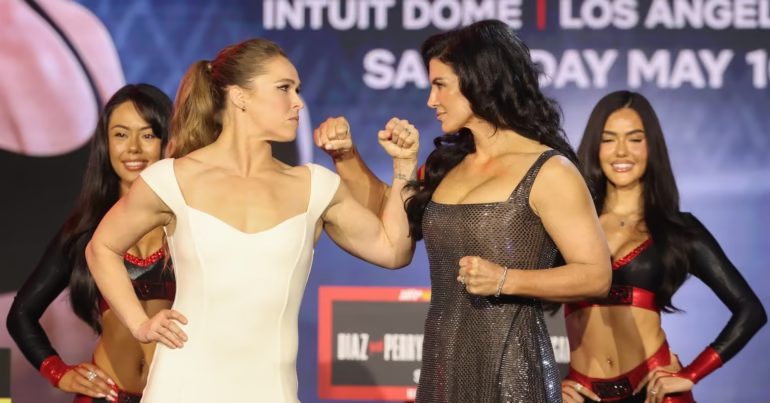
Ronda Rousey is going to fight Gina Carano in a women’s featherweight on May 16, 2026, happening at the Intuit Dome in LA.
In 2014, a hypothetical matchup between Ronda Rousey and Gina Carano was the “superfight” that defined mixed martial arts purity. It was the summit of athletic legitimacy—a clash between the woman who built the foundation of female combat sports and the woman who became its first global superstar. Back then, the stakes were legacy, gold, and the validation of a sport still clawing for mainstream respect.
Fast forward to 2026, and the fight is finally happening. But the Octagon has been replaced by a digital “Content Coliseum,” and the prize isn’t a UFC belt—it’s a retention metric.
When Rousey and Carano step into the cage on May 16 at the Intuit Dome, the broadcast won’t be on a legacy pay-per-view provider. It will be streamed live on Netflix, sandwiched between the Stranger Things finale and a live MLB opener. The promotion isn’t handled by the UFC, but by Jake Paul’s Most Valuable Promotions.
This isn’t a sports story; it’s a pivot-to-video story. It is the final form of the “Attention Economy,” where the actual fighting is secondary to the redemption arcs, the political polarization, and the desperate need for “Live” events to keep streaming subscribers from hitting the “Cancel” button.
A Timeline of Two Icons: From Purity to Provocation
To understand how we got here, one must look at the divergent yet strangely parallel paths of the two headliners.
- The Blueprint (2006–2009): Gina Carano was the “Face of Women’s MMA.” She was a Muay Thai specialist who brought a cinematic quality to the cage. Her career ended abruptly in 2009 after a brutal loss to Cris Cyborg, leading her into a Hollywood career that seemed destined for the A-list after starring in Steven Soderbergh’s Haywire.
- The Takeover (2012–2015): Ronda Rousey didn’t just fight; she conquered. She became a cultural phenomenon, an Olympic medalist who won fights in seconds and became the first woman to headline a UFC card. She was the hero of the “Do Nothing Bitch” era—an icon of female empowerment and athletic dominance.
- The Fractures (2016–2021): The shift began with vulnerability. Rousey suffered back-to-back knockout losses and retreated from the sport, eventually finding a second act in WWE. Carano, meanwhile, found a home in the Star Wars universe as Cara Dune in The Mandalorian.
- The Crystallization (2021–2024): The “culture wars” claimed Carano’s acting career. After a series of controversial social media posts—ranging from anti-mask sentiments to comparing modern political discourse to Nazi Germany—she was fired by Disney. Rousey, too, saw her “people’s champ” status fade as her WWE tenure grew contentious, marked by a perceived disdain for the fans who once worshipped her.
By 2026, both women found themselves in a similar predicament: they were legends without a home, too big for the regional circuits but too complicated for the corporate “cleanliness” of modern Hollywood or the UFC’s rigid brand management.
A Marriage of Necessity
The reaction to the Netflix announcement has been a microcosm of our fractured media landscape. To some, it is the “Un-Canceling” of Gina Carano—a victory for those who view her firing as a symbol of ideological blacklisting. To others, it is a cynical “freak show” fight, a desperate attempt by Netflix to replicate the viewership of the Paul-Tyson event by leaning into the notoriety of its stars.
The industry response has been equally telling. Dana White, the CEO of the UFC, reportedly passed on the bout, allowing Jake Paul’s MVP to swoop in. It marks a significant shift in the power dynamics of combat sports: the “legacy” promoter is no longer the only gatekeeper if a tech giant like Netflix is willing to provide the platform.
The Motivation: Relevance as Currency
Neither Rousey nor Carano are pretending this is about a title run. This is a strategic play for control over their own narratives.
For Carano, who recently settled a wrongful termination lawsuit against Disney, the fight is a return to the one arena where “truth” is objective: the cage. You cannot be “canceled” if you win a fight; the meritocracy of combat provides a shield against the winds of public opinion.
For Rousey, who has spent years badmouthing the WWE and its corporate structure, the move to Netflix is about autonomy. By partnering with MVP, she is essentially becoming her own promoter, leveraging her name to bypass the traditional sports hierarchies that she feels have failed her.
In her recent appearances, Rousey has been implicit about this shift: she isn’t looking for a “career” in the traditional sense. She is looking for moments. The fight with Carano is a massive, high-paying, one-off “moment” that requires no long-term commitment to a brand other than her own.
The Death of the “Retirement”
The Rousey-Carano fight reveals a fundamental truth about our current cultural moment: Legacy is no longer a static achievement to be protected; it is a resource to be mined.
In the previous era, an athlete’s career had a beginning, a middle, and a quiet end. Today, celebrity is a permanent state of being that requires constant maintenance through “events.” We are seeing the rise of the Zombie Brand—stars who haven’t been active in their primary field for a decade but possess enough “Name ID” to fuel an algorithm.

This reflects a broader shift in how cultural authority is gained. In the 2010s, you gained authority through dominance (Rousey) or pioneering (Carano). In the 2020s, you gain authority through friction.
- Netflix isn’t buying a sporting event; they are buying a “conversation starter.” They want the think-pieces, the Twitter feuds, and the “hate-watching” that comes with Carano’s return.
- Jake Paul isn’t building a sports league; he is building a disruptive media company that uses the physical bodies of legends to generate clicks.
- The Audience isn’t watching for the technique; they are watching to see if the “canceled” star can still perform, or if the “fallen” hero can find her fire.
It is a world where authenticity is a performance. We demand our stars be “real,” but we only provide them platforms when they are being “spectacular.” The result is a cycle of provocation where the only way to remain relevant is to lean into the very controversies that initially marginalized you.
The Weight of the Walk
As the date of May 16 approaches, the question remains: does this strategy still carry weight?
There is a risk that by turning combat into a content play, the “superfight” loses the very thing that made it super: the stakes. If the result of the fight doesn’t change the trajectory of the sport, and if the participants are more interested in the “walk” than the win, it becomes just another tile in the Netflix interface, destined to be scrolled past in a week.
Rousey and Carano are the architects of their own returns, but they are also subjects in a larger experiment. They are testing whether legacy can survive the transition from “Sports” to “Live Content.” In a changing environment where the “Face of Women’s MMA” is now a title held by whoever has the most followers rather than the most wins, this fight is a final, bloody stand for the icons of the past.
They are making the walk one more time—not for the glory of the sport, but to prove that in the digital age, the only way to stay alive is to keep the cameras rolling.