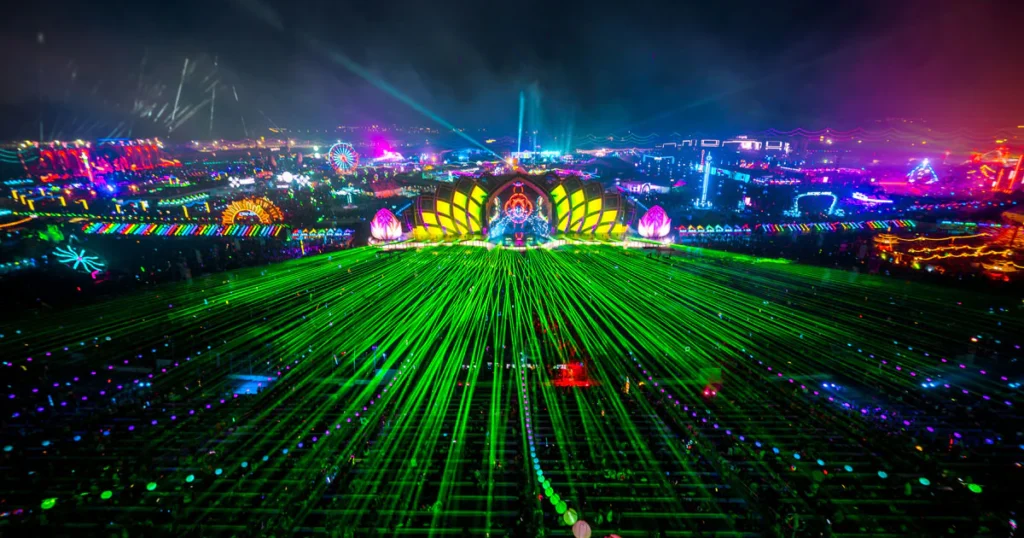
EDC is going to be in Las Vegas In May.
There was a time when the Electric Daisy Carnival (EDC) felt like a secret whispered in the dark, a strobe-lit sanctuary for those who found the daylight world too rigid, too judgmental, or too quiet. In its early iterations, the gathering was defined by “PLUR”—Peace, Love, Unity, Respect—a shorthand for a radical, grassroots inclusivity that existed on the fringes of the music industry. Today, as we approach the 2026 season, that fringe has become the frontier of a multi-billion-dollar global export. The “Under the Electric Sky” slogan, once a poetic invitation to a subcultural rite of passage, now serves as the branding for a highly optimized, algorithmically driven corporate ecosystem.
The tension at the heart of EDC 2026 is no longer about the music versus the “man”; it is about the soul of the spectacle. We are witnessing a fundamental transformation where the “Headliner”—Pasquale Rotella’s egalitarian term for the attendee—has shifted from a participant in a community to a consumer of a luxury experience. This evolution reflects a broader cultural pattern: the move from subcultural depth to experiential scale, where the feeling of belonging is manufactured through production value rather than shared ideology.
The Arc of the Electric Sky
The journey to 2026 began in the underground warehouse scenes of Los Angeles in the 1990s. In those formative years, EDC was a gamble, a nomadic carnival that survived on the raw energy of the rave movement. It was a period defined by breakbeats and anonymity, where the DJ was a facilitator rather than a deity, and the production was secondary to the collective vibration of the crowd.
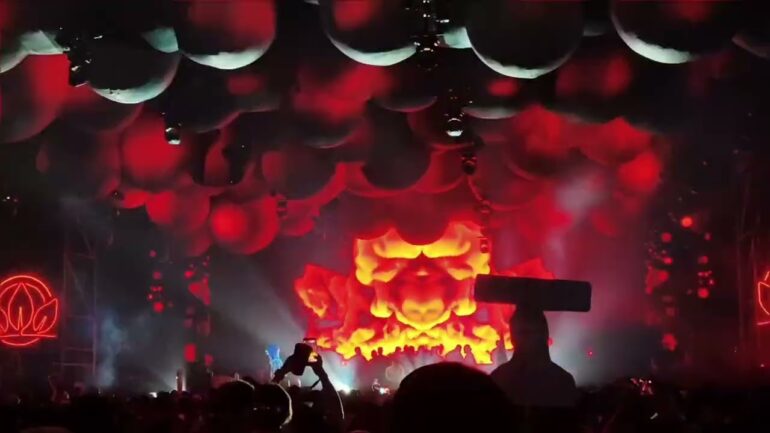
The mid-2010s marked the great pivot. Following the 2011 move to the Las Vegas Motor Speedway, EDC transitioned from a music festival into a “destination event.” This was the era of the EDM explosion, where the “drop” became a global currency and artists like Tiësto and Calvin Harris achieved the status of pop royalty. The symbolism shifted from the humble daisy to the “Kinetic Cathedral”—massive, animatronic stages that signaled the arrival of big-budget spectacle.
By the early 2020s, the festival faced its first true existential crisis: the post-pandemic “experience economy.” As audiences emerged from isolation, the demand for immersion skyrocketed. Recent events, specifically the sell-out of the 2025 and 2026 presales within minutes, have crystallized a new reality. EDC is no longer just a party; it is a high-stakes cultural pilgrimage that requires months of financial planning, aesthetic curation, and digital positioning.
The Conflict of the Velvet Rope
This growth has not been without friction. The primary conflict in the current EDC narrative lies in the widening gap between the festival’s “All Are Welcome” ethos and the increasing stratification of its experience. As VIP and “Skydeck” packages become more elaborate, the egalitarian spirit of the rave is being tested by the reality of the paywall.
Backlash has fermented in digital spaces like Reddit’s r/electricdaisycarnival, where veteran “ravers” express frustration over “influencer culture” and the perceived decline of “vibes.” The criticism often centers on the idea that the festival has become a backdrop for content creation rather than a space for presence. Peer reactions from within the industry also suggest a shift; some purist artists have opted for smaller, boutique festivals, citing EDC’s scale as an impediment to musical intimacy. Conversely, Variety and other trade outlets frame this scale as a triumph of logistics and brand loyalty, crowning Insomniac Events as the undisputed architect of the modern American festival.
Strategy Over Serendipity
In moments of rare candor, the architects of this neon empire have acknowledged that the shift toward “spectacle over subculture” is a calculated necessity. Pasquale Rotella, the founder of Insomniac, has frequently spoken about the need to “constantly innovate” to maintain relevance in a hyper-competitive market. In various interviews, he has admitted that the focus on production—the pyrotechnics, the drones, the gargantuan art installations—is a strategy to keep the brand “fresh” for a generation with a diminishing attention span.
Implicit in this strategy is the recognition that the music itself is no longer the primary draw. The “experience” is the product. This is evidenced by the festival’s heavy investment in “camp EDC,” a city-within-a-city that ensures the brand occupies every hour of the attendee’s weekend. It is a move for total immersion, a way to control the narrative and maximize the “shareability” of the event. The motivation isn’t just to throw a party; it’s to create a self-sustaining ecosystem that functions independently of external musical trends.
Analysis: The Industrialization of Transcendence
Zooming out, the state of EDC 2026 reveals a profound truth about our current cultural moment: we are obsessed with the performance of authenticity. In an era where digital life is often sterile and transactional, we crave “peak experiences” that feel visceral and real. However, because we are also a culture governed by the “attention economy,” these experiences must be visually spectacular to be validated.
EDC provides a solution to this paradox. It offers a “manufactured transcendence.” By combining the ancient human impulse for communal dance with the peak of modern technology, it creates a space where one can feel part of something larger than themselves while simultaneously documenting it for individual social gain.
This reflects a shift in how cultural authority is gained. In the past, authority was derived from “knowing”—knowing the DJ, knowing the track, knowing the history. Today, authority is derived from “being there”—the proximity to the spectacle. The “Headliner” is the protagonist of their own movie, and EDC provides the most expensive, most colorful set on earth. This is the new authenticity: not a connection to a historical lineage, but a high-definition engagement with the present.
Furthermore, the “industrialization” of EDC speaks to the consolidation of power in the media ecosystem. As independent venues and smaller promoters struggle, massive entities like Live Nation (which partners with Insomniac) create a gravity that pulls in all resources. This ensures a high-quality, safe, and reliable product, but it also raises questions about the future of cultural innovation. Can a festival that must satisfy shareholders and local governments truly remain a site of radical expression? Or does it inevitably become a “theme park” version of the culture it once pioneered?
The Weight of the Neon Crown
As we look toward the gates of the Las Vegas Motor Speedway opening in 2026, the strategy of EDC seems more like a masterclass in brand resilience than a musical movement. It has successfully navigated the transition from a niche subculture to a global rite of passage. But this success comes with a quiet cost.
In its quest for scale and “shareability,” EDC risks becoming a victim of its own perfection. When every moment is a photo-op and every drop is synchronized with a million dollars of fireworks, the serendipity—the “magic” that ravers once spent their lives chasing—can feel scripted.
The weight of the neon crown is heavy. For the 500,000 people who will descend on the desert, EDC 2026 will undoubtedly be the weekend of their lives. It will be loud, beautiful, and impeccably produced. But as the sun rises over the speedway on Monday morning, the question remains: is the “Electric Sky” a gateway to a new community, or just a very expensive mirror reflecting our own desire for relevance back at us? In the end, EDC’s greatest achievement might not be its survival, but its ability to convince us that the industrial can still feel intimate—even if only for three nights in May.