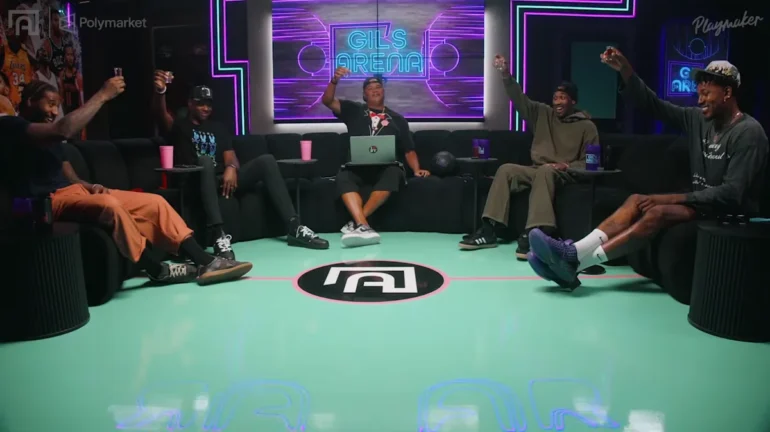
Gil’s Arena did not merely come back. It came back with something to prove.
After Gilbert Arenas’ public split with Underdog, the future of the show looked uncertain. Arenas left the hit NBA digital talk show in April amid a contract dispute, and the fallout became part of the story. The most visible break was Arenas’ deteriorating relationship with Rashad McCants, a former player who had become one of the recognizable voices around the program. From Arenas’ perspective, McCants appeared to switch sides during the Underdog dispute—even though Arenas was the person who helped create the opportunity in the first place.
That kind of public disagreement can damage a show. In this case, it may have been exactly what Gil’s Arena needed.
The breakup created a reset
The original cast—Brandon Jennings, Kenyon Martin and Rashad McCants—helped establish the show’s identity. They brought real NBA experience, strong personalities and plenty of memorable moments. But the new version feels less like a replacement cast than a full-scale relaunch.
Gil’s Arena has now added championship pedigree, media credibility and a different kind of tension. The new group includes returning voices Josiah Johnson and Nick Young, Arenas’ former Washington Wizards teammate Brendan Haywood, and Iman Shumpert. That combination gives the show a broader range of basketball experience without sacrificing the arguments and unpredictability that made the original work.
The numbers suggest the audience noticed. Across its run, Gil’s Arena has generated more than 17 million views in the current conversation around the relaunch, while Front Office Sports has reported that the show averaged more than 70 million views per year. Whatever the exact accounting window, the larger point is obvious: this is not a niche project waiting to be discovered. It is a proven sports-media property with a substantial audience.
The new cast looks like that audience has grown, too.
From a strong start to a deeper bench
Brandon, Kenyon and Rashad were a great beginning. They gave the show an immediate point of view, and each brought a distinct relationship to the league. But Season 5 feels as if the producers took the foundation and built upward instead of trying to recreate the past.
Haywood adds the perspective of a longtime NBA big man and a player who experienced the league from inside winning organizations. Shumpert brings a championship ring, entertainment instincts and an unmistakable willingness to challenge the room. Nick Young remains one of the most natural sources of chaos in basketball media. Josiah Johnson provides continuity and helps keep the show moving when the conversation threatens to spin completely off its axis.
That is a deeper bench than the show had before—and not just in terms of résumé. The new personalities create more ways for the conversation to develop. One guest can argue from personal experience, another can push back from a media perspective, and a third can turn the entire debate into a viral moment.
For all of Gilbert Arenas’ insistence that rings do not automatically settle every basketball argument, viewers clearly care about championship experience. They want to know what it was like in those locker rooms, on those teams and during those playoff runs. Only one team wins the championship each year. That means the number of people who can describe that experience from the inside is naturally limited.
Ironically, Arenas is one of the central figures on the show who never won a championship. But that has never prevented him from being the host. His entertainment value, confidence and willingness to say what other former players will not say have always been the show’s greatest asset. Now, the cast around him gives viewers more of the perspective he does not personally possess.
That is the formula: Gil’s ability to create the argument, surrounded by people who can speak credibly about the highest level of the sport.
The basement is not a step backward
One of the more interesting parts of the relaunch is the studio situation. During the dispute, Arenas said the show could not continue filming in its previous environment once the relationship with Underdog began to break down. Yet the show is back in the basement—and the basement looks better than ever.
That is more than a logistical footnote. It is a reminder that the appeal of Gil’s Arena was never dependent on a flashy set. The show’s real value is the chemistry between the people in the room. With better lighting, improved camera work and sharper cinematography, the familiar space now feels intentional rather than makeshift.
The production has leveled up without losing the informal energy that made the show work. The basement still feels like a place where former players can argue, joke and say something that would never survive a tightly managed television format. It just looks more polished now.
In other words, the show did not take a step back. It took two steps forward while keeping the setting that viewers already associate with it.
Playmaker gives the show a better runway
The move to Playmaker also matters. Arenas has partnered with the sports-media company to monetize the show and self-produce it, giving Gil’s Arena a new corporate home after its exit from Underdog. Playmaker’s portfolio and brand are more naturally aligned with personality-driven sports storytelling, while Underdog has increasingly focused on prediction markets and fantasy gaming.
Underdog’s original content arm was shut down as the company refocused its business. The company later agreed to be acquired by the U.K.-based IG Group in a deal reported at approximately $1.3 billion, including at least $1.1 billion in value before potential additional consideration. That is a major transaction, but it does not change the basic reality of the media split: Underdog’s priorities moved elsewhere, and Gil’s Arena needed a partner whose business was built more directly around content and culture.
Playmaker looks like that partner. The company has a more recognizable sports-entertainment identity and a portfolio built around athletes, creators and conversation. For Gil’s Arena, the move is not just about finding a new check. It is about finding a platform that understands why the show works.

Rashad’s role was replaceable. Iman’s is not.
Rashad McCants was entertaining, but the role he played on the show was replaceable. It is not difficult to find a former player willing to troll, take the opposite position or keep an argument alive. Contrarianism is a format. Credibility is harder to replace.
Shumpert seems to understand that distinction instinctively. He can shake the room without losing the authority that comes from having actually played at the highest level and won a championship. In a short period, he has already created several of the show’s most compelling exchanges—including moments that forced Kevin Durant to respond and the debate over his Tracy McGrady comparison after the discussion about whether rings matter as much as winning.
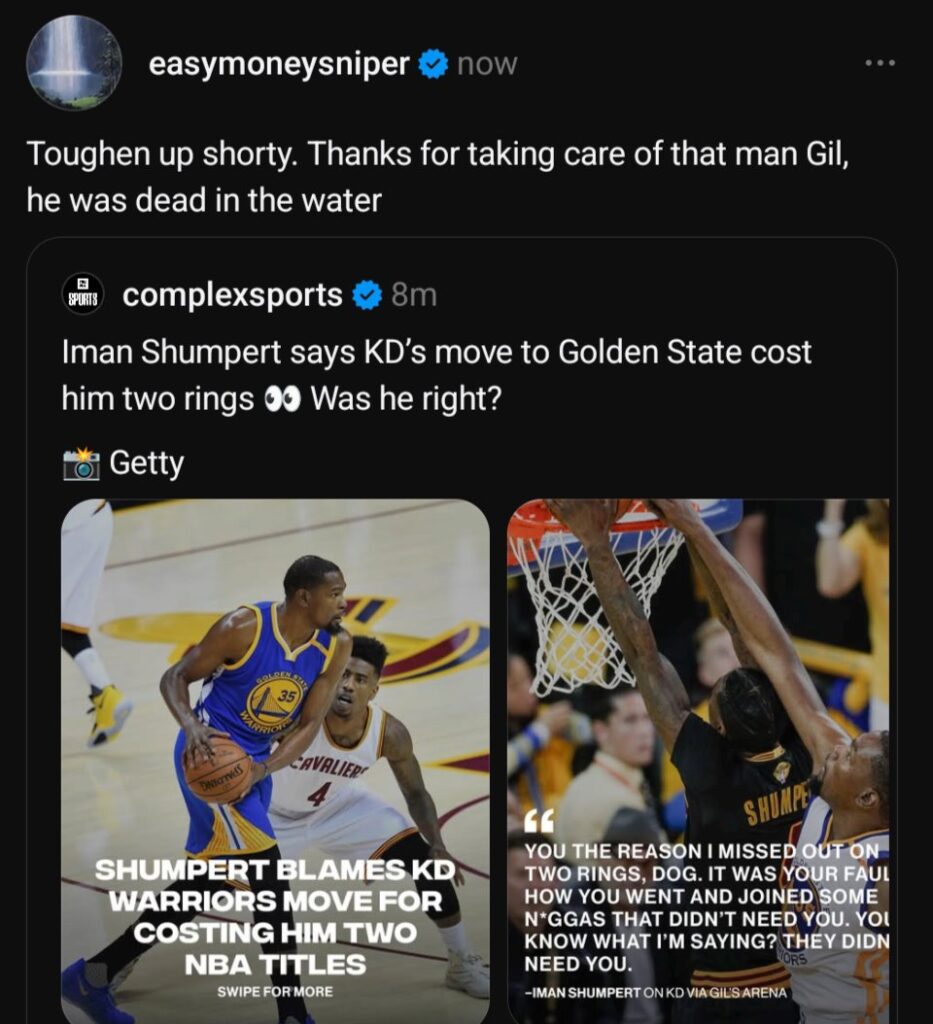
That rings debate is silly only if it is treated as a binary question. Of course a ring does not make every player better than every player without one. But if a player was a core contributor to a championship team, that experience carries enormous value. It is difficult to argue that Klay Thompson’s championships mean less than James Harden’s MVP award simply because awards are easier to isolate statistically. The same goes for Draymond Green and the demands of being a central piece of multiple title teams.
Too often, people compare a superstar’s résumé to the last man on a championship bench. That is not the real argument. The relevant comparison is between elite players and other elite players who contributed meaningfully to winning at the highest level.
Shumpert can make that point while still playing the agitator. That is why his presence feels more valuable than simply adding another loud voice.
The best season is the one that survived the drama
Gil’s Arena Season 5 is better because it did not pretend the drama never happened. The betrayal, the contract dispute and the collapse of the Underdog partnership forced the show to answer a difficult question: was the brand bigger than the original lineup?
The answer appears to be yes.
Arenas still provides the show’s center of gravity. The new cast supplies more championship experience, more credibility and more avenues for conflict. The production looks cleaner. The setting feels familiar. The new partner is better aligned with the product. And the audience has returned in meaningful numbers.
Rashad McCants helped build the first version of Gil’s Arena, but the show has made clear that no single cohost was the whole product. The relaunch has turned a messy split into a stronger ensemble.
Gil’s Arena did not just survive the breakup. It used the breakup to become what it should have been all along: a sharper, deeper and more credible basketball conversation—without losing the chaos that made people watch in the first place.