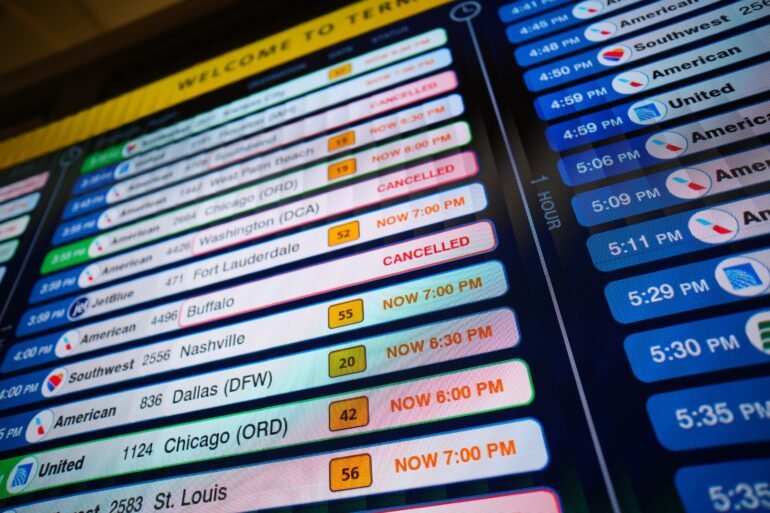
At 3:54 p.m. Eastern on Friday, the Federal Aviation Administration did something it has done only twice since Sept. 11, 2001. It stopped every departing flight in the United States.
The nationwide ground stop lasted more than four hours, until 8:15 p.m. ET, and its ripple effects are still working through the system. More than 4,700 flights were canceled and about 10,000 delayed on Friday alone, according to FlightRadar24, and ABC News reported that cancellations across Friday and Saturday topped 14,000. Al Jazeera described it as the longest ground stop in 25 years.
What Broke
The cause was not weather, staffing or an attack. Officials pinned it on equipment. Shortly after 3:30 p.m., the FAA began seeing instability in radar and communications across Air Route Traffic Control Centers and Terminal Radar Approach Control facilities. Transportation Secretary Sean Duffy said switches and routers became overloaded with data and began producing inconsistent information, so the system was shut down.
Duffy later said contractor L3Harris was replacing copper equipment when a router began flooding other routers in the network. FAA Administrator Bryan Bedford said Saturday that faulty equipment caused the stop and that he expected the system to fully recover by the end of the weekend.
Homeland Security Secretary Markwayne Mullin said there was no indication of a cyberattack and stressed the public was never in danger. About 3,500 planes were in the air when the order came down, and they were allowed to continue to their destinations.
The SMART Question
The timing raised eyebrows. The FAA had rolled out a new AI-powered program called SMART nationwide on Tuesday. AirSpace Intel, the contractor behind it, said the ground stop was not caused by its system, and Duffy said old legacy equipment was to blame. The union representing more than 11,000 FAA employees said its technicians were not involved in the upgrades that led to the outage.
A Warning Already on File
The more uncomfortable detail is that the risk was documented. A Government Accountability Office report published in September flagged aging copper cables dating to the 1960s and warned that poorly scheduled modernization work could cause further disruptions. Duffy himself described the network as running on 1980s copper lines.

That gap between warning and outage is now a business problem as much as a technical one. Aviation analytics firm Cirium estimated that roughly 11,000 flights carrying more than 1.5 million passengers were still scheduled to depart after 4 p.m. Friday. Airlines now face the costly work of repositioning aircraft and crews, and Duffy warned that delays and cancellations would continue as carriers reshuffle.
The $50 Billion Ask
Duffy spent much of his Friday night briefing pressing Congress for funding, calling for $50 billion in air traffic control upgrades and warning that more outages will follow without it. Democrats, including House leader Hakeem Jeffries and Sen. Tammy Duckworth, demanded answers and a full investigation, and Sen. Maria Cantwell said the Commerce Committee will review the communications failures.
Thanksgiving Is Next
The real test comes in less than two weeks. Thanksgiving is one of the busiest travel periods of the year, and Duffy said he expects the system to be back up and operational by then. Experts were less certain about the bigger picture, noting that the infrastructure that failed Friday is still in place. For airlines, travelers and the contractors rebuilding the system, the question is no longer whether modernization is needed. It is whether it can happen without grounding the country again.