On Monday, Mike McCarthy left no room for debate. Aaron Rodgers is our quarterback, the Steelers coach said after a 19-16 loss in Philadelphia. By late Tuesday night, that sentence had expired. Pittsburgh announced that Mason Rudolph will start Friday’s home game against the Denver Broncos and that Rodgers, the four-time MVP who came back for what he has called his final season, will be inactive.
The statement, issued by longtime communications director Burt Lauten, offered no explanation. Rodgers was not on Tuesday’s injury report and had spoken to reporters after practice. ESPN’s Brooke Pryor reported the move was a coaches’ decision made over the course of the day, driven as much by the hope that Rudolph can spark the offense as by Rodgers’ recent struggles.
The Numbers Behind the Switch
The production explains why Pittsburgh felt it had to act. Rodgers, who turns 43 next week, has completed 60.9% of his passes for 2,241 yards with 16 touchdowns and six interceptions. His 86.6 passer rating is the lowest of his career, and he has been sacked 31 times. Over the last two games, both losses, he averaged just 5.9 yards per attempt and went down eight times.
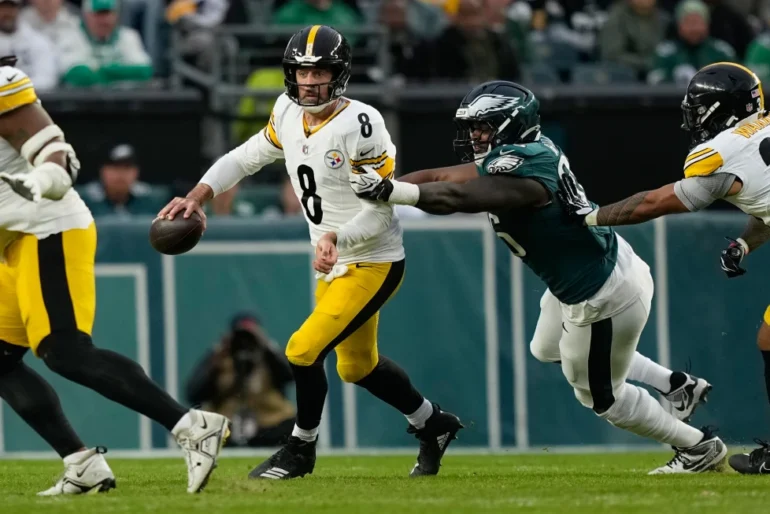
The Steelers have failed to top 200 passing yards in four straight games. Their offense ranks 23rd in total yards at 310.4 per game and 22nd through the air at 198.6, while averaging 21.4 points. In Philadelphia, Rodgers went 30 of 44 for 227 yards and a touchdown, took five sacks, and still led the team in rushing with 29 yards.
Context matters, too. The receiving corps has been gutted. DK Metcalf caught one pass before he was ejected against the Eagles, Michael Pittman Jr. did not play, and Pittsburgh’s leading receiver that day was Max Hurleman, making his NFL debut. Benching the quarterback does not fix any of that, which is exactly why the decision landed as such a shock.
What Rudolph Brings
Rudolph is no mystery in Pittsburgh. The 2018 third-round pick was once viewed as a possible successor to Ben Roethlisberger, and he has started 19 games across seven seasons with the Steelers and Titans, going 9-9-1. His best stretch came late in 2023, when he replaced Kenny Pickett, won three straight starts and pushed Pittsburgh into the playoffs before a wild-card loss to Buffalo. His career passer rating sits at 84.3, a shade below Rodgers’ number this season, and this year he has thrown just four passes in mop-up duty.
Behind him are second-year quarterback Will Howard and rookie Drew Allar, neither of whom has taken an NFL snap. That depth chart tells you this is a short-term bet on a steady veteran, not a youth movement.

A Reunion That Unraveled Fast
The sting is personal. Rodgers returned for his 22nd season largely to reunite with McCarthy, who replaced Mike Tomlin, and Rodgers recommended his old coach for the job. The two won a Super Bowl together in Green Bay after the 2010 season. Now McCarthy is the one sitting him down.
Rodgers’ first year in Pittsburgh produced a 10-6 record that ended with a 30-6 wild-card loss at Houston. His legacy is not in question. He ranks third all-time with 543 touchdown passes and fifth with 68,515 passing yards. But the end of his career has suddenly become uncertain, and it is unclear whether he will ask for his release to finish somewhere else.
What’s Next
At 6-4, the Steelers hold a wild-card spot, tied with Cleveland and one game clear of New England. Friday’s opponent, an 8-2 Denver team, is a brutal test for a quarterback getting his first meaningful action of the year. If Rudolph steadies the offense, McCarthy’s gamble looks bold and correct. If he doesn’t, Pittsburgh will have burned the bridge to a future Hall of Famer for nothing, and one of the great careers in league history may end not with a farewell tour but with a healthy scratch.