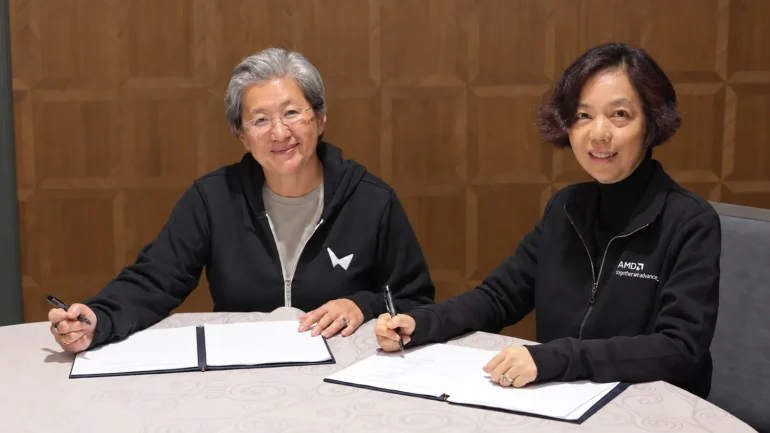
AMD has officially brought one of artificial intelligence’s most influential research teams inside its walls. The chipmaker said Monday that it has completed its acquisition of World Labs, the spatial intelligence startup led by Stanford computer scientist Fei-Fei Li, in an all-stock deal valued at roughly $8.2 billion.
Li now joins AMD as executive vice president and chief scientist, reporting directly to chair and CEO Lisa Su.
The Deal by the Numbers
An amended filing published November 16 shows the transaction legally closed on November 13, with AMD issuing 14,978,322 shares of common stock to former World Labs stockholders. The two companies signed their merger agreement on September 26 and announced it two days later, when the final share count had not yet been set.
The price is striking for a company of World Labs’ size. The startup had roughly 70 employees when the deal was announced, which works out to more than $100 million per person, and it was valued at about $1 billion as recently as 2024. The purchase ranks as AMD’s second-largest acquisition, behind its roughly $50 billion takeover of Xilinx completed in 2022.
What World Labs Builds
Founded in 2024 and based in San Francisco, World Labs develops models that generate, reconstruct and simulate interactive 3D environments from text, images and video. Its technology also extends into robotic learning and simulation, an area where AI systems need realistic virtual worlds to train in before they act in the physical one. The company released its Atlas tools and a developer API on November 12, one day before the deal closed.
Li is among the field’s most recognizable figures. Her lab created ImageNet, the labeled image database that helped spark the modern computer vision boom, and she previously served as chief scientist of AI and machine learning at Google Cloud and as founding co-director of Stanford’s Institute for Human-Centered AI. Co-founders Justin Johnson and Ben Mildenhall were slated to keep leading the World Labs team alongside her inside AMD.

Why a Chipmaker Wants a Model Lab
AMD does not need World Labs to sell more GPUs this quarter. It wants the lab to tell it what future AI workloads will look like before it designs the silicon to run them. Su framed the strategy plainly, saying the next stage of AI infrastructure requires companies to “optimize compute platforms and models together.”
The move follows AMD’s acquisition of Taalas in August, another bet on tightening the loop between model design and chip design, and it fits the company’s broader pitch of an open AI ecosystem. Analysts have cautioned that buying researchers alone does not guarantee a competitive edge; the payoff depends on whether their insights actually reach AMD’s hardware and software roadmaps.
What to Watch
The immediate questions are practical ones: how quickly World Labs’ research shows up in AMD products, whether its models remain broadly available to developers and how investors digest the roughly 15 million new shares. For an industry racing toward physical AI and robotics, AMD has made clear where it intends to compete, and it has paid a premium to put one of the field’s founding voices at the center of that effort.