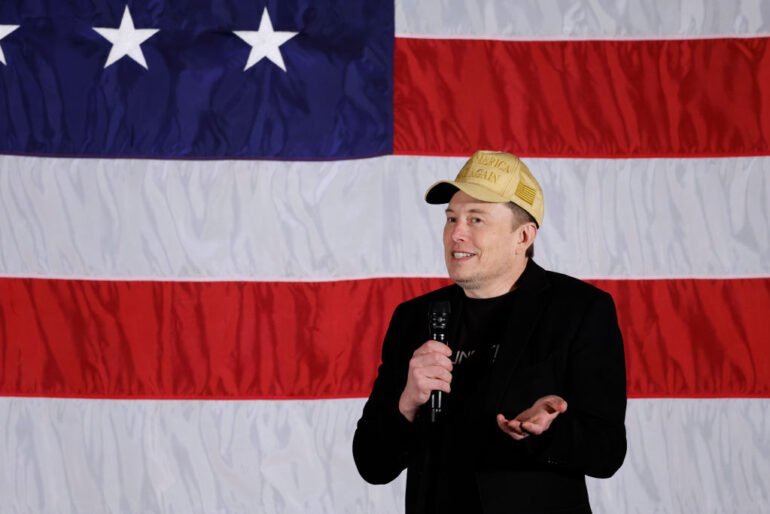
For decades, the standard playbook for American oligarchs was defined by quiet discretion. Billionaires funneled capital through opaque political action committees, hosted closed-door fundraisers, and cultivated bipartisan access to protect their commercial interests. Then came Elon Musk, who decided to shatter the mold by transforming himself into the most visible, combative, and well-funded surrogate in modern electoral history. Yet as the dust settles on an unprecedented election cycle, what was intended as a demonstration of raw executive clout has metastasized into a glaring cautionary tale.
Musk did not merely support a candidate; he effectively converted his sprawling business and media ecosystem into a partisan campaign arm. Through America PAC, the Tesla and SpaceX chief poured hundreds of millions of dollars into ground-game operations, voter mobilization, and headline-grabbing sweepstakes. Simultaneously, he leveraged X, the social media platform he purchased for $44 billion, into a megaphone for partisan narratives, conspiracy theories, and relentless campaign advocacy. It was a historic gamble that promised singular political influence, but it has triggered an equally historic backlash that threatens the foundations of his corporate empire.
A High-Stakes Gamble in the Public Square
The sheer scale of Musk’s political intervention marked a radical departure from Silicon Valley’s traditional lobbying norms. Beginning in the summer, Musk transitioned from an idiosyncratic commentator into an all-in political operative. He crisscrossed battleground states like Pennsylvania, headlined rallies, and distributed controversial million-dollar checks to registered voters—a move that prompted federal scrutiny and high-profile legal challenges from local prosecutors.
By positioning himself as the literal cheerleader of a polarized populist movement, Musk severed the separation between his personal ideology and his consumer-facing enterprises. For years, investors tolerated Musk’s erratic public behavior because his visionary charisma propelled Tesla to a trillion-dollar valuation and made SpaceX the undisputed leader in aerospace. However, turning corporate prestige into a political sledgehammer brought consequences that even his most ardent defenders cannot ignore.
The Collateral Damage Across a Corporate Empire
The most immediate and severe blowback has materialized at Tesla. Unlike legacy defense contractors or enterprise software firms, Tesla is fundamentally a consumer luxury brand. Its meteoric rise was built on the backs of affluent, environmentally conscious suburbanites—a demographic that overwhelmingly tilts progressive and moderate. Today, industry surveys and market data reveal that Tesla’s brand favorability among these core consumers has cratered, opening the door for rival automakers from Hyundai to BMW to capture critical electric vehicle market share.
Meanwhile, the situation at X remains precarious. Major global advertisers who fled the platform following Musk’s acquisition have shown little appetite to return to an environment defined by hyper-partisan vitriol and polarizing algorithmic amplification. Even SpaceX, historically insulated by its essential contracts with NASA and the Department of Defense, faces heightened oversight from regulatory bodies and foreign governments increasingly wary of relying on critical satellite infrastructure controlled by a single political partisan.
The Breaking of the CEO Playbook
Modern corporate governance has long rested on a simple maxim famously attributed to Michael Jordan: Republicans buy sneakers too. Consumer-facing enterprises thrive by building the widest possible tent. When a chief executive openly alienates more than half the country, the business ceases to be a universal utility and becomes an ideological lifestyle statement.

Musk bet that his personal cult of personality was strong enough to override standard economic gravity. He believed that consumers would buy cars, stream content, and book satellite internet regardless of his political crusade. Instead, the market has delivered a sharp rebuke. Brand loyalty is not indestructible, and when consumers are forced to choose between their technological preferences and their political values, values increasingly win.
A Warning Shot for the Oligarch Era
The ramifications of this fallout extend far beyond Musk’s personal fortune. Across Silicon Valley and Wall Street, a rising cohort of tech moguls had begun to view Musk’s unfiltered political activism as a blueprint for unapologetic oligarchic power. His aggressive maneuvering emboldened other executives to flirt with public partisanship, challenging the traditional neutrality of corporate leadership.
Now, Musk’s miscalculation serves as an unmistakable warning shot. The rapid erosion of consumer trust, coupled with mounting investor unease, demonstrates that absolute wealth does not grant immunity from market accountability. As corporate boards reassess their exposure and rethink executive boundaries, Musk’s costly gamble has proven that in a deeply divided nation, weaponizing a corporate empire for political dominance carries a price tag that even the world’s richest man cannot afford.