The San Antonio Spurs’ youth finally showed itself on the game’s grandest stage. But it didn’t come from the players you’d expect. It didn’t come from Stephon Castle, who fought valiantly in his minutes, or Dylan Harper, who is barely two years removed from high school. It came from the designated adult in the room.
In a grueling 107-106 Game 4 loss to the New York Knicks, the Spurs found themselves in a classic Finals crunch-time paradox: a young team suddenly paralyzed by the moment, actively shying away from the basketball, praying for someone else to steer the ship.
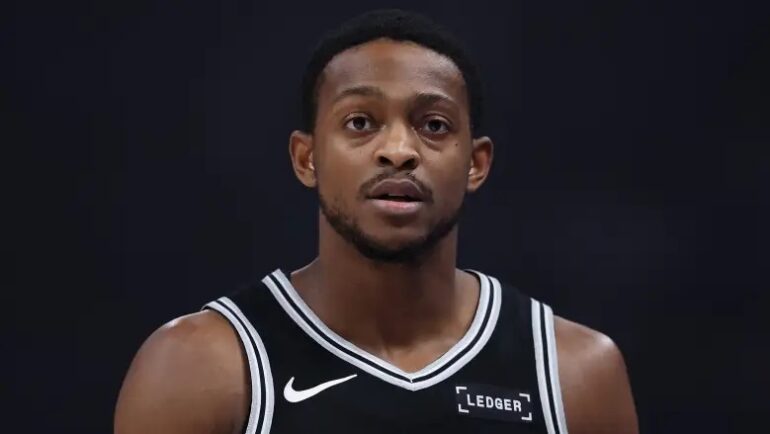
De’Aaron Fox didn’t shy away. He stepped up. He wanted the heavy lifting. But as the final buzzer echoed, a stark reality settled over the floor: you can credit Fox for having the guts to take the reins, but you absolutely cannot credit him for how he drove the car.
The Illusion of Experience
There is a dangerous assumption in the NBA that longevity equates to poise. We look at Fox—older, decorated, a former All-Star, and an established leader—and we stamp him as the veteran anchor for this hyper-young San Antonio squad. But a look at his year-by-year breakdown reveals a different story.
Fox has spent his career fighting up a different kind of hill. This is his very first time breathing the thin air of the NBA Finals. He is learning the calculus of June basketball in real-time, right alongside Victor Wembanyama.
Contrast that with the tandem across from him. The Knicks may not boast a roster dripping with championship rings, but their collective basketball miles are rugged and meaningful:
- Karl-Anthony Towns: Battle-tested in physical, trench-warfare playoff series during his time in Minnesota.
- Josh Hart: A player who has logged relentless, high-stakes minutes for winning cultures where every single possession is treated like a life-or-death scenario.
- Jalen Brunson: Lacks an NBA ring, but possesses an unshakeable championship pedigree stretching from his high school days straight through his legendary collegiate runs.
- Jordan Clarkson: A proven commodity who has played massive minutes in foundational games. Even on a night like tonight, where Clarkson barely cracked 8 minutes of floor time, his presence on the bench speaks to New York’s luxury of depth.
- Even on the sidelines, the contrast is glaring. Gregg Popovich is doing everything he can to steer this young roster, providing critical high-level guidance and support from the front office suite. But on the floor, the Knicks have the security blanket of Mike Brown’s bench presence—a man who walked into the Finals with LeBron James in Cleveland and polished his championship pedigree as a key assistant in Golden State. New York is insulated by a collective institutional memory of how to win. San Antonio is searching for it.
The Analytical Reality: The Late-Game Tax
The narrative eye test tells us that the Spurs’ young core defers completely to Fox when the game slows down into half-court execution. The numbers back it up flawlessly. When crunch time hits in this series, Fox’s structural responsibilities skyrocket into a high-friction, isolated tier.
4th Quarter Analytical Profile (Through Game 4)
- Usage Rate (USG%): 36.4% in the fourth quarter, compared to a full-game average of 24.8% (a massive +11.6% spike).
- Shot Frequency: He takes 31.2% of the team’s total fourth-quarter shots, a steep climb from his 18.5% full-game volume.
- Efficiency Splits: This taxing volume against a set, elite Knicks defense has crushed his efficiency, dropping him to 34.8% FG (8-of-23) and 28.6% 3PT (2-of-7) in the final frame, yielding a 41.2% True Shooting mark.
- Ball Security: A 16.1% Turnover Percentage in the fourth quarter, resulting in a tight 1.40 assist-to-turnover ratio.
This data completely mirrors the operational environment of this series. With rookie elements passing up looks late, Fox transforms from a fluid floor general into a high-volume closer out of sheer necessity. The resulting efficiency drop-off is the literal price of carrying a franchise on the Finals stage for the first time.
The 5.7-Second Disconnect
With under 20 seconds remaining on the clock and the season hanging in the balance, Fox attempted to make the kind of play that legends are built on. Following a chaotic sequence, Fox put his head down and drove hard to the rim, trying to catch the Knicks’ defense off-balance.
Instead, it highlighted the precise delta between a veteran by tenure and a veteran by tier.
Instead of manipulating the clock, forcing a structured set, or recognizing the defensive landscape, Fox tried to rely on pure athleticism. He met a brick wall. OG Anunoby trailed the play perfectly, using his elite length to slide over and cleanly block Fox at the cup, forcing a timeout with 5.7 seconds left. Fox later admitted his situational miscalculation, bluntly quoting that he “thought he could outrun him.” On the Finals stage, counting on outrunning a defender of Anunoby’s tier is a critical lapse in late-game awareness.
The block set up the definitive, heartbreaking sequence for the Spurs. On the ensuing inbound play, Jalen Brunson launched a long three-point attempt that clanged off the rim. A disciplined box-out would have ended the game and evened the series at 2. Instead, the Spurs’ young backline fell asleep. Anunoby ghosted down the lane completely untouched, elevating over two flat-footed Spurs jerseys to score a spectacular tip-in rebound with just 1.2 seconds left on the clock, sealing the game for New York.
When asked about the defensive breakdown and the sequence of the game-winner after the game, Wembanyama was intentionally vague, claiming he “didn’t see it.” It was a diplomatic answer to a question no teammate wants to touch. It’s hard to criticize the guy who tried to carry the team on his back when everyone else was passing the buck—but bad late-game execution is bad basketball, regardless of intent.

The Point Guard Standard
This is where the thesis of the modern NBA veteran crystallizes. In these identical late-game situations, does a Chris Paul bring you home? Does he freeze the defense, manipulate the clock, and manufacture a high-percentage look?
We even saw it earlier in these very playoffs with Marcus Smart. In the first round, Smart’s veteran savvy and rugged poise helped guide a heavily unfavored Los Angeles Lakers squad past a formidable Houston Rockets team. Smart didn’t just survive the crunch-time pressure; he orchestrated the survival.
The Stage Matters
This is not an indictment of De’Aaron Fox’s talent, nor is it a deletion of the big three-pointer he hit moments earlier to keep San Antonio alive. It takes a rare competitive fiber to demand the basketball when the lights are this bright and the Madison Square Garden crowd is deafening.
But the NBA Finals is a ruthless evaluator. It doesn’t give extra credit for good intentions. Fox is being forced to take these shots, carry this burden, and navigate these situational traps for the very first time in his life.
Tonight proved that every vet isn’t built the same. The Spurs have an incredibly bright future, but right now, their leader is learning a brutal lesson on the fly: on this stage, wanting the ball is only half the battle. Knowing what to do with it is what brings you home.