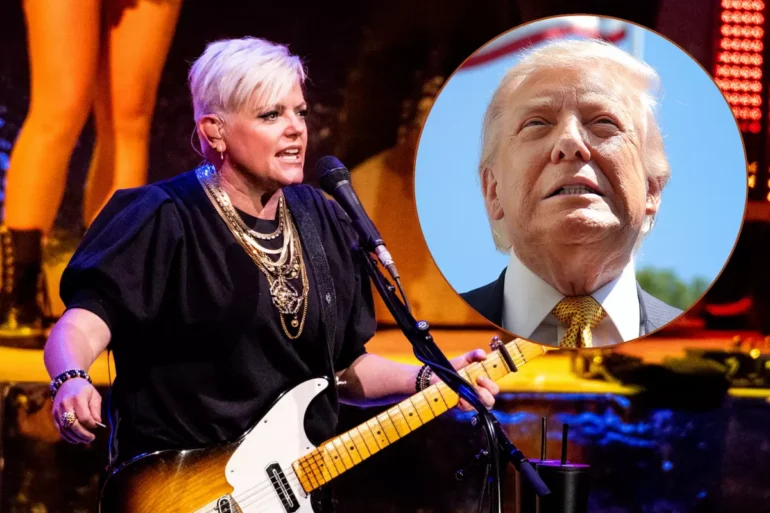
The Chicks’ Natalie Maines has once again entered the political arena, this time with sharp criticism directed at Donald Trump. The singer’s recent remarks follow reports of a newly established fund intended to benefit Trump’s allies, a move Maines has publicly denounced.
Maines, long known for her outspoken nature, has never shied away from expressing her political views, particularly those critical of conservative figures. Her past critiques, including those that led to significant backlash for The Chicks, have cemented her reputation as an artist unafraid to voice dissent. This latest commentary positions her against what she perceives as the misuse of financial resources for political patronage.
The controversy stems from the creation of a so-called “slush fund” reportedly designed to support individuals closely aligned with Donald Trump. Details surrounding the fund’s exact operations and beneficiaries remain under scrutiny, but the mere concept has drawn immediate condemnation from various political commentators and public figures, including Maines.
In a statement that has since circulated widely, Maines did not hold back. “This ‘slush fund’ for allies is just another example of the transactional politics we’ve come to expect,” she stated, according to a report by Billboard. She further elaborated, drawing a parallel to what she views as a pattern of behavior: “It’s about rewarding loyalty, not about serving the public. It’s disheartening to see public discourse reduced to such blatant self-interest.”
This is not the first time Maines has been at odds with political figures or movements. Her career took a significant turn in 2003 when she publicly criticized President George W. Bush during an international tour, leading to boycotts and considerable controversy for The Chicks. This incident, detailed on her Wikipedia page, marked a pivotal moment in the band’s history and solidified Maines’s image as a politically engaged artist.
The current political climate, marked by intense polarization and ongoing debates about campaign finance and political ethics, provides a backdrop for Maines’s statements. The establishment of funds for political allies, while not unprecedented, often sparks conversations about transparency and the influence of money in politics. Critics argue that such funds can be used to exert undue influence or reward political loyalty rather than support genuine policy initiatives.
Cultural analysts suggest that Maines’s continued willingness to engage in political commentary speaks to a broader trend of artists using their platforms to address social and political issues. In an era where authenticity is highly valued, her direct and unvarnished approach resonates with a segment of the public that feels alienated by more guarded public figures. However, her strong opinions also continue to divide audiences, a testament to the polarizing nature of the topics she addresses.

The relevance of such commentary in today’s fast-paced news cycle is a subject of ongoing discussion. While some dismiss celebrity political endorsements or criticisms as fleeting noise, others argue that they can still galvanize public opinion and draw attention to important issues. Maines’s legacy, already marked by her role in a significant cultural moment, is further shaped by these consistent interventions into political discourse.
The question remains whether Maines’s current strategy of vocal political critique still carries the same weight as it did in the early 2000s. In a media landscape saturated with opinions and immediate reactions, the impact of a single voice can be harder to measure. Yet, her willingness to engage directly with figures like Donald Trump ensures she remains a notable voice in cultural and political conversations, challenging the status quo and prompting reflection on the intersection of art, politics, and public life.
The formation of this fund, and Maines’s reaction to it, highlights the enduring tension between artistic expression and political engagement, and the power of a prominent voice to spark debate. As reported by The New York Times, such financial mechanisms are often under intense scrutiny, and public figures like Maines play a role in amplifying those concerns.