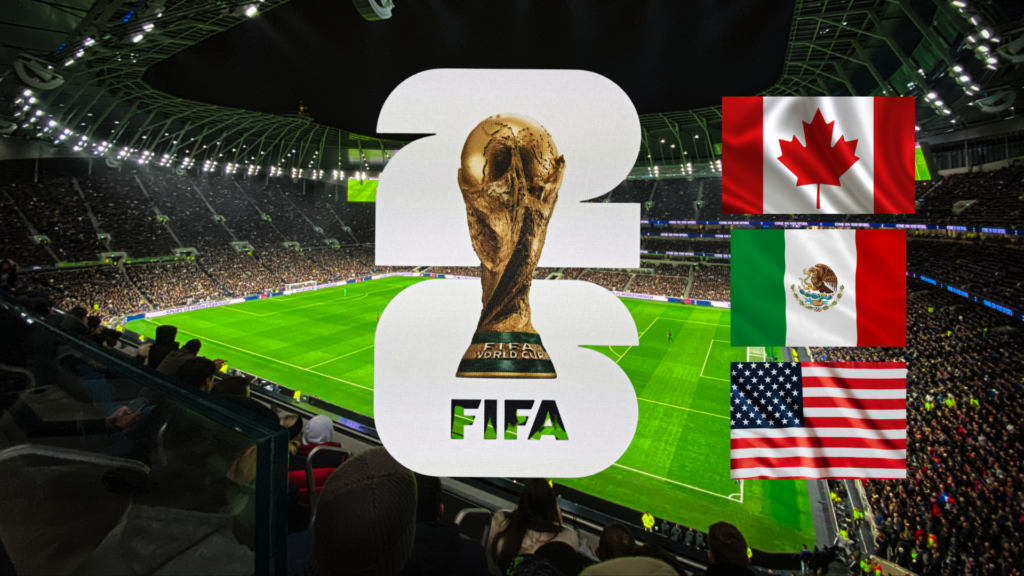
Fifa World Cup 2026 is going to be in three countries!
From Unity to Infrastructure
For decades, the FIFA World Cup has sold itself as something close to sacred—a borderless ritual where politics dissolved into spectacle, where the only language that mattered was football. From the pageantry of Brazil 2014 to the tightly controlled grandeur of Qatar 2022, FIFA positioned the tournament as both a unifier and a neutral stage.
But FIFA 2026, spread across the United States, Mexico, and Canada, no longer feels like a stage. It feels like an operating system.
The shift is subtle but undeniable: what was once a month-long cultural event now resembles a sprawling, hyper-commercialized, politically entangled mega-project. The expansion to 48 teams, the introduction of dynamic ticket pricing, and the increasing entanglement with national policy have transformed the World Cup from a shared global moment into something closer to a managed global product.
And in that shift lies a deeper cultural question: what happens when the world’s most universal event becomes too big—and too strategic—to feel universal at all?
The Expansion Era
The road to 2026 didn’t begin with controversy. It began with ambition.
The Old Identity: Scarcity and Prestige
Historically, the World Cup’s power came from limitations. With 32 teams and a tightly structured format, qualification itself was a marker of excellence. Hosting duties were typically concentrated in a single nation, reinforcing a sense of identity and cohesion.
FIFA’s branding leaned heavily on emotional universality—football as a common language, the tournament as a rare convergence.
The Mid-Shift: Expansion and Commercial Logic
That model began to shift in 2017, when FIFA formally approved the expansion to 48 teams for the 2026 tournament. The decision was framed as democratization—more nations, more representation—but it also introduced a new commercial logic.
More teams meant more matches. More matches meant more broadcast inventory. More inventory meant more revenue.
At the same time, FIFA began experimenting with new monetization strategies, including dynamic ticket pricing and expanded sponsorship integrations. By the early 2020s, the World Cup was no longer just a tournament—it was a scalable platform.
The Present Moment: A Tournament Under Pressure
Now, as the tournament approaches, the cracks in that model are increasingly visible.
Ticket pricing has become a flashpoint, with reports indicating group-stage seats ranging from $180 to $700, prompting backlash from fans who see the system as exclusionary rather than inclusive .
Human rights organizations have raised alarms about immigration policies, freedom of expression, and discrimination risks in host countries, warning that the tournament’s global accessibility may be compromised .
Even logistical concerns—like extreme heat affecting player safety—have underscored the tension between spectacle and sustainability .
What emerges is not a single controversy, but a pattern: the mechanisms designed to scale the World Cup are beginning to strain the very ideals it claims to represent.
The Cost of Going Global
The reaction to FIFA 2026 has not been explosive—but it has been persistent, layered, and telling.
Fans vs. Pricing
Supporters, long positioned as the emotional core of the tournament, are increasingly treated as market segments. The introduction of dynamic pricing has drawn criticism for prioritizing revenue optimization over accessibility, with many fans describing the system as opaque and exclusionary. The backlash isn’t just about cost—it’s about meaning. When attendance becomes a luxury good, the idea of the World Cup as a shared global experience begins to erode.
Advocacy Groups vs. Governance
Human rights organizations have also pushed back, highlighting contradictions between FIFA’s stated commitments and on-the-ground realities. Concerns about visa restrictions, protest limitations, and discrimination laws suggest that the tournament’s inclusivity may be more aspirational than operational .
These critiques echo earlier controversies—particularly around Qatar 2022—but with a crucial difference: this time, the issues are unfolding within established Western democracies, complicating the narrative of progress.
The Industry’s Quiet Unease
Even within football itself, there is a sense of unease. Player unions have raised concerns about scheduling and climate conditions, while governance controversies—such as allegations of labor oversight failures in stadium construction—suggest that FIFA’s structural challenges remain unresolved .
The result is a diffuse but growing skepticism: not a single scandal, but a cumulative loss of trust.
Strategy Over Sentiment
FIFA rarely frames its decisions in emotional terms. Its language is strategic, managerial, and often revealing.
The expansion to 48 teams, for instance, has been consistently justified as a move to increase participation and global reach. But the underlying logic is difficult to ignore: more teams mean more markets, more matches, and more monetization opportunities.
Similarly, the adoption of dynamic pricing reflects a broader shift toward data-driven revenue optimization—a model common in tech and entertainment, but relatively new to global sports at this scale.
Even symbolic initiatives, like the introduction of new awards or partnerships, have faced scrutiny for their lack of transparency and alignment with broader political narratives .
Taken together, these decisions suggest a governing philosophy that prioritizes growth and control over tradition and sentiment.
It’s not that FIFA is abandoning the idea of the World Cup as a unifying event. It’s that unity itself is being operationalized—treated as something to be engineered, rather than experienced.
The Age of Scalable Spectacle
FIFA 2026 is not an anomaly. It’s a case study in a broader cultural shift.

Relevance vs. Legacy
In an era defined by constant content and global competition for attention, even legacy institutions are under pressure to scale. For FIFA, expansion is a way to remain relevant—to ensure that the World Cup continues to dominate the global calendar.
But relevance comes at a cost. As the tournament grows, its identity becomes less distinct. What was once rare becomes routine. What was once intimate becomes industrial.
Authenticity vs. Performance
The World Cup has always been performative—but it has also felt authentic, rooted in genuine national pride and fan culture.
FIFA 2026 complicates that balance. When ticketing systems, media rights, and even fan access are mediated through layers of optimization, the experience begins to feel curated rather than organic.
The question is no longer whether the World Cup is authentic. It’s whether authenticity can survive at this scale.
Power and Control in the Modern Media Ecosystem
Perhaps most importantly, FIFA 2026 reflects a broader shift in how cultural authority is exercised.
In the past, the World Cup’s power came from its ability to bring people together. Today, its power lies in its ability to manage that convergence—across platforms, markets, and political contexts.
This is not unique to FIFA. It mirrors trends in streaming, social media, and global entertainment, where scale and control often take precedence over intimacy and spontaneity.
But the World Cup carries a different weight. It’s not just content—it’s culture. And when culture becomes infrastructure, something fundamental changes.
A Tournament at a Crossroads
FIFA 2026 will almost certainly be a success by traditional metrics. It will break records—for attendance, viewership, and revenue. It will deliver moments of brilliance, drama, and global attention.
But success, in this context, is not the same as meaning.
The tournament stands at a crossroads between what it has been and what it is becoming. On one side is the World Cup as a shared ritual—imperfect, emotional, and deeply human. On the other is the World Cup as a scalable system—efficient, expansive, and meticulously controlled.
The tension between those identities is not a problem to be solved. It is the story.
And as the world gathers in 2026, the question won’t just be who wins on the pitch. It will be whether the tournament itself still carries the weight it once did—or whether, in trying to include everyone, it has diluted the very thing that made it matter.