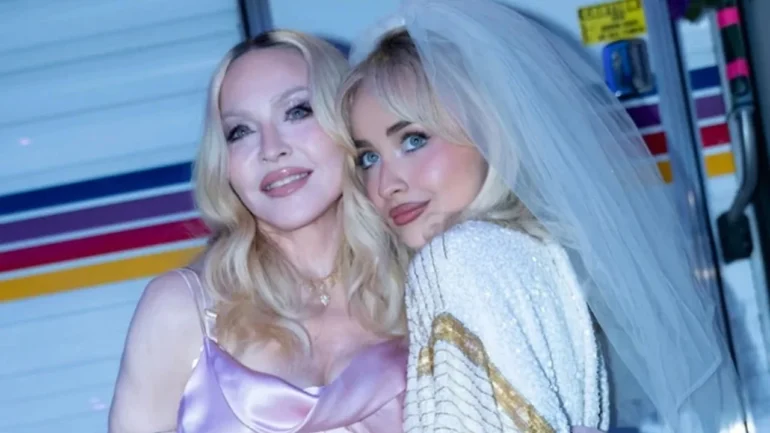
Madonna, a figure whose very name is synonymous with reinvention and the relentless pursuit of cultural relevance, has once again shifted her sonic landscape. This time, it’s a buoyant dance track titled ‘Bring Your Love,’ a collaboration with pop’s current darling, Sabrina Carpenter. The single, slated for Madonna’s forthcoming album *Confessions II*, marks a curious convergence of eras, a queen of pop past embracing the zeitgeist embodied by a rising star. It’s a pairing that, on the surface, might seem like a simple nod to pop’s enduring appeal, but delve deeper, and it reveals a complex interplay between legacy, reinvention, and the perpetual struggle for cultural currency in an attention-saturated world.
For decades, Madonna has been a master alchemist, transforming her image and sound with each successive era. From the raw, independent spirit of her early New York days, documented in early photographs and interviews, to the provocative artistry of *Like a Prayer* and the reinvention of herself as a disco queen with *Confessions on a Dance Floor*, Madonna’s career has been a masterclass in controlling her narrative. Her initial positioning was that of a defiant outsider, challenging sexual norms and religious iconography with an unapologetic fervor. This was a Madonna who famously declared, “I’m not looking for forgiveness, I’m looking for attention,” a sentiment that has echoed through her career. Her groundbreaking use of music videos, her fearless embrace of evolving dance music trends, and her willingness to court controversy cemented her status not just as a musician, but as a cultural phenomenon.
The mid-2000s saw Madonna solidify her position as a global icon. *Confessions on a Dance Floor* (2005) was a critical and commercial triumph, a triumphant return to the dance-pop roots that defined her early success, drawing inspiration from disco and house music. This album, in particular, showcased her ability to adapt and thrive, demonstrating a keen understanding of musical evolution while retaining her signature edge. However, as the landscape of music and celebrity shifted with the rise of social media and fragmented media consumption, Madonna’s subsequent artistic choices have sometimes been met with a more divided reception. While she has continued to experiment, her attempts to engage with newer sounds or aesthetics, such as her collaboration with Avicii on *Rebel Heart* or her more experimental work, have occasionally been perceived by some critics and fans as a struggle to maintain her place at the vanguard, a departure from the unequivocal dominance of her earlier work.
The recent collaboration with Sabrina Carpenter is a potent crystallization of Madonna’s current narrative. Carpenter, a former Disney Channel star who has successfully transitioned into a bona fide pop artist with a string of chart-topping hits like ‘Espresso’ and ‘Nonsense,’ represents the current generation’s pop sensibility. Her appeal is built on a blend of saccharine melodies, relatable lyrics, and a meticulously curated, yet seemingly accessible, online persona. By linking arms with Carpenter, Madonna is not just signaling an interest in contemporary pop; she is actively aligning herself with its most resonant voices. This is a strategic move, one that leverages Carpenter’s youthful energy and massive digital footprint to inject new vitality into Madonna’s own brand. The single ‘Bring Your Love,’ described as a buoyant dance number, suggests a musical landscape that is both familiar to Madonna’s core audience and perfectly calibrated for TikTok trends and streaming playlists, a space where Carpenter reigns supreme.
This strategic alignment has, predictably, generated a spectrum of reactions. For her staunchest admirers, it’s a validation of Madonna’s enduring influence, proof that she can still command the attention of the industry’s brightest new stars. They see it as a testament to her ability to remain relevant, a queen mentor guiding a princess. Conversely, some critics and a segment of her longtime fanbase have expressed skepticism. Is this a genuine artistic confluence, or a calculated maneuver to stay in the cultural conversation? The media, ever eager to frame Madonna’s career through a lens of perpetual reinvention or, at times, perceived desperation, has leaned into the narrative of a legend seeking to borrow relevance from a younger generation. This framing, while not entirely unfounded, often overlooks the agency and enduring power Madonna wields. Her ability to orchestrate such high-profile collaborations is itself a testament to her sustained influence, regardless of the critics’ reservations. The online discourse, particularly on platforms like X (formerly Twitter) and TikTok, buzzed with both excitement and debate, highlighting the polarized perceptions of Madonna’s continued bid for contemporary relevance.
Madonna herself has been remarkably candid, albeit often indirectly, about the motivations behind her career choices. Her famous quote about seeking attention has been a guiding principle, underscoring a career built on visibility and provocation. More recently, she has spoken about the importance of artistic freedom and the desire to continue pushing boundaries, even when it invites criticism. In interviews, she has often pushed back against the notion that she is past her prime, asserting her right to evolve and experiment. While she hasn’t explicitly addressed the Carpenter collaboration in terms of seeking validation, her career trajectory suggests a deep-seated understanding that relevance is not a birthright but a continuous performance. The pursuit of attention, once a raw, defiant declaration, has evolved into a sophisticated strategy for maintaining cultural capital in a landscape that constantly demands novelty. It’s a performance of perpetual youth and artistic vitality, a conscious effort to remain a central figure rather than a venerated relic.

This Madonna-Sabrina Carpenter nexus is a microcosm of broader cultural patterns. The dynamic between legacy artists and emerging stars reflects the complex ecosystem of cultural authority in the 21st century. It raises critical questions about relevance versus legacy. Is it more valuable to rest on one’s laurels and preserve a hallowed legacy, or to actively engage with the present, risking dilution for continued visibility? The line between authenticity and performance has become increasingly blurred. In an era where social media dictates much of public perception, even the most genuine artistic endeavors can be interpreted as strategic brand management. Power, attention, and influence are now currency, and artists, especially those with established careers, must constantly find ways to re-earn them. Madonna’s move can be seen as an attempt to harness the gravitational pull of contemporary fame, demonstrating that cultural authority is not static; it is constantly negotiated, borrowed, and leveraged.
Ultimately, Madonna’s decision to collaborate with Sabrina Carpenter and feature on *Confessions II* is more than just a musical pairing; it’s a strategic positioning in a rapidly shifting cultural landscape. The question remains whether this strategy, however effective in generating buzz and maintaining immediate relevance, can truly resonate beyond the ephemeral nature of viral trends. Madonna has built a formidable legacy, but in an era that venerates youth and rapid assimilation, her continued pursuit of the spotlight invites scrutiny. Her ability to adapt has been her superpower, but as she navigates the current media ecosystem, the challenge lies in ensuring that her reinventions feel less like a desperate grasp for relevance and more like the authentic, boundary-pushing artistry that defined her for so long. The buoyant sound of ‘Bring Your Love’ may capture the moment, but the enduring power of Madonna’s legacy will be tested by how she continues to evolve, or chooses to remain, within it.