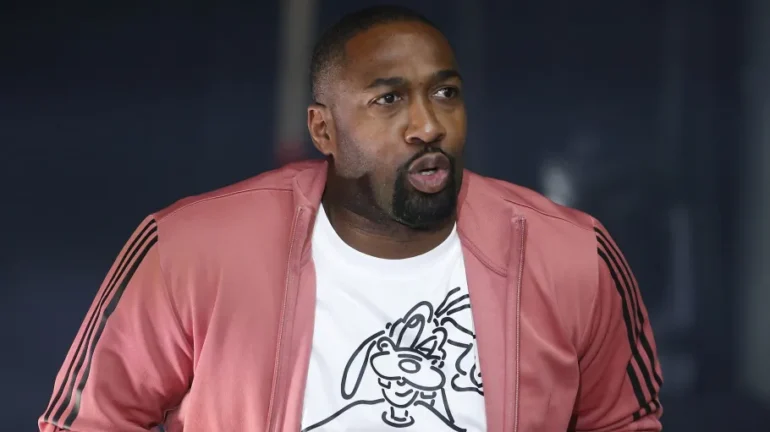
There was a stretch where Gil’s Arena felt untouchable. Not just successful, not just viral — untouchable. The show had the looseness of barbershop basketball talk mixed with the infrastructure of a network production. Former players weren’t walking in sounding media-trained or filtered through corporate talking points. They sounded comfortable. Gilbert Arenas especially sounded comfortable, because the entire thing revolved around him. His house. His energy. His rhythm. His audience.
That’s why the recent conversations around Gilbert’s absence from his own platform feel bigger than simple scheduling conflicts.
The issue isn’t merely that Arenas hasn’t appeared consistently. It’s that the identity of Gil’s Arena suddenly feels negotiable.
Recent commentary from Marcellus Wiley framed the situation less like a routine media transition and more like a shift in power dynamics. Wiley described visiting Arenas’ setup during the show’s peak and being stunned by the scale of the operation. What looked online like another athlete podcast was, in reality, a fully industrialized studio environment inside Arenas’ home. Makeup teams, assistants, production infrastructure, catering — the kind of ecosystem normally associated with legacy television. The implication was clear: Gil’s Arena stopped being “just a podcast” a long time ago.
That scale helped the show become one of the defining sports media successes of the independent creator era. While legacy outlets were still trying to figure out how to make athlete-driven content feel authentic, Gil’s Arena already understood the formula. Basketball conversation worked best when it sounded unfiltered, slightly chaotic, occasionally uncomfortable, and deeply informed by people who actually lived through the league.
But scale changes things.
Arenas’ partnership with Underdog was initially positioned as a strategic evolution rather than a surrender of independence. At the time, athlete-led media was entering a new phase where creators were realizing that infrastructure, distribution, sponsorship acquisition, and audience growth often required outside investment. What looked like independence on-screen frequently depended on corporate support behind the scenes.
Now the downside of that tradeoff appears harder to ignore.
The show’s schedule reportedly changed. The frequency dropped. Branding shifted. New programming moved into the same production environment. Most notably, Arenas himself no longer feels like the uncontested centerpiece of the ecosystem he built. Wiley’s commentary repeatedly returned to one central tension: when audiences start believing a platform works without its star, the relationship between creator and company changes immediately.
That matters because sports media is built almost entirely on perceived leverage.
The NBA comparison Wiley made wasn’t accidental. Teams constantly convince themselves they can replace aging stars with cheaper, more manageable alternatives. Sometimes they’re right. Often they discover too late that audience attachment doesn’t scale cleanly across interchangeable talent. A player’s production might be replicable. Their gravity usually isn’t.
The same principle applies here.
Gil’s Arena was never valuable simply because basketball topics were discussed there. Thousands of basketball shows exist. The differentiator was Gilbert Arenas himself — his unpredictability, his honesty, his willingness to say things polished network analysts would never risk saying publicly. Even when audiences disagreed with him, the appeal was that he sounded emotionally invested rather than algorithmically optimized.
That authenticity becomes harder to preserve once a show starts functioning like a network property instead of a personality-driven platform.
The introduction of Skip Bayless added another layer to the conversation. Bayless remains one of the most influential figures in modern sports debate television, but his arrival also symbolized a collision between old sports media and the newer athlete-led ecosystem. For years, shows like Gil’s Arena represented an alternative to the manufactured intensity of legacy debate formats. Suddenly, one of the defining architects of that older model was sitting inside Arenas’ own production environment.
The optics alone changed the conversation.
Bayless’ post-FOX trajectory has been heavily scrutinized by outlets like Variety and Billboard, largely because sports media itself is undergoing a broader identity crisis. Audiences increasingly reward chemistry over polish and personality over institutional credibility. Yet companies still gravitate toward recognizable legacy names because familiarity remains commercially valuable.

That leaves Gil’s Arena caught between two eras.
On one side is the raw athlete-driven authenticity that made the show explode in the first place. On the other is the reality that scaling a media platform often introduces executives, contracts, branding strategies, and programming decisions that dilute the original appeal.
Wiley’s interpretation of Arenas’ recent demeanor leaned heavily into that contradiction. He described Gilbert not as someone publicly fighting for control, but as someone reacting to a changing environment he no longer fully dictates. The silence around Arenas’ role has arguably become louder than any direct statement he could make.
That silence matters because audiences are unusually sensitive to authenticity shifts. Fans can tolerate format changes. They can tolerate cast rotations. What they struggle with is sensing that the emotional center of a show no longer believes in the product the same way they once did.
The larger question now is whether Gil’s Arena still works as a cultural force without Gilbert Arenas operating as its undeniable focal point.
Because sports media history suggests audiences rarely fall in love with platforms. They fall in love with people. And once viewers begin debating whether the platform still belongs to the person who built it, the brand itself enters dangerous territory.
Gilbert Arenas still has relevance. He still has audience equity. He still has the kind of basketball credibility most media companies spend years trying to manufacture artificially. But relevance and control are not the same thing.
That distinction appears to be at the center of everything happening around Gil’s Arena right now.