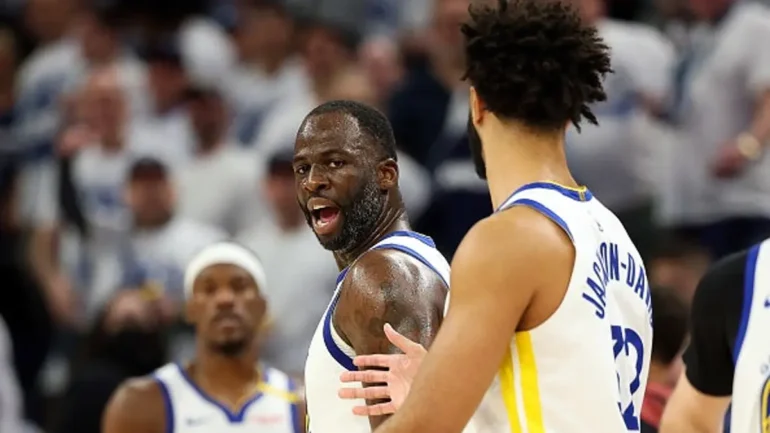
Draymond Green, a player known as much for his blunt commentary as his defensive intensity, recently reignited debate around nepotism in the NBA when he claimed Doc Rivers “gave” his son, Austin Rivers, a $40 million contract. The statement immediately sparked discussion online, not necessarily because the number was inaccurate, but because it reopened a long-standing conversation about Austin Rivers’ true value during his tenure with the Los Angeles Clippers.
Unlike exaggerated internet retellings of the quote that ballooned the figure into hundreds of millions, Draymond’s actual statement was rooted in reality. In 2017, Austin Rivers signed a three-year, $35 million extension with the Clippers, a deal that rounded naturally into the “$40 million” framing Green used during discussion. The bigger question, however, is whether that contract represented favoritism from Doc Rivers — who at the time held dual power as both head coach and president of basketball operations — or whether Austin Rivers was legitimately worth the investment during that era of NBA economics.
To answer that, the contract must be viewed through the lens of the NBA’s financial climate in 2016 and 2017. Following the league’s massive television rights deal, the salary cap exploded upward, creating one of the most inflated spending periods in modern basketball history. Teams across the league handed out enormous contracts to mid-tier role players and rotational starters. Players who would have commanded $6–8 million annually just a few years prior suddenly found themselves earning $15–20 million per season.
Within that environment, Austin Rivers’ contract was far from unprecedented.
During the 2016–17 season preceding his extension, Rivers averaged 12.0 points, 2.2 assists, and shot roughly 37 percent from three-point range while playing a key bench role for a playoff team. Though he was never an All-Star or elite creator, he developed into a reliable rotational guard capable of defending multiple perimeter positions, attacking off the dribble, and creating secondary offense when needed.
When normalized to per-36-minute statistics, Rivers averaged approximately 16 points per game production during stretches of his Clippers tenure, placing him comfortably within the category of valuable NBA rotation guards. His versatility became especially important in playoff settings where switchable defenders and shot creators off the bench carried increased value.
The broader market further supports the idea that Rivers’ deal aligned with league trends rather than existing as a major outlier.
Around the same timeframe:
- Allen Crabbe signed a four-year, $75 million contract.
- Evan Turner secured four years and $70 million.
- Timofey Mozgov received four years and $64 million.
- Kentavious Caldwell-Pope earned $18 million annually on a short-term deal with the Lakers.
- Jrue Holiday signed a five-year, $126 million extension with New Orleans.
Compared to those deals, Austin Rivers earning approximately $11.7 million annually does not appear particularly excessive. In fact, relative to some contracts handed out during that cap-spike era, his extension looks relatively moderate in hindsight.
Still, Draymond Green’s criticism resonates because the optics surrounding the deal were impossible to ignore.
Doc Rivers was not simply Austin’s coach — he was also responsible for personnel decisions. That dynamic naturally created skepticism around whether another player with identical production but without family ties would have received the same level of organizational commitment. In professional sports, perception matters almost as much as performance, and the Rivers situation became one of the NBA’s most visible examples of a father coaching and financially investing in his son.
Critics argued Austin benefited from opportunities unavailable to other players fighting for roster security. Supporters countered that while the family connection may have opened certain doors, Austin ultimately had to prove he belonged on the floor against elite competition every night.
That latter point is important when evaluating the full picture of his career.
Austin Rivers remained in the NBA long after leaving the Clippers and his father’s direct influence. He carved out rotational roles with the Houston Rockets, Denver Nuggets, New York Knicks, and other teams that had no incentive to play him out of loyalty or family ties. Coaches continued trusting him because he provided genuine value as a veteran guard capable of handling defensive assignments and contributing offensively in spurts.
That longevity weakens the argument that his entire career was artificially manufactured through nepotism. Players who survive more than a decade in the NBA typically do so because they possess legitimate skill and adaptability, regardless of how they initially entered the league.
Ultimately, Draymond Green’s statement works best as a commentary on optics and power dynamics rather than a literal indictment of Austin Rivers’ basketball ability. The idea that Doc Rivers “gave” his son a contract reflects the reality that family relationships inevitably influence opportunities in professional sports. However, framing the deal as some outrageous financial disaster ignores both the NBA’s inflated market conditions at the time and Austin Rivers’ actual on-court value as a capable rotational player.
The truth lies somewhere in the middle. Austin Rivers likely benefited from trust and opportunity that came with having one of the league’s most powerful coaches as his father. But he also produced enough, competed hard enough, and lasted long enough in the NBA to demonstrate that he was more than simply a product of favoritism.