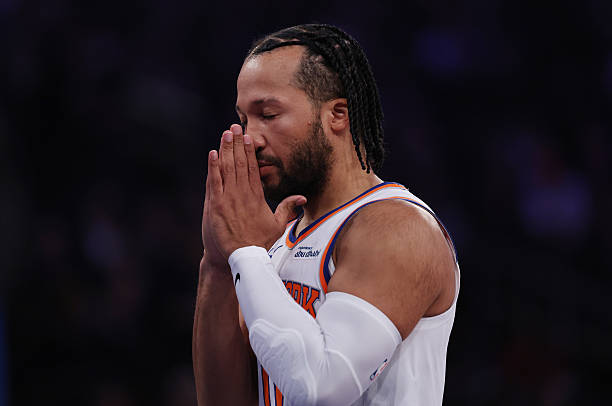
SAN ANTONIO — Long before Jalen Brunson became the face of a championship franchise, before Madison Square Garden shook beneath a shower of confetti and before he hoisted the Larry O’Brien Trophy after the New York Knicks defeated the San Antonio Spurs in five games, there were people around basketball who struggled to explain why every team he joined seemed to keep winning.
The numbers were always impressive, but they never told the full story.
One of the earliest clues came only weeks after the 2018 NBA Draft. Fresh off being selected 33rd overall by the Dallas Mavericks, Brunson arrived in Las Vegas as part of USA Basketball’s Select Team, a collection of young NBA players assembled to challenge the senior national team during training camp. The assignment wasn’t glamorous. The Select Team existed to sharpen future Olympians and World Cup stars, not to create its own.
Even within that group, Brunson wasn’t expected to command much attention.
Several lottery picks entered camp carrying considerably more hype. Scouts were eager to watch explosive athletes and highly touted prospects whose names had dominated draft coverage. Brunson, meanwhile, entered the NBA carrying labels that followed him throughout college. Too small. Not explosive enough. Limited upside. Reliable, perhaps, but not someone franchises envisioned becoming a cornerstone.
He had heard every criticism before.
Rather than answer them with words, he answered them the same way he always had.
He won.
As scrimmages unfolded over the following days, executives from around the league settled into the stands to evaluate young talent. While most eyes naturally drifted toward first-round selections, another pattern quietly emerged. Every time Brunson took control of a game, his group found itself walking off the floor on the winning side.
Then it happened again.
And again.
One Mavericks scout who had only recently begun evaluating Dallas’ newest second-round pick noticed something impossible to ignore. Brunson didn’t overwhelm opponents with breathtaking athleticism or highlight-reel plays. Instead, possessions became cleaner. Teammates looked more comfortable. The ball moved. Mistakes disappeared. Somehow, the scoreboard kept favoring whichever side he happened to be leading.
During one scrimmage, Brunson absorbed an accidental shot to the eye that left visible damage. The redness was obvious from the stands. Coaches checked on him immediately.
He insisted he was fine.
Minutes later he was still directing traffic, still making the right reads and still finding ways to finish possessions. The injury barely registered compared to the result.
His team won again.
Inside the Mavericks organization, executives eventually developed their own way of describing what they believed separated Brunson from so many other talented players. Statistics captured his production. Film explained his decision-making. Neither fully explained the outcome.
One longtime evaluator called it “gold dust.”
The phrase spread throughout Dallas’ scouting department because everyone seemed to understand what it meant without needing further explanation. Some players accumulate impressive numbers. Others elevate every environment they enter.
Brunson belonged in the second category.
Wherever he played, victories tended to follow.
Years later, after New York ended a 53-year championship drought by dispatching the Spurs in five games, that old scouting phrase suddenly sounded less like exaggeration and more like prophecy.
The Knicks certainly didn’t win because of one player alone.
Karl-Anthony Towns delivered arguably the finest postseason basketball of his career, stretching defenses while anchoring the interior offensively. OG Anunoby transformed every defensive assignment into a personal challenge, routinely changing games with his versatility. Josh Hart once again embraced every thankless responsibility imaginable, while Mikal Bridges supplied consistency on both ends of the floor night after night. Mitchell Robinson protected the paint, role players accepted changing responsibilities, and Tom Thibodeau’s demanding system finally reached its ultimate payoff.
Together, they built one of the most complete playoff teams the franchise has ever assembled.
Yet every championship team develops a personality, and New York’s reflected the point guard holding the ball.
The Knicks became impossible to rattle.
Throughout their postseason run, deficits rarely produced panic. Momentum swings failed to create finger-pointing. Whether trailing by fifteen or leading comfortably in the fourth quarter, the emotional temperature inside New York’s huddles barely changed.
Players consistently credited that steadiness to Brunson.
His confidence never came across as loud or theatrical. It lived in his body language, his decision-making and the certainty that the next possession mattered more than the previous one. That mentality spread throughout the roster until it became the defining characteristic of a championship team.
Opponents learned the hard way that no lead against New York ever felt safe.
Several postseason victories followed familiar scripts. The Knicks absorbed early punches before gradually taking control through execution rather than urgency. Big comebacks stopped feeling miraculous because the group expected them.
Inside the locker room, that belief became simple.
As long as Brunson was orchestrating the offense, there was always another run waiting.