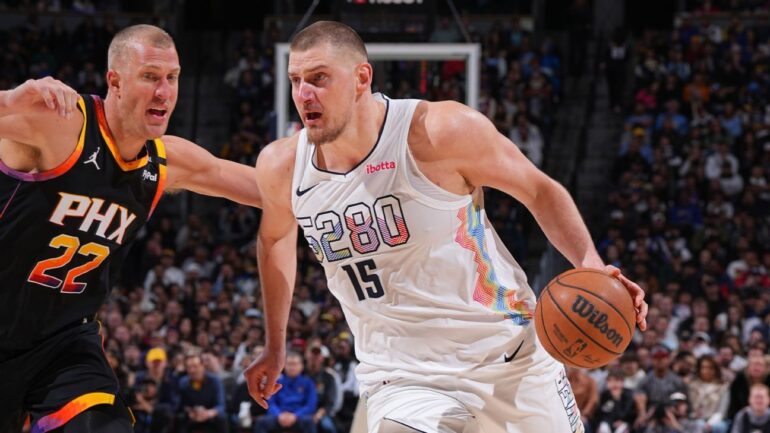
Nikola Jokic, a player celebrated for his seemingly effortless brilliance and revolutionary impact on the game of basketball, has recently found himself at the center of a peculiar controversy. It’s a debate that moves beyond X’s and O’s, touching upon the very nature of competitive spirit and the public’s perception of effort in the hyper-scrutinized world of professional sports. The narrative emerging is one of a star player seemingly disengaged, prompting questions not just about his performance on specific plays, but about the evolving cultural understanding of what constitutes genuine effort and commitment in the face of immense pressure and expectation.
The current discourse, fueled by moments captured on film and amplified across social media, hinges on specific instances where Jokic has appeared to exert minimal effort in critical game situations. The most prominent examples involve instances where opponents have scored seemingly uncontested layups or dunks, often after a turnover by Jokic’s team. Critics point to plays where, instead of hustling back on defense, Jokic appears to jog or even stand still, only to later engage in what is perceived as performative effort, such as a late, half-hearted attempt to contest a shot or a rhetorical confrontation. This stark contrast between his offensive wizardry and perceived defensive apathy has sparked a debate about his commitment and the very definition of “heart” in basketball. The sentiment, as articulated by some observers, is that Jokic’s actions suggest a selective engagement, prioritizing offensive flow over defensive responsibility until a moment arises that might garner attention or fulfill an unwritten, performative code of conduct.
To understand this shift, one must look at Jokic’s established persona. For years, he has been lauded as a unique talent, a player who defied traditional athletic archetypes. His brilliance often appeared innate, a consequence of his unparalleled court vision and exceptional skill set. Early in his career and throughout his ascendance to superstardom, the focus was overwhelmingly on his offensive genius. His MVP awards and his status as one of the league’s premier players were built on this foundation. There were few, if any, public criticisms regarding his effort during this period, as his overall impact on the game overshadowed any perceived lapses. However, as the stakes have risen, and as the Nuggets have become consistent contenders, Jokic’s moments of perceived disengagement have become more magnified. The transition from a player whose effort was rarely questioned to one whose effort is now a focal point of criticism marks a significant mid-career evolution, amplified by the ever-present lens of modern sports media.
The backlash, while often couched in sports jargon, speaks to deeper anxieties about authenticity and commitment. Social media platforms have become battlegrounds where fans and analysts dissect every movement, turning individual plays into cultural touchstones. The narrative that emerges is one of a player who, by some accounts, appears to be gaming the system, conserving energy until a moment demands a dramatic flourish, or until he feels the need to project an image of competitiveness. This has led to peer reactions and public pushback, with the media often framing these incidents as evidence of a player lacking the “killer instinct” or the requisite intensity. The controversy is not merely about basketball strategy; it’s about how effort is perceived, valued, and performed in an era where every action is recorded, analyzed, and debated. The very idea of “unwritten rules” in basketball—like responding to perceived slights or showing visible effort on defense—is being challenged by Jokic’s perceived nonchalance, creating a cultural friction point.
While Jokic himself has not directly addressed these specific criticisms in extensive detail, his public persona and his team’s success often serve as implicit defenses. His reputation for stoicism and his singular focus on winning are often cited by supporters as reasons why his on-court demeanor should not be misconstrued. Yet, the evidence presented by critics—the slowed-down film clips, the side-by-side comparisons of offensive and defensive effort—suggests a pattern that goes beyond mere stoicism. The argument is that these moments aren’t isolated incidents but rather indicative of a player who, perhaps consciously or unconsciously, operates on a different energy economy. The perceived “fake acting” or “bullshit” described by critics is interpreted not as a lack of care, but as a strategic or emotional detachment that becomes glaringly apparent in the moments where intense, sustained effort is most expected.

This situation with Nikola Jokic is a microcosm of broader cultural shifts occurring in the modern media ecosystem, particularly concerning relevance, authenticity, and performance. In an age saturated with content and constantly seeking the next viral moment, the line between genuine action and calculated performance blurs. Jokic, by his very nature, often appears to operate outside the traditional script of athletic stardom. His unique skill set and unassuming demeanor make him an enigma. However, in a culture obsessed with narrative and explicit displays of emotion or effort, his perceived lack of these can be interpreted as a lack of commitment. The debate also highlights the tension between legacy and relevance. Jokic is building an undeniable legacy, yet the ephemeral nature of current media cycles demands constant engagement and visible exertion to maintain relevance. The question arises whether a player’s intrinsic value and historical achievements are enough, or if contemporary cultural expectations demand a more overt and consistent performance of effort, especially in defense.
Ultimately, Nikola Jokic’s current public perception forces us to confront what we value in athletes. Is it the singular moments of brilliance, the statistical dominance, or the visible, sustained grind? In a sporting landscape that increasingly commodifies intensity and emotional output, Jokic’s approach stands out. Whether his perceived lapses in effort are a calculated strategy, a genuine reflection of his unique approach to the game, or a product of a cultural moment that demands more visible displays of competitive fire, remains a subject of debate. As the cultural conversation evolves, one must question whether this style of play, this perceived detachment, can sustain its weight in an environment that increasingly rewards not just the outcome, but the very visible process of striving, especially when the cameras are always rolling.