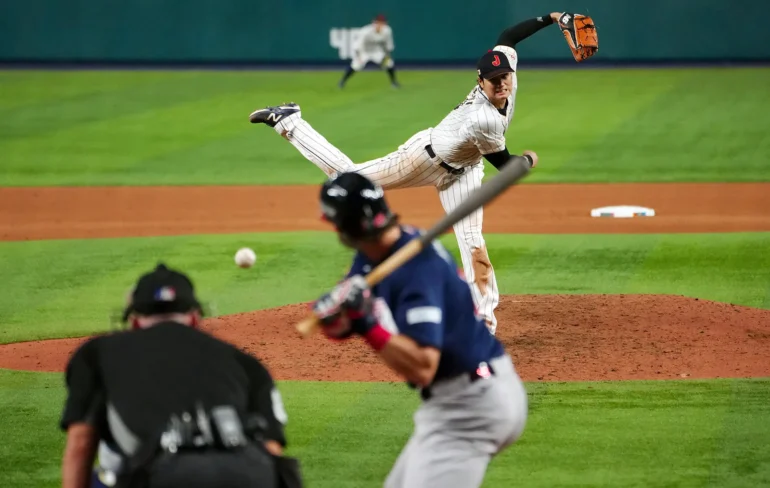
The World Baseball Classic opening day on March 5.
In March 2023, the sports world witnessed a moment of scripted perfection that seemed to exist outside the laws of probability. Shohei Ohtani, the Japanese polymath who has effectively broken the statistical model of modern baseball, stood on a mound in Miami facing Mike Trout, his teammate and the undisputed American gold standard of the previous decade. It was the bottom of the ninth, two outs, a one-run game in the World Baseball Classic final. When Ohtani blew a 100-mph fastball past Trout to secure the title for Japan, it wasn’t just a strikeout; it was a vibe shift.
For decades, the narrative of professional baseball was defined by a steady, comfortable insularity. Major League Baseball (MLB) was the “Big Leagues,” and everything else—from the Caribbean Series to the Nippon Professional Baseball (NPB) league—was a secondary satellite. The World Baseball Classic (WBC), launched in 2006, was long treated by the American sports establishment as a preseason curiosity, a high-risk exhibition that threatened the health of expensive pitching arms. But as we approach the 2026 iteration, that condescension has evaporated. The WBC has transformed from a corporate experiment into the most vital expression of the sport’s future, reflecting a broader cultural transition where the “center” of global entertainment is no longer a fixed geographical point in North America, but a fluid, polycentric network.
The Evolution of a “Exhibition”
The trajectory of the WBC mirrors the messy globalization of the 21st century. At its inception, the tournament was met with profound skepticism. The 2006 and 2009 editions were dominated by Japan and South Korea, yet the American media response was often defensive, focusing on the timing of the tournament and the absence of top-tier U.S. starters. The prevailing sentiment was that the “real” baseball happened in October, and this March madness was merely a distraction.
By the mid-2010s, however, the internal logic of the sport began to shift. The 2017 WBC saw a surge in emotional investment, particularly from Puerto Rican and Dominican fans who brought a winter-league intensity to MLB stadiums. When Team USA finally won its first title that year, the victory felt less like a confirmation of dominance and more like a desperate “catch-up” to the passion displayed by the rest of the world.
The 2023 tournament broke every previous metric of relevance. It generated record-breaking viewership in Japan—where nearly half of all households tuned in for the quarterfinals—and sold out stadiums in Miami and Phoenix. More importantly, it shattered the myth that elite players didn’t care. When Edwin Díaz, the star closer for the New York Mets, suffered a season-ending injury during a post-game celebration, the ensuing “moral panic” from some U.S. media outlets was met with a fierce counter-narrative from players themselves. They argued that representing their country was not a risk to be mitigated, but the pinnacle of their careers.
The Conflict: Risk vs. Representation
This tension between the franchise and the flag remains the central conflict as the 2026 WBC looms. The tournament sits at the intersection of a multibillion-dollar labor market and a rising tide of national sporting identity. In the past, MLB front offices were the primary antagonists, often “discouraging” their $200 million assets from participating.
But the power dynamics have flipped. Today, the most influential players in the game—Ohtani, Ronald Acuña Jr., Juan Soto—view their global brand as paramount. The industry response has shifted from resistance to co-option. Variety and Billboard have noted how the WBC has become a lifestyle event, merging reggaeton culture, high-fashion tunnel walks, and nationalistic fervor.
The pushback no longer comes from the fans, who have signaled they prefer the high-stakes theater of the WBC to the slow burn of the 162-game season. Instead, the controversy is now logistical and philosophical: How does a sport built on “patience” and “longevity” reconcile itself with a tournament built on “sudden death” and “intensity”?
The Strategy of Passion
In the aftermath of the 2023 final, Mike Trout—long criticized for his reticent, “just the facts” public persona—was unusually candid about the tournament’s impact. “It’s probably the most fun I’ve had on a baseball field,” Trout told reporters. This admission was a quiet earthquake in the baseball world. It was a confession that the structured, corporate environment of the MLB regular season was failing to provide the emotional stakes that players, even those at the top of the food chain, craved.
The motivation for players to participate in 2026 isn’t just patriotic; it’s a strategic play for relevance. In a fragmented media ecosystem, the WBC provides a “Super Bowl” level of concentrated attention that baseball rarely achieves. For a player like Ohtani, the WBC was the final stage of his ascent to becoming a global icon on par with Lionel Messi or LeBron James. He recognized that cultural authority in 2024 is not granted by local beat writers or regional sports networks, but by moments that can be clipped, shared, and memed across every time zone simultaneously.
The Mirror of Modern Culture
The transformation of the WBC reflects a broader cultural pattern: the decentralization of American soft power. For a century, baseball was “America’s Pastime,” an export that signaled U.S. cultural hegemony. In 2026, the WBC will reflect a world where the sport’s most innovative tactics, its most fervent fans, and its most marketable stars are increasingly non-American.

This shift mirrors what we see in film (the rise of South Korean cinema) and music (the global dominance of Afrobeats and Latin Trap). The “center” is everywhere. The WBC succeeds because it leans into this “Authenticity vs. Performance” divide. While the MLB regular season often feels like a highly polished performance of “tradition,” the WBC feels like an authentic explosion of cultural identity. When Team Mexico players donned “Lucha Libre” masks in the dugout or Team Japan players performed their “pepper grinder” celebrations, they weren’t just playing a game; they were asserting a cultural presence that the traditional baseball establishment had spent years trying to suppress under the guise of “unwritten rules.”
The WBC has effectively killed the “unwritten rules.” It has replaced the stoic, Midwestern ethos of the 1950s with a vibrant, multilingual, and high-energy aesthetic that is far more aligned with the modern media ecosystem. Cultural authority in sports is now gained through emotional vulnerability and national pride, not just statistical efficiency.
Toward 2026: The New Landscape
As we look toward the 2026 World Baseball Classic, which will be hosted across Miami, Houston, San Juan, and Tokyo, the stakes have never been higher. The tournament will no longer be an “alternative” to the MLB season; for many fans and players, it will be the primary event of the year.
However, this success brings a new set of questions. As the WBC becomes more commercialized—more “Super Bowl-ized”—can it maintain the raw, underdog energy that made it so compelling? Or will it become another hyper-curated corporate product, smoothed over by sponsors and broadcast rights holders?
The 2026 tournament will be the ultimate test of whether baseball can sustain its new global momentum. It is a sport that spent too long looking backward, obsessed with its own history. Through the WBC, it has finally found a way to look forward. The strategy of using national identity to fuel global interest has worked, but it has also permanently altered the hierarchy of the sport. The MLB is no longer the sole arbiter of what matters in baseball.
In the modern cultural landscape, power is no longer about who owns the stadium, but about who commands the attention. By 2026, the World Baseball Classic won’t just be a tournament; it will be the definitive proof that the game has outgrown the country that invented it. Whether the American establishment is ready to accept its role as just one of many stakeholders in a global game is the story that will be written on the dirt of the diamond in two years’ time.