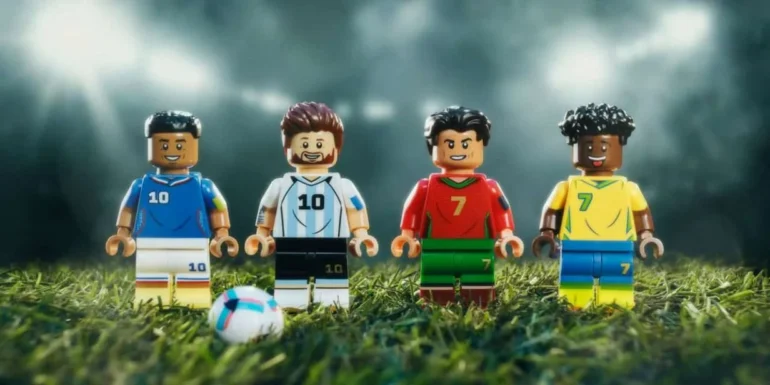
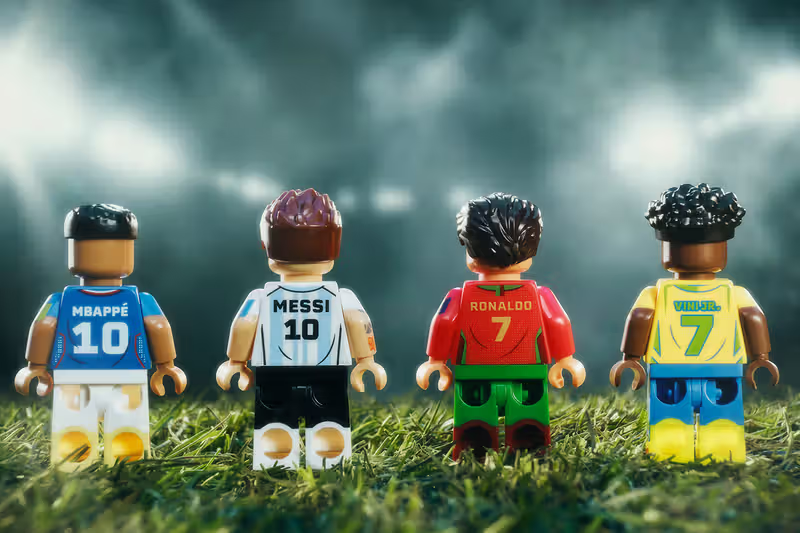
LEGO partnered with FIFA.
How it started!
For decades, LEGO cultivated an identity rooted in open-ended imagination—a system of play that famously insisted there was no “right” way to build. FIFA, by contrast, has long embodied structure, spectacle, and control: a governing body synonymous with rigid hierarchies, billion-dollar tournaments, and geopolitical gravity. One built worlds from the ground up; the other staged them at planetary scale.
So when LEGO announced its partnership with FIFA—bringing the world’s most powerful sports brand into the toy aisle—the shift felt less like a collaboration and more like a quiet philosophical pivot. What happens when a company built on creative freedom aligns itself with an institution defined by rules, regulation, and global authority? The answer says less about toys or sports, and more about how culture itself is being packaged, licensed, and sold to the next generation.
Imagination Without Instructions
Since its modern reinvention in the late 20th century, LEGO has framed itself not just as a toy company, but as a creative philosophy. Its messaging—visible in campaigns like “Only the best is good enough”—emphasized imagination as a kind of moral good. Even as it expanded into licensed properties in the late 1990s and early 2000s (notably with Star Wars), LEGO maintained a careful balance: branded sets existed, but the core promise remained that any structure could be broken down and rebuilt into something entirely new.
This ethos extended into LEGO’s cautious approach to real-world institutions. While it partnered with entertainment franchises, it largely avoided aligning with organizations that carried political, corporate, or ideological weight. The brand’s neutrality was part of its appeal—an almost utopian vision of play, insulated from the messiness of adult systems.
The Rise of Licensed Worlds
By the 2010s, that neutrality began to erode—not dramatically, but incrementally. LEGO leaned further into intellectual property, building expansive product lines around Marvel, DC, and Harry Potter. These weren’t just toys; they were ecosystems, complete with films, video games, and digital platforms.
This shift mirrored a broader trend in children’s media: the consolidation of storytelling into franchised universes. As The New York Times has noted in its coverage of entertainment conglomerates, the logic of modern media increasingly favors recognizable brands over original concepts. LEGO, once a counterpoint to that logic, became one of its most effective participants.
Still, there was a distinction. These partnerships, while commercial, were rooted in fiction. Aligning with Batman or Luke Skywalker didn’t carry the same real-world implications as aligning with a global governing body.
The FIFA Partnership: A New Kind of Alignment
The announcement of LEGO’s collaboration with FIFA marks a different kind of move. According to reports from outlets like Variety and Billboard, the partnership aims to promote play and creativity through football (soccer), particularly among children who may lack access to the sport.
On its surface, the initiative is difficult to critique. It emphasizes inclusivity, physical activity, and global connection—values that align neatly with both brands’ public messaging. But the symbolism runs deeper. FIFA is not just a sport; it is an institution with a complex history, including well-documented controversies around governance and labor practices, extensively covered by The Guardian and Reuters.
By entering into this partnership, LEGO is not simply making football-themed sets. It is integrating itself into a global system of branding, where even play becomes a site of institutional influence.
Fans Reactions
Public reaction to the LEGO–FIFA partnership has been notably muted—at least compared to the backlash that often accompanies FIFA-related news. This absence of outrage is itself telling. In an era of constant controversy, the collaboration has largely been framed as benign, even positive.
Industry observers have pointed out the strategic alignment. As Vogue has explored in its coverage of brand collaborations, partnerships that merge lifestyle and identity are increasingly central to how companies maintain relevance. For LEGO, football offers a universal language, one that transcends cultural and economic boundaries. For FIFA, LEGO provides access to a younger, more impressionable audience.
Yet beneath this mutual benefit lies a quieter tension. Critics of FIFA have long questioned its role in shaping global narratives around sport, particularly in relation to labor conditions during events like the World Cup. While LEGO has not directly engaged with these controversies, its partnership inevitably links its brand to FIFA’s broader reputation.
The media framing reflects this ambiguity. Coverage in outlets like People emphasizes the partnership’s focus on children and play, while more critical voices—often in independent or niche publications—highlight the ethical complexities. The result is a split narrative: one that celebrates the collaboration’s intent while sidestepping its implications.
Why is it important?
Unlike some high-profile brand pivots, LEGO’s move into FIFA territory has not been accompanied by overt admissions of strategy or necessity. The company’s official statements emphasize values—creativity, inclusivity, joy—rather than market positioning.
However, the language itself offers clues. In announcing the partnership, LEGO executives described football as “a powerful force for positive change” and emphasized the goal of reaching children “where they are.” This phrasing echoes a broader shift in corporate communication, where social impact is framed as both mission and market opportunity.
FIFA, for its part, has been more explicit about the role of partnerships in shaping its future. In interviews with outlets like BBC, FIFA leadership has highlighted the importance of engaging younger audiences and diversifying the organization’s cultural footprint. The LEGO collaboration fits squarely within that strategy.
What emerges is a kind of implicit acknowledgment: both organizations understand that relevance is no longer guaranteed. It must be cultivated, often through unexpected alliances.
It is very ethnic.
Relevance vs. Legacy
At its core, the LEGO–FIFA partnership is a story about relevance. Both brands are, in different ways, legacy institutions. LEGO has been a staple of childhood for generations; FIFA has governed the world’s most popular sport for over a century.
But legacy alone is not enough in a media landscape defined by constant innovation and fragmentation. As younger audiences gravitate toward digital platforms and personalized content, traditional forms of engagement—physical toys, televised sports—face increasing pressure to adapt.
By joining forces, LEGO and FIFA are attempting to bridge this gap. The collaboration suggests that relevance today is less about maintaining a singular identity and more about creating intersections—moments where different cultural domains overlap.
Authenticity vs. Performance
The partnership also raises questions about authenticity. LEGO’s brand has long been associated with genuine creativity, a form of play that feels inherently personal. FIFA, by contrast, operates on a scale that often feels impersonal, even corporate.
When these two identities merge, the result is a kind of performative authenticity. The messaging emphasizes grassroots play and community engagement, but it is delivered through a highly orchestrated partnership between global entities.

This dynamic reflects a broader cultural pattern. As The New York Times has observed in its analysis of modern branding, authenticity has become less about origin and more about presentation. It is something that can be constructed, curated, and, ultimately, sold.
Power, Attention, and Influence
Perhaps the most significant implication of the LEGO–FIFA collaboration is what it reveals about power. In the modern media ecosystem, influence is not confined to a single domain. It is distributed across networks of brands, platforms, and institutions.
By entering the world of football, LEGO expands its sphere of influence beyond the toy aisle. By partnering with LEGO, FIFA extends its reach into the intimate space of childhood play. Each gains access to new forms of attention, new ways of shaping perception.
This exchange of influence is not inherently problematic. But it does blur the boundaries between different kinds of cultural authority. When a child builds a LEGO football set, they are not just playing; they are engaging with a network of meanings that includes sport, branding, and global identity.
The Commodification of Play
Ultimately, the partnership underscores the extent to which play itself has become commodified. What was once an open-ended activity is increasingly structured by external narratives, whether through licensed sets, digital integrations, or branded collaborations.
This does not mean that creativity disappears. Children will always find ways to reinterpret and reimagine the materials they are given. But the context in which that creativity occurs is shifting.
In this sense, the LEGO–FIFA partnership is less a departure from LEGO’s identity than an evolution of it. The company is not abandoning imagination; it is embedding it within a broader system of cultural production.
It all comes to a perfect piece.
The collaboration between LEGO and FIFA is easy to dismiss as a simple marketing move—a harmless blending of toys and sport. But viewed more closely, it reveals a deeper transformation in how culture operates.
In a world where attention is fragmented and competition is constant, even the most established brands must find new ways to remain relevant. Partnerships like this are not just about expanding audiences; they are about redefining identity.
For LEGO, the challenge will be maintaining its core promise of creativity within an increasingly branded environment. For FIFA, it will be translating its global authority into forms that resonate with younger generations.
Whether this strategy succeeds remains to be seen. What is clear is that the boundaries between play, commerce, and culture are becoming harder to distinguish. And in that blurred space, the simple act of building—once an end in itself—becomes part of something much larger, and far more complex.