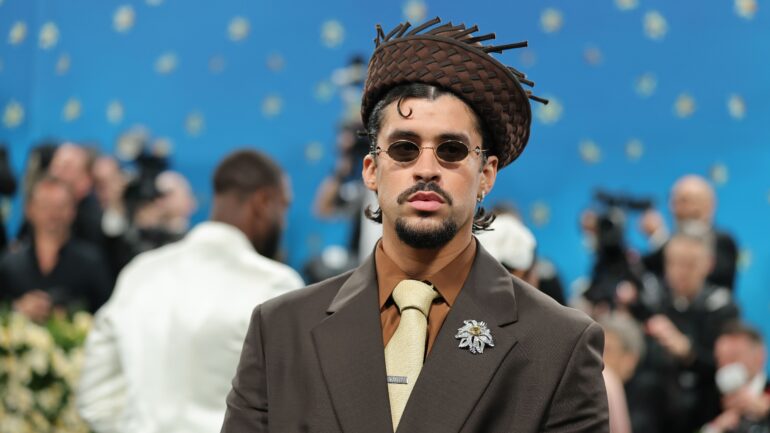
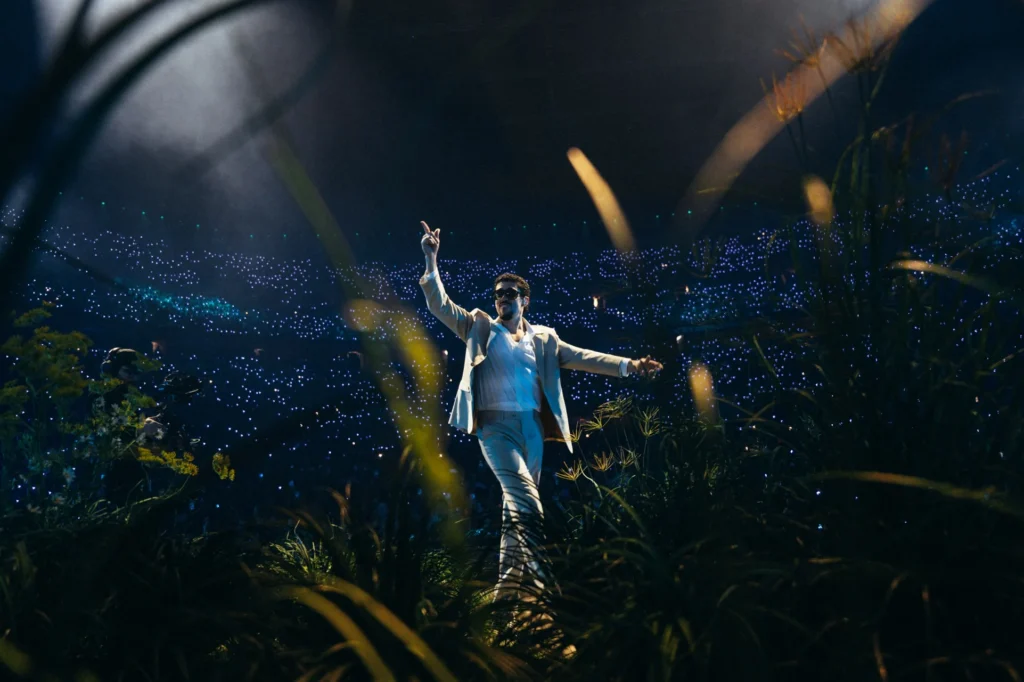
the “Billions Club Live” performance in Tokyo, is available as a concert film on Spotify as of April 8, 2026
There was a time, not long ago, when Benito Antonio Martínez Ocasio was the ultimate disruptor. He was the skirt-wearing, gender-fluid iconoclast who dragged urbano from the carousels of San Juan to the main stage of Coachella. He was the artist who famously declared he would never record in English just to appease the American market, a stance that felt like a radical act of cultural preservation. Yet, as the lights dimmed for the filming of his Spotify Billions Club concert film in early 2026, the tension was palpable. The man who once stood as the antithesis of the industry machine was now the centerpiece of a corporate victory lap—a glossy, high-production monument to the very metrics that have come to define modern success.
The shift is subtle but profound. Bad Bunny hasn’t “sold out” in the traditional sense; rather, he has become the institution itself. The Spotify Billions Club special isn’t just a concert film; it is a coronation ceremony for a new kind of monarch—one whose crown is forged not from critical consensus or counter-cultural rebellion, but from the relentless, algorithmic logic of the stream.
From the Underground to the Algorithm: A Timeline of Domination
The trajectory of Bad Bunny’s career serves as a roadmap for how Latin music moved from a “crossover” novelty to the global default.
- The SoundCloud Catalyst (2016-2018): In his early years, Bad Bunny was the face of the Latin Trap movement. Songs like “Soy Peor” were characterized by a raw, nihilistic energy. He was the weirdo with the shaved head and the painted nails, an aesthetic that Billboard noted was a stark departure from the hyper-masculine tropes of reggaeton’s forefathers.
- The Global Pivot (2020-2022): During the pandemic, Bad Bunny achieved a level of ubiquity rarely seen in any language. With the release of YHLQMDLG and El Último Tour Del Mundo, he became the most-streamed artist on Spotify for three consecutive years. His symbolism shifted from the “outsider” to the “global superstar,” punctuated by his appearance in major Hollywood films and high-fashion campaigns.
- The Institutional Era (2024-2026): By the time he began filming the Billions Club special, the narrative had crystallized. After the more experimental and divisive Nadie Sabe Lo Que Va a Pasar Mañana, Benito pivoted back to a presentation that felt designed for the platform. The concert film represents the ultimate merger of artist and infrastructure. He is no longer just an artist on Spotify; he is the face of Spotify’s global dominance.
The Friction of Success
This evolution has not been without its friction. As Bad Bunny ascended to the “Billions Club”—a designation Spotify uses to celebrate songs that surpass one billion streams—the public reaction began to bifurcate. On one side is the industry’s unwavering praise for his ability to maintain a stranglehold on the charts. On the other, a growing segment of his core audience has expressed a sense of “streaming fatigue.”
The controversy surrounding the Billions Club film stems from its inherent nature as a marketing tool. Critics argue that by leaning so heavily into the Spotify branding, the art becomes secondary to the achievement. Peer reactions have been telling as well; while contemporaries like J Balvin have faced their own struggles with relevance, Benito has managed to stay on top, but at the cost of the “everyman” persona that made Un Verano Sin Ti a cultural touchstone. The media framing has moved from “Can a Spanish-language artist run the world?” to “What happens to the world when one artist is everywhere?” This ubiquity has sparked a backlash from those who feel the “algorithmic pop” sound is flattening the very cultural nuances Bad Bunny once championed.
The Strategy of Relevance
Benito himself has been uncommonly transparent about this transition. In various interviews and lyrics, he has hinted that his moves are calculated risks in a game where the only sin is being forgotten. During the press cycle for his 2026 appearances, he suggested that the Billions Club project was about “marking a territory.”
Implicit in his recent work—and the lavish production of the concert film—is an admission that relevance is a currency that must be constantly guarded. By aligning himself with the “Billions” brand, he is making a claim to a legacy that is data-backed and indisputable. It is a pivot from the “puro party” ethos to one of “legacy management.” He isn’t just playing for the fans in the front row anymore; he is playing for the history books of the digital age, where success is measured in decimal points and server space.
The Curation of Authenticity
Zooming out, the Bad Bunny/Spotify partnership reveals a deeper truth about our current cultural moment: the total institutionalization of the “independent” spirit. We live in an era where authenticity is a performance that requires a massive budget.

The Billions Club film is a masterpiece of this paradox. It features “behind-the-scenes” footage designed to feel intimate, yet every frame is polished to a high-fashion sheen. It highlights the “Power, Attention, and Influence” dynamics of 2026. Cultural authority is no longer granted by the gatekeepers of radio or print media; it is self-generated through scale. If you stream it enough, it becomes true.
This reflects a broader shift where artists are expected to be their own CEOs, creative directors, and data analysts. Bad Bunny’s mastery of this ecosystem is what makes him the definitive artist of the 2020s. He understands that in the modern media landscape, being “real” is less important than being “significant.” The Billions Club is the ultimate proof of significance. It is the music industry’s version of a “Too Big to Fail” bank; the infrastructure is now so intertwined with the artist that one cannot exist without the other.
The Weight of the Crown
As the credits roll on the Spotify Billions Club film, the question remains: does this level of institutional success carry the same weight as the cultural movements of the past?
In a landscape where trends move at the speed of a thumb-swipe, Bad Bunny has achieved the impossible by staying at the center of the conversation for nearly a decade. However, by embracing the “Billions” narrative so tightly, he risks becoming a monument rather than a living, breathing artist. The concert film is an impressive display of power, but it also signals a closing of a chapter.
The strategy of total domination has worked, but it leaves little room for the spontaneity and subversion that first made Benito a star. In the high-stakes world of 2026, where the algorithm is king, Bad Bunny has secured his throne. But as any monarch knows, the view from the top can be lonely, and the very systems that built your castle are the ones that can eventually render it a relic of a previous era. Whether his legacy will be defined by the music or the metrics is a question that even a billion streams cannot yet answer.