In the high-stakes theater of professional sports, narratives are often forged in moments of triumph, yet the most compelling stories frequently emerge from the crucible of adversity. For the Los Angeles Lakers, a team steeped in legacy and perpetual expectation, the recent narrative arc has taken a sharp turn, moving from a position of perceived vulnerability to one of defiant resurgence. When leading scorers Luka Doncic and Austin Reaves found themselves sidelined by injury on April 2nd, a collective groan might have been expected. Instead, coach JJ Redick, who admitted the situation felt bleak, witnessed a different reaction from his squad. The Lakers, rather than succumbing to the weight of their absent stars, rallied together, a stark contrast to the individualistic narratives that often dominate sports coverage. This unlikely cohesion propelled them past the Houston Rockets in six games, earning them a Western Conference semifinal berth against the formidable Oklahoma City Thunder. It’s a feat that marks their first trip to the second round since 2023, a period that ended in a loss to the Denver Nuggets in the Western Conference finals.

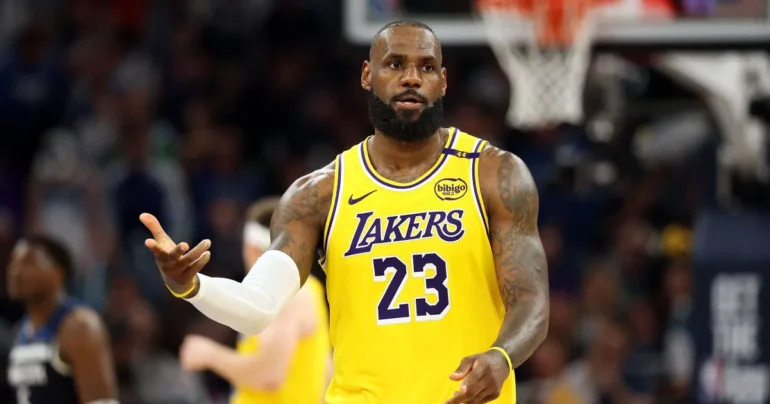
The victory in Game 6, a decisive 98-78 win over the Rockets, was underscored by a tenacious defense that limited Houston to their season low in points. Central to this triumph was the enduring brilliance of LeBron James, who poured in 28 points. His performance, in the face of depleted ranks and mounting pressure, has reignited discussions about his place in basketball history. Redick’s post-game comments, in particular, served as a powerful testament. “It speaks to his greatness,” Redick stated, his voice resonating with admiration. “To me, he’s had the greatest career of any NBA player. You can argue all you want and I really don’t care to postulate on who’s the greatest of all time, but he’s one of, if not the greatest of all time.” This declaration, coming from a prominent analyst and former player, moves beyond mere statistical accolades, framing James’s career as a narrative of sustained excellence and leadership, particularly in times of collective struggle.
To fully grasp the significance of this current Lakers narrative, one must trace the evolution of their public perception and the context surrounding James’s enduring presence. The Lakers, historically, have been a franchise defined by superstar power and championship aspirations. From the Minneapolis Lakers to the Showtime era and the Kobe Bryant years, the expectation has always been immediate contention. James’s arrival in Los Angeles in 2018 was initially met with the understanding that he would carry this championship burden. His early years with the team, while punctuated by a championship in 2020, were also marked by periods of inconsistency and questions about the team’s construction and overall direction, often fueled by intense media scrutiny and the ever-present shadow of the franchise’s storied past. The constant narrative was that the Lakers were either contenders or failures, with little room for nuance.
The mid-period of James’s tenure saw shifts that oscillated between flashes of dominance and periods of rebuilding or navigating injuries. The 2021-2022 season, for instance, was particularly rough, with the Lakers missing the playoffs entirely despite the presence of James, Anthony Davis, and Russell Westbrook. This generated significant backlash, with criticism often directed at James’s perceived influence on team-building decisions and his ability to elevate teammates. The media framing at times painted him as a player whose gravitational pull, while immense, could also disrupt team chemistry if not perfectly managed. The narrative was increasingly centered on whether he could recapture the championship magic with a changing roster and an aging body, a question that loomed large over every Lakers game.
The recent turn of events crystallizes the current narrative with undeniable clarity. The absence of Doncic and Reaves, two pivotal offensive engines, presented a scenario that, on paper, should have signaled the end of their playoff hopes. However, the Lakers’ ability to not only compete but to dominate the Rockets in a close-out game, powered by James and a collective defensive effort, fundamentally alters the perception of the team and its leader. It shifts the focus from individual talent to collective resilience and strategic adaptation. The Lakers’ advancement to the second round, particularly under these challenging circumstances, is not merely a statistical achievement; it’s a testament to a profound organizational and team-wide commitment to overcoming obstacles. This resilience is amplified by James’s continued statistical and leadership prowess, which directly challenges any notion of his decline.
The public reaction to this turnaround has been a mixture of admiration and renewed debate, particularly surrounding the “greatest of all time” (GOAT) conversation that James perpetually finds himself in. For years, his career has been framed by the constant comparison to Michael Jordan, a debate that often overshadows his unique journey. While some fans and analysts have long championed James’s case based on his longevity, statistical accumulation, and adaptability across different eras and teams, others maintain Jordan’s undefeated Finals record and scoring dominance as the ultimate benchmark. Redick’s emphatic endorsement, however, transcends the typical back-and-forth. It positions James not just as an individual contender for the GOAT title, but as an embodiment of greatness itself, a player whose impact is so profound that it resists easy categorization or comparison. This is a significant shift in how James’s legacy is being discussed, moving from a competitive ranking to an acknowledgment of his singular impact on the sport.
The cultural analysis here extends beyond the hardwood. In an era saturated with fleeting trends and performative authenticity, James’s sustained relevance offers a compelling case study. The modern media ecosystem thrives on novelty and disruption, often prioritizing the loud and the ephemeral over the enduring and the substantive. Yet, James has navigated this landscape for over two decades, consistently adapting his game and his public persona while maintaining an elite level of performance. His current positioning, especially in the Lakers’ recent success, speaks to the evolving nature of cultural authority. It’s no longer solely about peak performance or singular iconic moments, but about sustained impact, adaptability, and the ability to inspire collective action. The narrative of James, particularly in this playoff run, is one of a seasoned master craftsman, demonstrating that deep-seated skill, leadership, and resilience can still command attention and respect, even in an attention-scarce world.

This season, more than many others, highlights the tension between relevance and legacy. For James, the relentless pursuit of relevance – the ability to still command the court, to be the primary decision-maker, to lead his team deep into the playoffs – is inextricably linked to his legacy. He is not content to coast on past glories; he is actively shaping his historical narrative with every game played. His leadership in the absence of key players suggests a strategic evolution, a testament to his enduring understanding of the game and his teammates. This performance challenges the conventional wisdom that older athletes must transition to a supporting role. Instead, James is demonstrating that sustained elite performance, coupled with profound leadership, can redefine expectations of aging in professional sports.
The cultural moment is also defined by the complex relationship between authenticity and performance. Is James’s leadership a calculated performance for the cameras and the narrative, or is it an authentic expression of his competitive drive and his connection to the Lakers franchise? The distinction, perhaps, is becoming increasingly blurred. What matters is the outcome and the inspiration derived. His ability to rally his team, to deliver under pressure, and to command respect from coaches and peers alike, regardless of its performative or authentic origins, holds significant cultural weight. It underscores how in contemporary culture, the effectiveness of a performance can often be the ultimate arbiter of its perceived authenticity.
Ultimately, LeBron James’s current standing, bolstered by the Lakers’ hard-fought playoff progress, presents a compelling question about the enduring power of established cultural figures in a rapidly changing environment. While the discourse often gravitates towards the next big thing, the disruptive force, or the flash-in-the-pan sensation, James’s career serves as a powerful counter-narrative. His ability to remain at the pinnacle of his sport, to adapt and lead through multiple eras, and to inspire a level of collective effort from his team, even in the face of significant adversity, suggests that true greatness, when sustained and adaptable, retains its resonance. The question for the future, however, is whether this enduring influence can continue to captivate audiences and shape cultural conversations as the landscape of sports, media, and public attention continues its relentless evolution.