In the modern streaming era, the music industry operates on a meticulous, heavily engineered conveyor belt. Labels demand multi-month rollout campaigns, TikTok-optimized snippets, and carefully spaced release windows to maximize quarterly profits.
Then there is Aubrey Drake Graham.
At midnight on Friday, May 15, Drake didn’t just drop a new project. He dropped an entire ecosystem. In a staggering, unprecedented blitz, the Toronto megastar surprise-released three full-length solo albums simultaneously: Iceman, Habibti, and Maid of Honour. Clocking in at a gargantuan 43 tracks total, the trilogy effectively broke the internet, sent streaming platform servers into a tailspin, and completely disrupted the industry’s release mechanics.
By sunrise, the math became undeniable: Drake is poised to become the first artist in history to concurrently occupy the Top 3 spots on the Billboard 200 albums chart. It is a flex of pure cultural dominance, but beneath the musical onslaught lies a calculating, corporate chess move that has left executive suites in a state of absolute panic.
Breaking Hearts at Santa Monica
Behind the scenes, the chatter among music business insiders isn’t just about the streaming numbers—it’s about the contracts. Rumors had been swirling that Drake faced a steep multi-album requirement to fulfill his heavily publicized, estimated $400 million megadeal with Universal Music Group (UMG). By delivering three distinct, full-length LPs in a single night, Drake didn’t just deliver music; he delivered a masterclass in corporate evasion.
What makes the move so fascinating is that it carries the same energy hip-hop fans romanticize in “beating the system,” but Drake executes it with discipline instead of destruction. Where Pooh Shiesty became a cautionary tale of pressure, impulsiveness, and consequences that ultimately landed him behind bars, Drake appears to have mastered the corporate game without ever publicly losing composure. No explosive fallout. No desperate standoff. Just timing, leverage, and calculated dominance. If the theory surrounding these releases is true, Drake may have fulfilled years of contractual obligations in a single night — transforming what should have been business paperwork into a historic cultural event. It’s the kind of move that doesn’t just disrupt the music industry; it reframes the balance of power between artist and label entirely.
The tension between the superstar and the corporate giant was palpable on release morning. As late as 11:00 AM EST, all official UMG corporate social media accounts were noticeably, blindingly silent regarding the biggest musical event of the year. Instead, the promotional heavy lifting was left entirely to UMG’s sub-labels, like Republic Records and OVO Sound.
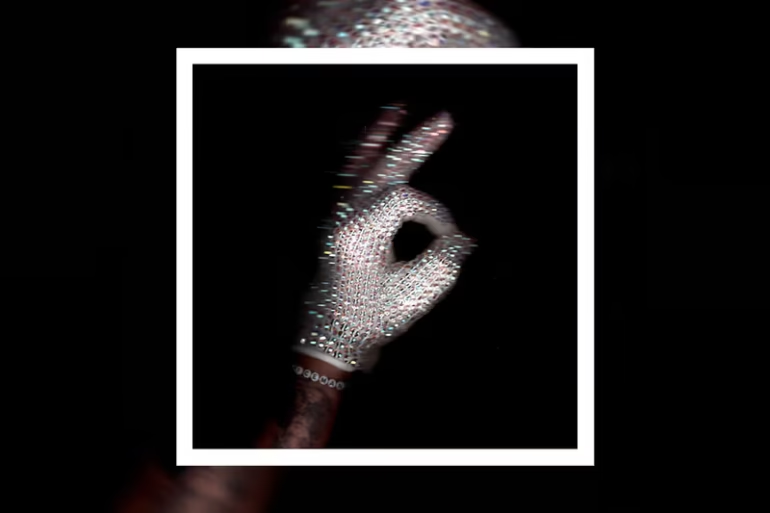
For Drake, the silent treatment from corporate headquarters is a badge of honor. On tracks like “Make Them Pay,” he explicitly raps about his desire for liberation from the major label system. If the album artwork for Iceman—a single hand donning a singular, sequined Michael Jackson glove—is any indication, the King of Pop reference is a clear nod to his next move as a global free agent. The industry is already whispering the ultimate question: Is Sony waiting in the wings with a historic independent distribution partnership, or is Drake preparing to become the machine itself?
The Architecture of a Marketing Genius
While the corporate suits scramble, the rollout leading up to May 15 proved that Drake’s marketing genius operates on the exact same high-altitude plane as his musical instinct. This wasn’t a standard rollout; it was an interactive, high-concept urban thriller.
- The Courtside Freeze: It began when Drake showed up to Scotiabank Arena for a Toronto Raptors game, sitting in courtside seats that had been completely encased in custom, high-contrast faux ice.
- The Toronto Scavenger Hunt: Days later, a massive, 25-foot-tall ice sculpture was erected in downtown Toronto. Madness ensued as hundreds of fans took pickaxes, hammers, and lighters to the monolith in a city-wide scavenger hunt, eventually revealing a hidden bag containing the May 15 release date.
By treating his release like a blockbuster film premiere, Drake bypasses traditional media and label-funded marketing entirely. He proved that when you have a direct pipeline to the culture, the traditional machine is obsolete.
Drake's 3-Album Drop At A Glance:
======================================================
1. ICEMAN         | 18 Tracks | The Rap & Diss Heavyweight
2. HABIBTI        | 14 Tracks | Global Sound & R&B Inflections
3. MAID OF HONOUR | 11 Tracks | Late-Night Introspection & Pop
======================================================
The Music: Culmination, Contradiction, and an Unlikely Reunion
Musically, the trilogy feels like the ultimate culmination of the Drake ethos. For years, listeners have argued over which version of the artist they prefer. This three-tiered release solves the debate by giving every era of Drake its own dedicated canvas.

We finally receive the return of the introspective, fearless, self-admitting songwriter. The emotional vulnerability and late-night transparency that made women around the world fall in love with “Young Drake” anchor the softer corners of Maid of Honour and Habibti. Yet, the hardened, street-aligned, mob-tied version of the 6 God still commands authority. On the Iceman standout track “B’s on the Table” featuring 21 Savage, Drake reminds audiences that his ties to the concrete are as sharp as ever, trading menacing, clinical verses over a ominous, subterranean bassline.
But the true jaw-dropper of the entire release arrives on the track “Ran to Atlanta.” In a twist of pure poetic irony, the song features a guest appearance from longtime collaborator Future.
Given that Future was the co-pilot on Metro Boomin’s We Don’t Trust You—the very project that ignited the explosive, multi-platinum feud between Drake and Kendrick Lamar—his presence here is a cultural earthquake. Whether the track was recorded pre-feud or represents a quiet, lucrative truce behind closed doors, hearing Drake and Future back on a track together signals a massive tectonic shift in hip-hop’s political landscape.
Instant Classics and the Return of the Turn-Up
If Iceman is the armor, then the individual tracks are the weapons. Among the gargantuan tracklist, “Shabang” stands out as an immediate, undeniable classic. The track leans heavily into a nostalgic, high-energy trap bounce, utilizing signature, chaotic ad-libs from the Migos lineage to create an infectious anthem tailored for stadium speakers and summer club nights. It’s Drake at his most effortless, catching a pocket and riding the production with the confidence of a man who knows he’s untouchable.
With 43 tracks to digest, the world will be dissecting the lyrical Easter eggs, the subliminal shots at rivals, and the corporate implications of this release for months to come. But on day one, the narrative is singular. Drake defied his label, overloaded the culture, and reasserted his position at the absolute top of the food chain.
The machine tried to box him in. Drake just bought the arena.