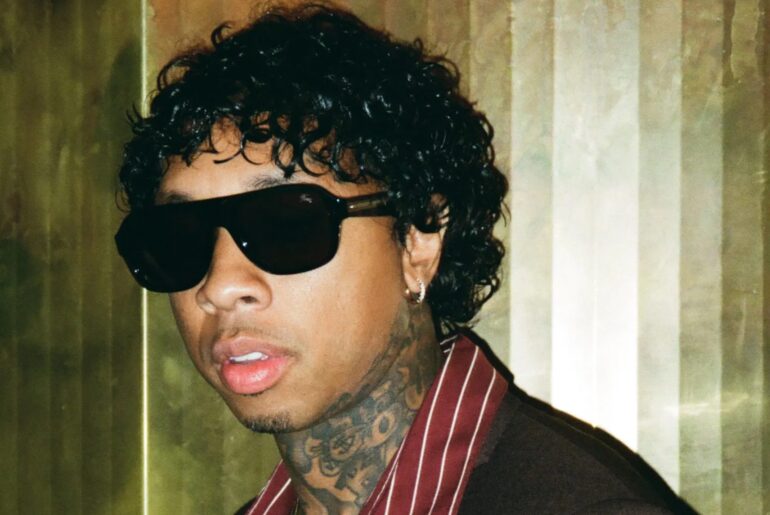
There is something almost fascinating about how bad Tyga’s $tarface is—not because the concept was doomed from the beginning, but because it was actually the best thing about it. Tyga wanted to create an ’80s-inspired alter ego, stepping away from the rapper audiences know and building a cinematic synth-pop and R&B world around himself. On paper, that sounds like exactly the kind of ridiculous left turn that could produce something great. Instead, it sounds like an elaborate piece of unintentional satire that nobody told him was supposed to be funny.
The biggest problem isn’t even the writing; it’s the complete lack of collaboration. Tyga confirmed that AI was used as a tool throughout the project for synths and guitar parts, while maintaining the vocals are his own. Honestly, that explains why the production is frequently much better than the actual performance. The beats are crisp, retro, and surprisingly competent—the AI wallpaper provided a functional skeleton. But the moment Tyga actually starts singing, the entire thing falls apart.
There is a difference between an artist intentionally stepping outside of their comfort zone and an artist entering a genre without bringing anybody from that genre into the room. $tarface desperately needed pop songcrafters, R&B vocalists, and someone who knows what sounds good coming out of a human mouth. Imagine these records handed to a faded ’80s pop star looking for a second act, or an R&B singer with a genuine vocal identity. Imagine Tyga leveraging this concept to tap into the massive Bravo and Real Housewives audience, the nostalgia crowd, or the fashion-forward space where artists like Sophie Ellis-Bextor or Ravyn Lenae thrive. By keeping the creative circle as small as possible—presumably in an effort to hoard every single publishing split—he accidentally isolated himself into pure comedy.
What makes this record an abysmal performance is that it burns the bridge behind it. You cannot simply put on the old uniform and return to 2011; you can’t just go backward to the “Rack City” sound. Ironically, Drake even referenced the track on his recent release “2 Hard 4 the Radio,” taunting Mustard to get back to that level. The line wasn’t necessarily aimed at Tyga, but the timing is almost comically relevant. Tyga can’t go back, but he clearly can’t go forward alone either.
Great records are collaborative. Sometimes the person who makes a song great isn’t the person who wrote it—it’s the vocalist who brings the soul, or the executive producer brave enough to say, “No, that line is terrible, and you shouldn’t be singing it.” $tarface sounds like an album where nobody said “no.” The ideas buried inside this project could have been incredible if Tyga had stepped up as an executive producer of a new world rather than insisting on being the entire cast. Artists don’t lose relevance simply because music changes; they lose relevance when they stop collaborating with the people who understand where it’s going. Tyga had the opportunity to step into an entirely new lane, but he decided to walk into the genre all by himself, and the result is disastrous.