Consider, for a moment, the cupboard — maybe in the spirit of irreverence we should term it a closet — in which, for 30-odd years, lay undisturbed the footage that future star cinematographer Seamus McGarvey (Atonement, Die, My Love) shot behind the scenes of Derek Jarman’s 1991 movie Edward II. Consider then, the opening of this documentary, a portal to the early ’90s that captures and liberates Derek Jarman’s trailblazing spirit.
This film offers a unique glimpse into the creative process behind Jarman’s radical adaptation, bridging raw behind-the-scenes reportage with the sociopolitical friction of early-1990s Britain. Directed by Theo Rollason, Queer Edward II weaves McGarvey’s candid 16mm footage into an intimate portrait of independent filmmaking, queer activism, and artist resilience.
A Fly-on-the-Wall Time Capsule
The documentary shines brightest when capturing the everyday logistics and chaotic charm of Bray Studios. Viewers watch the humdrum machinery of low-budget cinema unfold: crew members adjusting ladders, workers wrestling with set pieces, and producers agonizing over tight budgets and extra pay. Amid the production hustle, legends-in-the-making move casually through the frame. A 30-year-old Tilda Swinton wanders the lot in preparation for the performance that would win her the Volpi Cup at Venice, while costume designer Sandy Powell and composer Simon Fisher Turner go about their craft.
Art as Direct Action
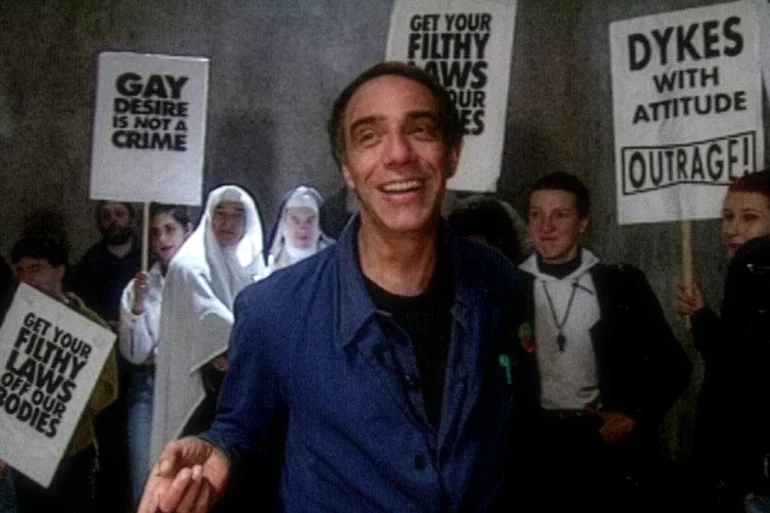
For Jarman, who had been diagnosed with HIV five years prior and was living under the shadow of Section 28, art and political resistance were inseparable. Queer Edward II highlights how Jarman deliberately blurred these lines by inviting real-life OutRage! activists—led by Peter Tatchell—to play King Edward’s army on set.
The film recounts one of the production’s most bizarre footnotes when a group of these activist extras stormed an adjacent studio on their lunch break to confront pop star Cliff Richard, demanding he publicly come out. The resulting media frenzy and threat of legal action sent producers into a panic, yet Jarman remained famously serene, regarding the turmoil with a sly, amused detachment.

The Heart of the Director
What ultimately elevates Queer Edward II is the effortless warmth of its central figure. Jarman emerges not as a frantic auteur, but as a deeply calm, beaming presence directing with quiet confidence and sharp wit. Whether joking with McGarvey about making a “mainstream” movie or quietly taking his daily medication between takes, Jarman’s radical openness anchors the entire feature.
While occasional tangents and circular conversations slow the documentary’s midsection, Queer Edward II stands as a vital piece of non-fiction reportage. It serves as both an essential document of 1990s British queer cinema and a fitting tribute to an artist who met political oppression with fearless creativity.