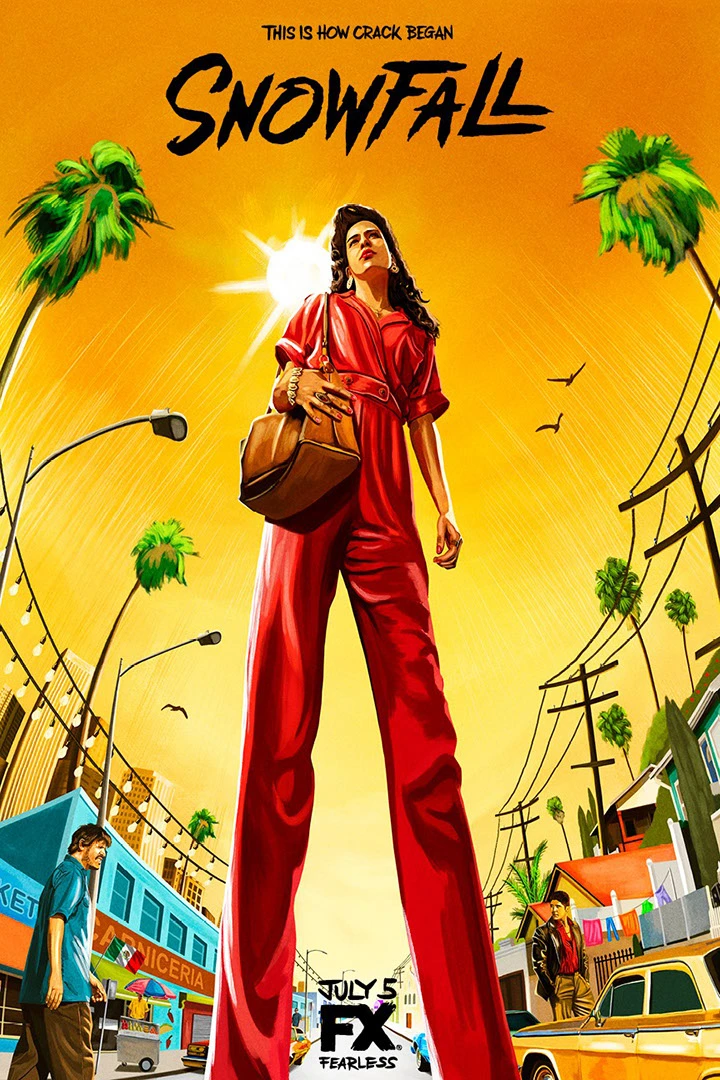
Long before Snowfall became one of FX’s defining dramas, before Franklin Saint built his empire across South Central Los Angeles and the series connected the crack epidemic to the CIA’s covert war in Nicaragua, the show existed in a much different form. John Singleton, Eric Amadio and Dave Andron had conceived a sprawling drama about the birth of the crack era, but the version that eventually reached television was separated from its earliest incarnation by a development process that reshaped nearly every major element of the series — its cast, its characters, its tone and, ultimately, the way its story was told.
The earliest version of Snowfall was built around a larger ensemble and a different dramatic center. Billy Magnussen was attached to play Logan Miller, a wealthy young man described as a prodigal son whose desperation to escape his father’s shadow brought him into the emerging cocaine economy. Damson Idris was already attached as Franklin Saint, while Sergio Peris-Mencheta had been cast as Gustavo “El Oso” Zapata. The three characters represented dramatically different paths into the same expanding world: Franklin was a young South Central hustler looking for an opportunity, Gustavo was a Mexican wrestler being pulled into organized crime, and Logan came from a world of wealth and privilege but saw the drug trade as a way to establish an identity of his own.
The supporting cast reflected just how expansive that original conception was. Jill Scott was considered for Cissy Saint and Lauren London was attached as Louie before Michael Hyatt and Angela Lewis ultimately took those roles. Other actors who appeared in early versions of the project included Camila Banus as Lucia Villanueva and Andrew Howard as Avi Drexler, while DeRay Davis was initially associated with Jerome. Some of those characters survived the redevelopment, but the relationships surrounding them changed considerably as FX began narrowing its focus.
Singleton’s involvement gave the project an unusual authenticity from the outset. The filmmaker had already made Boyz n the Hood, and his understanding of Los Angeles gave Snowfall a perspective that went beyond simply recreating the aesthetics of the 1980s. The story was being built around a city he knew, a community he understood and an epidemic whose consequences would eventually reshape American culture. When FX moved forward with the project, however, the network did not simply take the existing pilot and prepare it for broadcast. The material was subjected to a substantial redevelopment process that ultimately required the pilot to be rewritten and reshot.
That process became particularly consequential for Dave Andron, who had been developing the project alongside Singleton and Amadio and would eventually become the series’ showrunner. The challenge was not simply making the material darker or lighter. Snowfall was dealing with an inherently grim subject — the emergence of crack cocaine in Los Angeles, the violence surrounding its distribution and the political machinery operating behind the scenes — and the creators needed a structure that could sustain that darkness for an entire series without flattening its characters into symbols. Andron’s approach was to give the drama more humanity and tonal variation, creating the kind of warmth and dark humor that could make the brutality land harder rather than simply exhausting the audience.
The most visible evidence of that redevelopment was the disappearance of Magnussen’s Logan Miller. A character who had once been positioned near the center of the story was removed from the core ensemble, fundamentally changing the balance of the series. The government storyline was also reconfigured around Carter Hudson’s Teddy McDonald, giving the CIA operation a much more defined presence and creating the three-world structure that eventually became one of Snowfall‘s most important storytelling devices: Franklin’s rise in South Central, Gustavo’s movement through the cartel world and Teddy’s increasingly compromised covert operation.
The directorial transition reinforced the scale of the change. Singleton, who had directed the earlier version, stepped away from directing the reshot pilot while remaining deeply involved in the series as a writer and executive producer. Belgian filmmakers Adil El Arbi and Bilall Fallah were brought in to direct the new pilot, giving the project a different visual language while the underlying story was being reconstructed around a new dramatic architecture.
By the time Snowfall arrived on FX, viewers were therefore watching the product of a development process that had effectively produced two different versions of the same series. The original conception had been broader and more heavily populated, with Logan serving as an important bridge between the worlds of privilege and the emerging drug economy. The finished series was more disciplined about its central characters and increasingly interested in the machinery connecting them. Franklin was no longer simply one part of an ensemble; he was becoming the gravitational center of the entire story, while Teddy’s CIA operation provided the larger geopolitical explanation for the cocaine pipeline that was transforming Los Angeles.
That history also explains why the original pilot has become something of a Snowfall holy grail for fans. Unlike a deleted scene or an alternate cut that eventually appears as a bonus feature, the earlier version has remained largely inaccessible to the public. There is no widely available official release of the footage, leaving the surviving scripts, casting records, production reports and archival material as some of the only ways to reconstruct what the show once looked like.
What survives on paper is enough to make the differences striking. Logan Miller existed in a form that audiences who only know Snowfall through Franklin, Teddy and Gustavo would barely recognize. Cissy and Louie went through different casting iterations. Lucia and Avi were already part of the show’s DNA. Franklin and Gustavo were there from the beginning, even as their relationships to the larger story evolved. The eventual series was therefore not created from scratch after the original pilot failed; it emerged by stripping away pieces of the first version and strengthening the elements that proved capable of carrying the story forward.

That is what makes the unreleased pilot more interesting than a simple piece of lost television. It represents the moment when Snowfall was still trying to determine what kind of story it wanted to be. Singleton’s original conception supplied the subject matter, the city and much of the show’s emotional foundation. FX’s redevelopment supplied a tighter structure, a new visual approach and a more interconnected narrative. Andron’s role became increasingly important in turning those pieces into a series that could move between intimate family drama, street-level crime and international politics without allowing any one of those worlds to overwhelm the others.
By the time Snowfall premiered, the seams were invisible. Franklin, Gustavo and Teddy felt as though they had always belonged together, their separate stories gradually revealing themselves as parts of the same machine. The fact that the series had required such a fundamental reconstruction to arrive at that structure is almost impossible to see from the finished product.
Somewhere before the version audiences know existed, there was another Snowfall — one with Logan Miller at its center, a larger ensemble surrounding him and John Singleton directing the story as he originally imagined it. That pilot never became the series. But its fingerprints remain all over the one that did.
And in the end, the lost version may be the clearest evidence of how much work went into making Snowfall look inevitable.