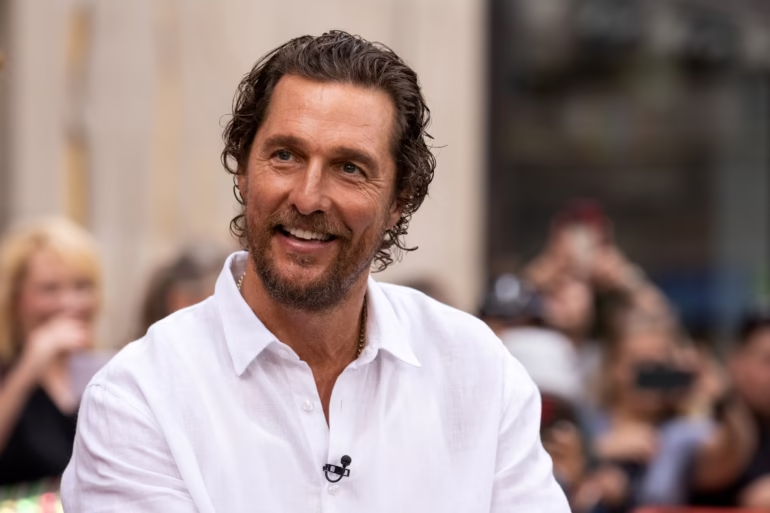
Imagine a movie star with an estimated $200 million fortune packing a stack of bad reviews and driving into the desert for a weekend of reading. That is the image Matthew McConaughey gave us when he admitted that, after poring over two decades of negative criticism, some of those critiques “had a point.” The scene is arresting because it upends the usual celebrity script: not defensive outrage, but a deliberate act of listening.
McConaughey’s career has long threaded between populist hits and prestige pivots, and with that trajectory comes an inconsistent chorus of praise and disdain. The very visibility that fuels his brand also ensures that every misstep is magnified. Taking time to catalogue criticism is, on its face, a humble choice—and it reads as a form of self-examination from someone who has, by all measures, already won in Hollywood.
That history matters. Critics respond to a body of work as much as to isolated performances, and stars who move across genres are especially liable to attract sharply differing verdicts. For McConaughey, reading those negative takes is less about contrition and more about reconciling how his public persona and his craft are perceived. When a performer of his stature concedes critics ‘had a point,’ it shifts the conversation away from victim narratives and toward the possibility that critique can be constructive.
There are plausible motives for such a ritual. On one level it is straightforward humility: an acknowledgement that success does not erase bad choices. On another it can be tactical, a way to separate signal from noise in an era when social media amplifies every grievance and aggregates every score. And, candidly, it risks being performative—an anecdote that polishes a public image of grown-up reflection without guaranteeing real change.
But the act itself points to something more interesting about contemporary fame. The feedback loop surrounding actors now includes traditional critics, mass audience ratings, streaming metrics and relentless social chatter. Each of those inputs can steer casting decisions and public perception. McConaughey’s desert exercise looks like an attempt to intervene intentionally in that loop: to hear the criticism on his own terms rather than through the secondhand fog of headlines and hot takes.
There is also a cultural dimension tied to persona. McConaughey has cultivated a particular brand of folksy philosophy and self-help–adjacent aphorisms. Choosing to sit with criticism reframes familiar performative tropes as an inward practice rather than mere image management. It suggests that accountability, when genuinely taken on, can be a resource for an artist trying to recalibrate how they show up on screen and in public.

Of course, admitting that some critics had a point does not automatically translate to different creative choices. The proof will be in what comes next: the roles he accepts, the collaborations he pursues and whether his work leans into risk or retreat. Even so, the spectacle of a high-earning star voluntarily reading his own bad reviews models a kind of humility that is rare in public life.
At a moment when celebrity culture often swings between entitlement and performative mea culpas, McConaughey’s desert weekend feels quietly subversive. It doesn’t erase the gap between box-office success and critical approval, but it does offer a template—imperfect, human—for how a public figure might reckon with criticism without collapsing into cynicism or defensiveness. If anything, it reminds us that listening can be a creative act, and that being attuned to critique might be the first step toward doing better work.