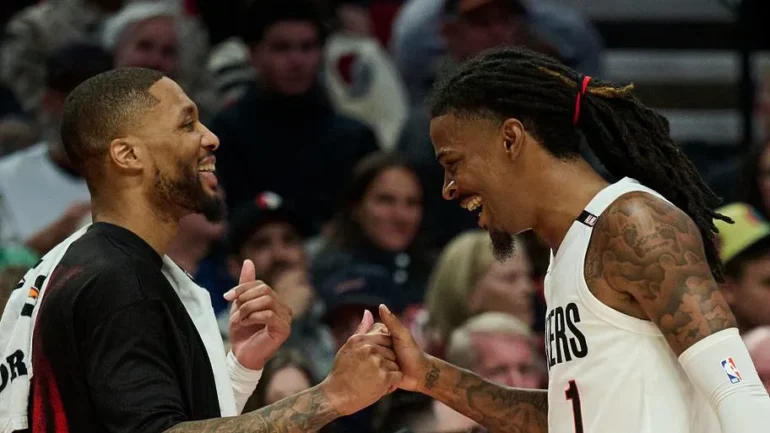
Damian Lillard and Ja Morant made an emphatic first impression in Portland’s 2026-27 opener on October 22, steering the Trail Blazers to a 124-83 rout of the Phoenix Suns. The final score masked a more important takeaway: a clear schematic fit that combined elite spacing with dynamic creation.
The stat line was efficient and complementary. Lillard finished with 25 points on 7-of-12 shooting, drilling 6-of-10 from three and handing out 6 assists in just 24 minutes. Morant chipped in 14 points on 6-of-8 shooting, added 8 assists, 5 rebounds and 3 steals in 23 minutes. Those numbers underscore two things at once — high offensive efficiency and immediate playmaking synergy.
On the court, Lillard operated primarily as the gravity engine. His deep shooting consistently forced Phoenix defenders to step out, which in turn opened lanes for Morant to attack downhill. Morant’s ability to break the first line of defense created kick-outs and collapse opportunities that Lillard and Portland’s shooters could exploit. The result was an offense that generated high-percentage looks without relying on volume isolation possessions.
Defensively, Morant’s three steals signaled active hands and timely disruption, and Portland’s rotations looked coordinated enough to turn stops into transition chances. Both stars logged limited minutes — 23 and 24 respectively — a sign of controlled load management in a game that tilted early. That minute restraint allowed the Blazers to build a large cushion while protecting their new core.

Tactically the debut validated the core premise behind the pairing: Lillard’s long-range threat amplifies Morant’s drive-and-create strengths, and Morant’s playmaking generates the spacing Lillard needs to be lethal from deep. The primary questions now are whether Portland can maintain defensive consistency against stronger opponents and how the coaching staff will balance minutes and usage over the long haul.
One game is a limited sample, but this performance offered concrete reasons for optimism. If the Blazers keep their stars healthy and refine rotations around this backcourt chemistry, the team’s identity could shift quickly toward a high-octane, spacing-first attack. The next few games will tell whether this debut was a blueprint or an outlier, but for now Portland has a promising new axis to build around.