The NBA’s modern era has long been sold as a frictionless, “positionless” utopia—a world where seven-footers operate like point guards and traditional roles are dismissed as relics of a rigid past. For years, the league’s “hype beast” contingent has championed the idea that specialized skills are secondary to interchangeable length. But in the high-stakes vacuum of the Western Conference quarterfinals, that glossy narrative collided with a 220-pound reality named Marcus Smart. While the Houston Rockets attempted to navigate the closing seconds of Game 3 with a frontcourt-heavy lineup lacking a true floor general, Smart didn’t just play defense; he performed an autopsy on the very concept of positionless basketball.
The Evolution of the Grinder
Marcus Smart’s reputation was forged in the fires of the Boston Celtics’ gritty defensive culture. During his early tenure, he was the archetypal defensive specialist, a player whose value was often obscured by a lack of traditional shooting efficiency but highlighted by “winning plays” that didn’t always show up in the box score. He was the Defensive Player of the Year who proved that a guard could anchor a championship-level defense through sheer force of will and IQ.
However, as the league shifted toward a premium on high-volume scoring and “unicorn” versatility, Smart’s role began to be viewed with skepticism. Critics, including vocal personalities like Gilbert Arenas, questioned whether a “grit-and-grind” guard could remain a centerpiece on a modern contender, especially when compared to the flashy, AirPods-tucked-in aesthetic of new-age stars like LaMelo Ball. The mid-period of Smart’s career was defined by this ambiguity: was he a relic of a dying breed of “enforcers,” or was he the missing ingredient for a team with championship aspirations? His move to the Los Angeles Lakers was met with raised eyebrows, framed by many as a desperation play for veteran leadership rather than a tactical masterstroke.
The Houston Collapse: A Case Study in Specialization
The tension surrounding Smart’s utility crystallized in the final 27.8 seconds of Game 3 at the Toyota Center. The Houston Rockets, having clawed back from a 15-point deficit, were on the verge of making the series competitive. But without a dedicated point guard on the floor to navigate the “clutch time” pressure of “Choke City,” the Rockets’ structural flaws were exposed.
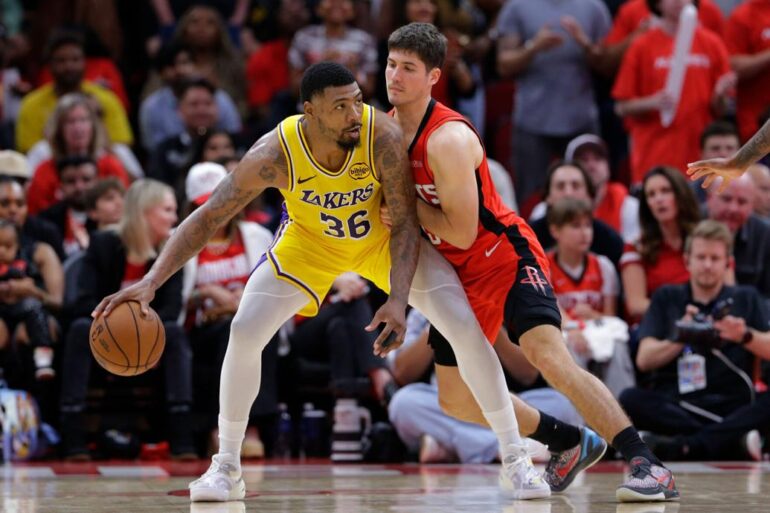
Jabari Smith Jr., a power forward thrust into the role of an “unnatural ball handler” by the demands of a positionless scheme, found himself trapped in a backcourt nightmare. As the Houston bench implored him to cross half court, Smart—the lone defender in the backcourt—didn’t just guard the ball; he manipulated the space. When Smith lofted a desperate “lollipop” pass toward Amen Thompson, Smart’s veteran savvy took over. He intercepted the pass, drew a critical foul on Jae’Sean Tate, and calmly sank three free throws to turn a two-possession deficit into a manageable one-score game.
The ensuing collapse was a domino effect of missing roles. Without a primary initiator to steady the ship, the Rockets surrendered a backcourt steal to LeBron James, leading to a game-tying three-pointer. By the time the game reached overtime, the Rockets were playing “panic mode” defense, with the diminutive Reed Sheppard forced into mismatches against James. Smart, meanwhile, sat in the corner, a looming threat that forced Houston into rotations they couldn’t complete. The result was a 112-108 Lakers victory and a commanding 3-0 lead.
The Instinctual Veteran vs. The Performance Narrative
Public reaction to Smart’s performance has been a mix of vindication and critical reassessment. While Houston fans grapple with the realization that their roster’s lack of a traditional “floor general” made stars like Kevin Durant look uncharacteristically pedestrian—drawing comparisons to TJ Warren’s bubble run rather than his usual MVP self—the broader basketball media has been forced to acknowledge the “Smart Play.”
Smart himself leaned into the narrative of the “vet savvy” in his post-game remarks. “Just make a play—my instincts, right?” he noted, explaining how he “stunted” to force Jabari Smith into “no-man’s-land.” This wasn’t a player relying on physical gifts alone; it was a 12-year veteran using “tricks” picked up from a decade of high-level competition. His self-admission of “instincts” highlights a crucial divide in the modern NBA: the difference between players who can do everything on paper and those who know exactly what to do when the clock is winding down.

Cultural Analysis: The Utility of Roles in an Age of Flash
This moment reveals a deeper cultural friction within professional sports. We are currently living in an era that prizes “relevance” and “aesthetic” over functional legacy. The “AirPods in” style of play—defined by individual flair and highlights—often fails to translate to the gritty, unglamorous work required in the playoffs. The Rockets’ failure isn’t just a coaching mishap; it’s a failure of the “positionless” ideology that suggests anyone can do anything if they are athletic enough.
Cultural authority in the NBA is often granted to the “unicorns”—the players who break the mold. But Marcus Smart represents the return of the specialist. His impact proves that while point guards might score more now than in the 1960s, the role of the point guard—the ability to handle pressure, manage the clock, and manipulate a defense—remains an essential mechanic. In a media ecosystem that often rewards provocation and “hype beast” narratives, Smart’s performance is a sober reminder that authenticity in basketball isn’t found in a pre-game tunnel walk, but in the ability to “ice a game” when the lights are brightest.
The Weight of Strategy
As the Lakers look toward a potential sweep, the conversation around Marcus Smart has shifted from his “fit” to his “necessity.” In a changing environment where teams are increasingly obsessed with finding the next versatile wing, the Lakers found success by leaning into a player who understands the nuances of a specific, defensive-minded role.
The strategy of “positionless” basketball remains an alluring dream for front offices, but Game 3 served as a definitive argument for the importance of traditional basketball IQ. Whether the Rockets can learn this lesson before their season ends at Toyota Center remains to be seen. For now, Marcus Smart stands as the architect of a chaos that he alone seems to know how to control, proving that in the NBA, identity is nothing without utility.
The question for the rest of the league is whether they will continue to chase the ghost of “positionless” versatility, or if they will recognize that when the playoffs arrive, the smartest man on the floor is usually the one who knows exactly where he belongs.