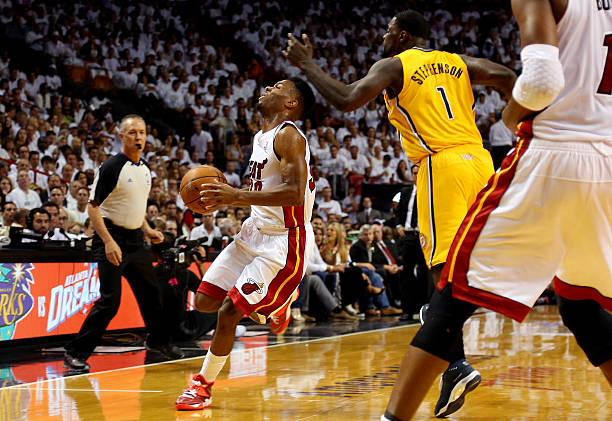
Norris Cole, a former NBA player, has recently made a striking claim, asserting that his former agent, Rich Paul, cost him approximately $80 million in career earnings. This assertion stems from a contract dispute during his 2015 restricted free agency with the New Orleans Pelicans. While Cole accepted a one-year, $3.03 million qualifying offer from the Pelicans, he believes the fallout from his agent situation and a subsequent detour to play in China significantly hampered his earning potential. This article will delve into the specifics of Cole’s claim, examining historical NBA contract data, player statistics, and market comparisons to assess the validity of his assertion.
The contract dispute at the heart of Cole’s claim revolves around his 2015 restricted free agency. After being traded to the New Orleans Pelicans, Cole accepted a $3.03 million qualifying offer for the 2015-16 season. This decision, he argues, was a pivotal moment that led to a cascade of events costing him tens of millions of dollars. The narrative suggests that issues with his representation and a decision to play overseas instead of pursuing further NBA opportunities directly impacted his long-term financial trajectory.
Cole’s NBA career began with the Miami Heat, where he was drafted in 2011. His statistics over his first few seasons showed him as a developing guard, averaging between 5.6 and 6.8 points per game. Before his trade to New Orleans in the 2014-15 season, his scoring hovered around 6.3 points per game. Upon joining the Pelicans, Cole saw an uptick in his performance, averaging 9.9 points in 28 games and then 10.6 points in the 2015-16 season, his first year in double figures. This improved production came at a critical juncture, just as he was entering restricted free agency.
To evaluate Cole’s claim, it’s essential to compare him to guards with similar production who entered free agency between 2015 and 2017. The market during this period offered varied contracts for players in similar roles. For instance, Jerryd Bayless, who averaged 10.4 points per game, secured a three-year, $27 million deal. D.J. Augustin, with averages of 7.1 points per game, signed for four years and $29 million. Isaiah Canaan, who averaged 11.0 points per game, received a two-year deal worth $2.2 million. These examples highlight a range of outcomes for guards with comparable statistical profiles.
The following table illustrates the market for similar players:
| Player | Age (at signing) | PPG | APG | MPG | Contract Signed | Average Annual Salary |
|---|---|---|---|---|---|---|
| Norris Cole | 27 | 10.6 | 3.4 | 28.5 | Qualifying Offer: 1 Year, $3.03M | $3.03M |
| Jerryd Bayless | 27 | 10.4 | 3.1 | 27.0 | 3 Years, $27M | $9.0M |
| D.J. Augustin | 28 | 7.1 | 3.1 | 22.0 | 4 Years, $29M | $7.25M |
| Isaiah Canaan | 24 | 11.0 | 1.8 | 19.0 | 2 Years, $2.2M | $1.1M |
Based on this comparison, Cole’s statistics and role in the 2015-16 season suggested he was in line for a multi-year deal, likely in the range of $7-9 million annually, similar to Bayless and Augustin. Accepting the $3.03 million qualifying offer, while providing immediate financial security, may have signaled to other teams that he was not commanding a higher market value, potentially hindering his ability to secure a more lucrative long-term contract later.
Cole’s decision to play in China following the 2015-16 season, where he reportedly earned significant money, also played a role in his career trajectory. While this overseas stint provided financial compensation, it removed him from the NBA’s radar and potentially diminished his perceived value upon his return. The NBA market is dynamic, and extended absences can lead to players being overlooked for opportunities that might have otherwise materialized.
Calculating Cole’s actual NBA career earnings versus a realistic projection reveals a significant potential shortfall. If Cole had secured a contract averaging, for instance, $8 million per year for three years in 2015, his earnings would have been substantially higher than his actual career earnings. His reported career earnings are around $16 million. A contract of $8 million annually for three years would have netted him $24 million, a difference of $8 million. However, Cole’s claim of losing $70-80 million suggests a projection of much larger contracts over a longer career span, which, based on his production and the market at the time, seems overly optimistic.

Arguments supporting Cole’s claim might point to the potential for a player of his caliber to have secured more lucrative deals if his free agency situation had been handled differently, perhaps with different representation or a different approach to his contract negotiations. The possibility exists that a different agent could have leveraged his improved performance in New Orleans into a more substantial offer. Conversely, arguments against his claim highlight that his statistical output, while improving, did not place him in the elite tier of guards commanding max contracts or even near-max deals. The market for backup guards, while offering decent salaries, did not typically extend to the $15-20 million annual range that would be necessary to approach an $80 million loss over a career.
Is Norris Cole Right?
Assessing the accuracy of Norris Cole’s $80 million claim requires a realistic look at his career trajectory and the NBA market. While it’s plausible that he could have secured a more lucrative multi-year deal in 2015 had circumstances been different, the figure of $80 million appears to be a significant overestimation. His statistics and the contracts signed by comparable players suggest a market value that would have likely resulted in a career total in the $20-30 million range, assuming consistent NBA employment. The subsequent opportunities for him to sign further substantial NBA contracts would have depended on sustained performance and staying within the league’s active player pool. Given his career arc, including the overseas stint, it is unlikely he lost $70-80 million. A realistic estimate suggests he might have missed out on an additional $10-15 million over his career due to the events he described. Therefore, the likelihood of his $80 million estimate being accurate is low.
Verdict: 15%