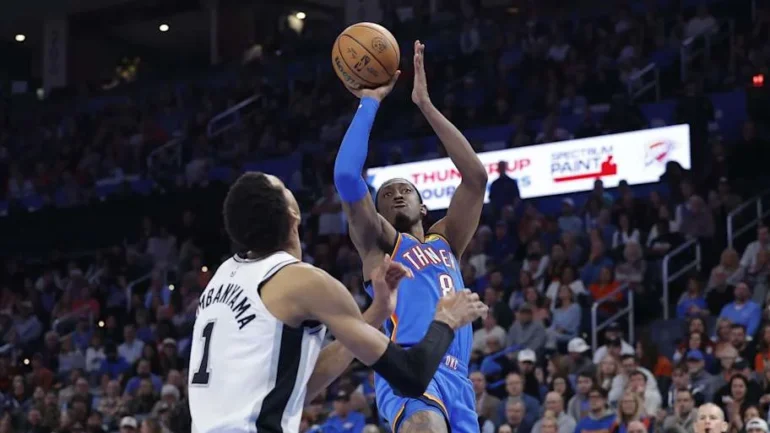
The Oklahoma City Thunder showcased a masterclass in offensive execution, particularly in the third quarter, as they systematically dismantled the San Antonio Spurs’ defense. The Spurs struggled to contain the Thunder’s dynamic ball movement and off-ball cuts, leading to numerous open looks and exploitable defensive breakdowns. The core issue for San Antonio revolved around their inability to consistently rotate and communicate, often leaving shooters wide open on the perimeter.
A significant tactical problem identified was the Spurs’ defensive scheme against Shai Gilgeous-Alexander (SGA). When SGA drew double teams, which was frequent, the Spurs’ defense would often overcommit or rotate late. On one instance, a backdoor cut from Jaylen Williams exploited the defense’s focus on SGA. Players were seen screaming at Dylan Harper to rotate, highlighting a communication breakdown. The transcript notes, “They don’t want Wembanyama in the strong side guarding this corner. They want Wembanyama in the paint to stop the drive. So, when you don’t rotate over to the strong side, he’s wide open and they got to fix that.” This lack of timely rotation allowed for easy three-point opportunities, a recurring theme throughout the game.
The Thunder’s offensive strategy effectively utilized spacing to disrupt the Spurs. When Wembanyama was positioned in the strong side dunker spot to deter SGA’s drives, it opened up the weak side. Alex Caruso, left unguarded on the weak side, capitalized on this, draining wide-open threes. As the transcript states, “If Wembanyama’s going to be guarding Caruso, stick him all the way across the court from SGA, and let’s see how you guys defend that, right? So, we swing it over once again, late contest, wide open three, and Caruso says, ‘Hey, if you’re going to leave me open, you’re going to pay.'” This highlights the Spurs’ defensive vulnerability to perimeter shooters when their attention was focused on the paint.
Chet Holmgren also found success, particularly when Wembanyama was off the floor. A switch led to Chet driving against Keldon Johnson, resulting in a strong finish and an and-one opportunity. The Thunder also effectively used inverted screens, creating pockets of space. Alex Caruso excelled in the short roll, acting as a facilitator and finding Chet for an alley-oop lob. “Again, beautiful job by Alex Alex Caruso. He’s been so huge in this series. I know it’s 1-1, but man, what a play in the short roll,” the analysis pointed out.
Furthermore, the Thunder’s ability to create advantages through ball screens and subsequent rotations was evident. When SGA drove into a double team, he accelerated past it, forcing further defensive rotations. This led to opportunities for Chet in the corner or SGA isolating against a smaller defender like Keldon Johnson, which he finished with a powerful dunk. The Spurs’ defense was described as being in a “scramble” and “stuck in rotation,” unable to recover effectively once an initial advantage was created.
The Thunder’s offensive scheme, particularly their movement off the ball and the utilization of players like Caruso in the short roll, consistently created advantages. They exploited the Spurs’ tendency to over-focus on specific actions, leaving other areas of the floor vulnerable. This strategic exploitation of defensive weaknesses, combined with efficient scoring from players like SGA, Chet Holmgren, and Alex Caruso, led to a dominant offensive performance for Oklahoma City.