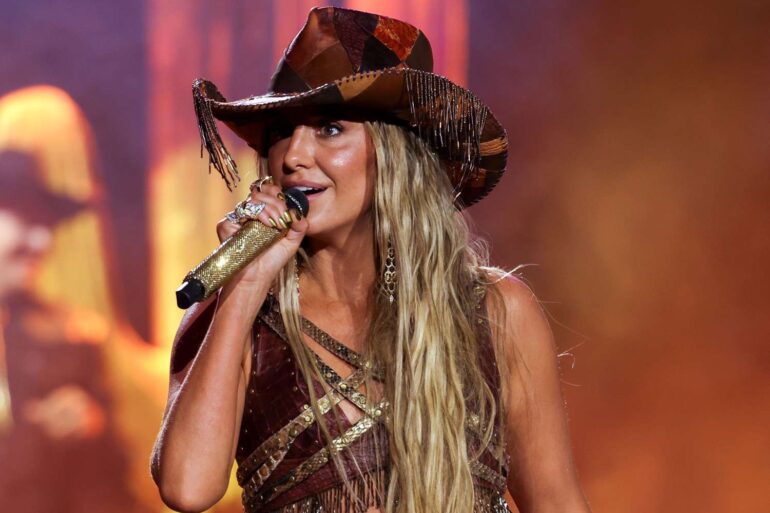
The desert winds at Stagecoach festival can be notoriously fickle, capable of whipping up dust devils and testing the resolve of even the most seasoned attendees. But this past weekend, the tempest was less about nature’s caprice and more about the unexpected turbulence surrounding Lainey Wilson’s highly anticipated headlining set. A festival evacuation due to high winds, which forced a delay and ultimately impacted the flow of the show, has inadvertently spotlighted a curious narrative: the growing tension between authenticity and calculated performance in the country music landscape, and how artists navigate the ever-shifting tides of public perception and relevance.
Just a few years ago, Lainey Wilson was the picture of earnest, down-to-earth country sincerity. Her early career was built on a foundation of relatable storytelling, a distinct visual style (her signature bell-bottoms becoming a calling card), and a voice that seemed to channel the very essence of traditional country storytelling. Hits like “Things a Man Oughta Know” resonated for their straightforward, no-nonsense wisdom, positioning her as a refreshing antidote to what some perceived as the increasingly pop-infused or overtly manufactured sounds in mainstream country. She was the “real deal,” a singer-songwriter who felt grounded, authentic, and utterly herself. This carefully cultivated image became her bedrock, earning her critical acclaim and a rapidly growing fanbase eager for artists who seemed to speak their language.
The seeds of a potential shift, however, began to subtly germinate. While Wilson’s music continued to chart and win awards – including multiple CMA Entertainer of the Year nominations and wins – a growing segment of the audience and industry observers started to detect a calculated strategy at play. This wasn’t necessarily a departure from her core sound, but rather an amplification of certain elements for maximum impact in an increasingly competitive media environment. The visual branding became sharper, her social media presence more curated, and her public appearances, while still exuding a certain charm, began to feel less like spontaneous moments and more like finely tuned performances designed to capture attention. The transition from a breakout star to a bona fide headliner at a festival like Stagecoach signifies a significant elevation in stakes, demanding a more sophisticated approach to maintaining visibility and cultural currency.
The Stagecoach incident, though primarily a logistical hiccup caused by extreme weather, became a focal point for these simmering discussions. As news of the evacuation spread, and speculation mounted about how it would affect Wilson’s performance, the narrative inevitably turned to the pressures faced by artists at her level. Backlash, while not directly aimed at Wilson for the weather itself, often surfaces in online forums and social media when perceived authenticity wavers. Some fans expressed frustration not with the delay, but with what they might interpret as the larger spectacle surrounding the event, a spectacle that sometimes overshadows the music itself. Industry peers, meanwhile, are keenly aware of the tightrope artists walk. Maintaining credibility while embracing the demands of mainstream superstardom – which often involves a degree of calculated performance and strategic media engagement – is a constant challenge. The media framing, often leaning towards dramatic narratives of festival chaos or artist resilience, can further complicate how these moments are perceived, sometimes oversimplifying complex career trajectories into easily digestible soundbites.
While Wilson herself hasn’t directly addressed the perceived tension between authenticity and performance in a way that would satisfy every critic, her career trajectory speaks volumes. The drive for relevance in the modern music industry often necessitates a conscious effort to remain in the public eye and conversation. This can manifest as embracing larger-than-life personas, engaging in strategic collaborations, or, as in Wilson’s case, amplifying a signature style and message to cut through the noise. The implicit motivation behind such a strategy is often the pursuit of sustained attention and influence. In a landscape where attention is the primary currency, artists must continuously innovate and adapt their public-facing selves to remain captivating. Wilson’s evolution can be seen not as a betrayal of her roots, but as a strategic adaptation to the demands of commanding a stage as massive as Stagecoach’s main event.

This situation is emblematic of a larger cultural pattern at play today. The lines between genuine expression and deliberate performance are increasingly blurred. For artists like Lainey Wilson, the quest for relevance often means leaning into a heightened version of their public persona. The concept of “authenticity” itself has become a performance; audiences crave it, but often in a curated, digestible form. The modern media ecosystem thrives on narratives of transformation and evolution, and artists who can successfully manage their public image, balancing perceived sincerity with strategic positioning, often achieve the greatest longevity. Power, attention, and influence are no longer solely dictated by raw talent but by the ability to capture and hold the cultural imagination. This dynamic compels artists to constantly assess their legacy versus their immediate relevance, often prioritizing the latter to ensure they remain a dominant force.
As the dust settles from Stagecoach, and the winds subside, Lainey Wilson’s headlining set stands as a potent symbol of contemporary stardom. The incident, however minor in the grand scheme of a festival, underscores the delicate balance artists must maintain. In an era where every move is scrutinized and every public persona is subject to constant re-evaluation, the question remains: can a performance crafted for maximum cultural impact, while still rooted in genuine talent, truly resonate as authentic? As Wilson continues to ascend, her journey will be a barometer for how artists can navigate the complexities of the modern entertainment landscape, proving that sometimes, the most compelling performances are those that masterfully blend the real with the meticulously staged.