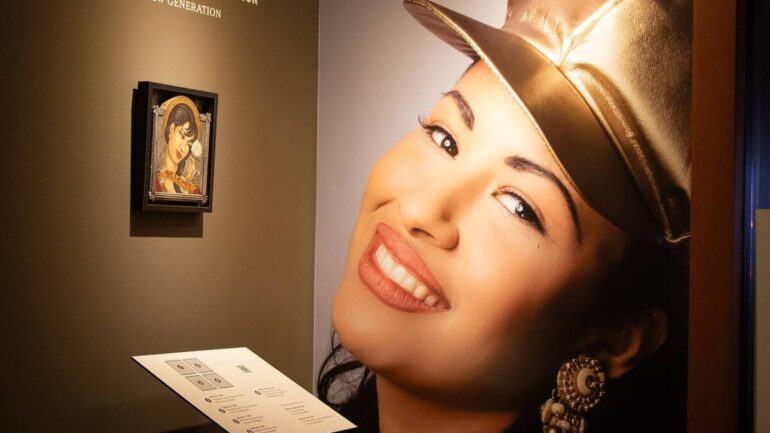
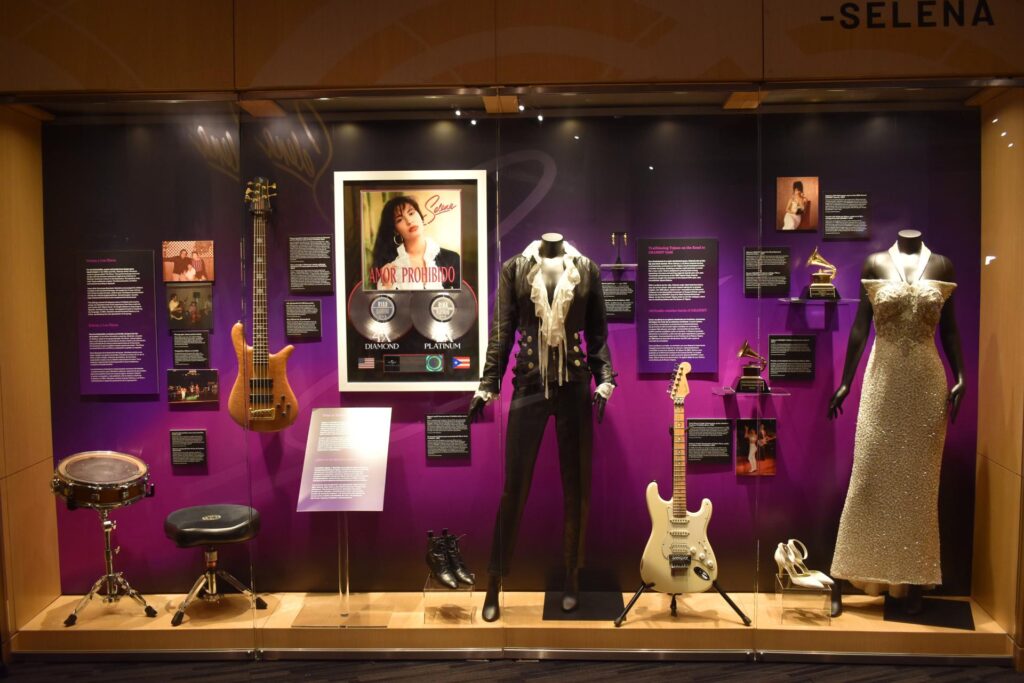
Items from the “Selena: From Texas to the World” exhibit at the Grammy Museum in Los Angeles, featuring the singer’s iconic stage costumes and awards. (Photo: Getty Images, 2017).
There was a time when the name Selena Quintanilla-Pérez represented a very specific, burgeoning promise: the bridge between the American Dream and the Mexican-American reality. In the early 1990s, she was the girl from Lake Jackson, Texas, who made her own stage outfits and ate pizza by the box, even as she revolutionized Tejano music. Today, that human accessibility has been replaced by a crystalline, untouchable sainthood. The opening of the “Selena: From Texas to the World” exhibit at the Grammy Museum marks a significant pivot in how we consume her legacy. It is no longer just about the music; it is about the curation of a secular relic. By placing her personal bustiers and awards behind glass, the industry is transitioning Selena from a pop star who died too young into a permanent fixture of American institutional history, revealing a cultural hunger for “authentic” icons that can be endlessly commodified.
The Arc of an Immortal
The trajectory of Selena’s public identity is a unique case study in posthumous branding. In her early career, she was defined by a DIY ethos. Her reputation was built on grassroots touring across the “Chitlin’ Circuit” of the Southwest, a vibrant but regional fame. She was a symbol of biculturalism—the girl who learned Spanish phonetically to connect with her roots while remaining unapologetically American. This was the era of the purple jumpsuit and the Houston Astrodome, a moment where she was a living, breathing disruptor of the Latin music industry’s male-dominated status quo.
The mid-period of her legacy, spanning the late 90s and 2000s, was characterized by a transition into Hollywood myth-making. The 1997 biopic starring Jennifer Lopez acted as a secondary birth for Selena, introducing her to a global audience that hadn’t known her while she lived. During this time, the narrative was one of tragedy and “what ifs.” The focus was on the crossover album Dreaming of You, which peaked at No. 1 on the Billboard 200, representing the potential of a career cut short.
However, recent years have seen a final crystallization. The Grammy Museum exhibition, the Netflix series, and a flurry of high-profile collaborations—from MAC Cosmetics to Forever 21—have moved her beyond music. She has become a lifestyle brand and a museum piece. The narrative has shifted from the loss of a singer to the preservation of an eternal aesthetic. We are no longer mourning Selena; we are archiving her.
The Politics of Preservation
This shift has not occurred without friction. Each new project—whether a hologram proposal or a posthumous clothing line—ignites a debate between the Quintanilla family and a fan base that feels a proprietary ownership over her image. The conflict often centers on the tension between “honoring a legacy” and “capitalizing on a ghost.”
While industry peers like Katy Perry and Lady Gaga have cited her as a foundational influence, the media framing of Selena has often oscillated between reverent celebration and a subtle critique of how her estate manages her likeness. Critics have noted that while the Grammy Museum display provides a necessary academic platform for Latinx contributions to American culture, it also safely packages Selena into a “frozen in time” version of herself that cannot age, evolve, or contradict her own brand. The pushback usually comes when the commercialization feels too far removed from the music, leading to accusations that the “Queen of Tejano” is being used as a shorthand for “Latinx marketability.”
The Strategy of Presence
The motivation behind these exhibits is rarely just about nostalgia; it is about institutional validation. Selena’s family, particularly her father Abraham Quintanilla, has been transparent about the goal of keeping her name alive for future generations. In various interviews, the family has acknowledged that maintaining her relevance requires a constant presence in the modern media ecosystem.
“When she passed away, I told my family that I was going to keep her memory alive through her music,” Abraham told People. The museum exhibit is the ultimate manifestation of this strategy. By moving her personal effects into the Grammy Museum, the estate ensures that Selena is viewed not just as a pop star, but as a historical figure on par with Elvis or Sinatra. This is a deliberate move toward “legacy security”—ensuring that even as the music industry changes, her physical artifacts remain as evidence of her cultural authority.
Authenticity in the Age of the Archive
The museumification of Selena reveals a deeper cultural pattern in the 2020s: our obsession with “curated authenticity.” In an era where digital presence is fleeting and AI-generated content is rising, there is a premium on the physical. We want to see the stitches in her costumes and the scuffs on her boots because they provide a tangible link to a pre-digital era of stardom.

Selena serves as a perfect vessel for this modern hunger. She represents a “purer” form of celebrity—one that was built through talent and charisma rather than social media algorithms. However, the irony is that her image is now managed with the same algorithmic precision as any modern influencer. The cultural authority she once gained through her proximity to her fans is now being sustained through her distance from them, mediated by museum glass and curated social media feeds.
Furthermore, Selena’s enduring power reflects the shifting demographics of American influence. As the Latinx population grows, the demand for “canonical” heroes increases. The Grammy Museum’s decision to highlight her “Texas to the World” journey is an admission that the story of American music is incomplete without the Tejano narrative. Selena isn’t just a Latin star; she is the foundational architect of the modern American bicultural identity.
The Weight of a Glass Case
As we look at the shimmering costumes and gold records on display in Los Angeles, we have to ask: does the strategy of constant visibility actually preserve the essence of the artist? Or does it turn them into a hollowed-out symbol?
Selena’s legacy currently occupies a strange, liminal space. She is more famous now than she was at the time of her death in 1995, yet the “person” Selena feels increasingly obscured by the “brand” Selena. The Grammy Museum exhibit is a triumph of cultural recognition—a long-overdue seat at the table of American legends. But it also signals the end of Selena as a contemporary artist and the beginning of her life as a historical artifact.
In a changing environment where cultural weight is often measured in “likes” and “trends,” Selena’s team has successfully gambled on the “long game” of institutional respect. Whether this positioning will continue to carry weight with Gen Z and beyond depends on whether they see her as a person they can relate to, or merely a beautiful ghost in a glass case. For now, the world continues to watch, listen, and buy, proving that while the woman may be gone, the icon is increasingly, and perhaps perpetually, under construction.