:max_bytes(150000):strip_icc():focal(749x0:751x2)/jessie-buckley-christian-bale-bride-of-frankenstein-040424-1-8ac3c73aefb4494bbac273f4fdb2aad1.jpg)
‘The Bride’ in theaters March 2026.
For most of the 21st century, Maggie Gyllenhaal occupied a very specific corner of the cultural consciousness: she was the indie darling of “Secretary,” the “thinking man’s” actress who chose projects that interrogated desire, vulnerability, and the quiet tremors of the domestic sphere. She was the personification of a certain kind of grounded, intellectual Hollywood—a performer who seemed more interested in the psychological truth of a scene than the pyrotechnics of a blockbuster. But as she approaches the March release of her second directorial effort, The Bride!, that identity has undergone a radical transmutation. The woman who once specialized in the intimate and the understated has now fully embraced the grotesque, the punk-rock, and the maximalist. In reimagining James Whale’s 1935 classic Bride of Frankenstein, Gyllenhaal is no longer just observing the human condition; she is suturing a new one together from the discarded parts of our collective cinematic memory.
This shift isn’t just a career pivot from actor to auteur; it represents a fundamental tension between the “prestige” Gyllenhaal of the early 2000s and the provocateur filmmaker of the 2020s. By trading the nuanced realism of her past for the jagged, high-contrast world of 1930s Chicago monsters, Gyllenhaal is signaling a departure from the “safe” lanes of female-led filmmaking. She is stepping into the realm of the mythic, and in doing so, she is challenging a Hollywood system that is increasingly terrified of anything that cannot be easily categorized by an algorithm.
A Timeline of Transformation
Gyllenhaal’s reputation was forged in the fires of the early 2000s indie boom. Following her breakout in 2002’s Secretary, she became the face of a specific type of cinematic complexity—fearless in her portrayal of sexuality and psychological frailty. Throughout the 2010s, she maintained this positioning, earning an Oscar nomination for Crazy Heart and critical acclaim for the HBO series The Deuce. She was seen as a pillar of the “serious actress” establishment, a performer whose presence guaranteed a certain level of gravitas and emotional honesty.
However, the mid-period of her career saw the first tremors of a shift. As she moved toward the director’s chair, her interests began to veer away from the “relatable” toward the unsettling. Her directorial debut, 2021’s The Lost Daughter, was a masterclass in ambiguity. It took a revered Elena Ferrante novel and turned it into a tense, almost claustrophobic exploration of maternal ambivalence. It was here that we saw the first real crack in the “indie darling” facade—a willingness to sit with the uncomfortable and the taboo without providing the audience with a clean resolution.
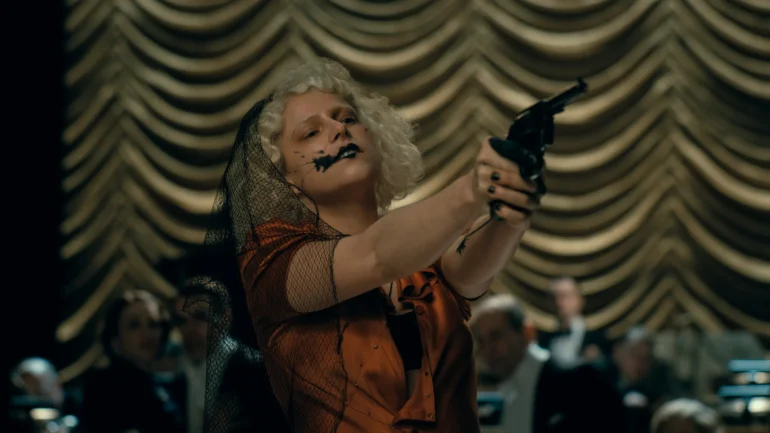
Now, with The Bride!, the evolution is complete. The first look images released by Warner Bros. show a scarred, peroxide-blonde Jessie Buckley and a tattooed, grimy Christian Bale as Frankenstein’s monster. This is not the Gothic romance of old; it is something more feral and anarchic. Recent reports from the set and industry screenings suggest a film that leans into the “weird,” blending 1930s aesthetics with a modern, punk sensibility. The narrative has crystallized: Gyllenhaal is no longer content to act within the world; she wants to build—and break—new ones.
The Conflict of the “Gothic Reboot”
The reaction to Gyllenhaal’s latest venture has been a mix of exhilaration and skepticism, reflecting a broader industry debate about the value of the “reimagining.” While cinephiles have lauded her bold aesthetic choices, there is an underlying tension regarding the “prestige-ification” of horror. Some purists argue that the Bride of Frankenstein is a sacred icon that shouldn’t be subjected to a “modern feminist deconstruction,” while others see it as a necessary evolution.
Furthermore, the project sits in the shadow of Guillermo del Toro’s own upcoming Frankenstein project for Netflix, creating a sort of monster-movie arms race that has fueled media framing around Gyllenhaal’s “audacity.” Is she stepping out of her depth? Or is she the only one capable of breathing new life into a tired trope? The pushback isn’t just about the film itself; it’s about Gyllenhaal’s claim to cultural authority in a genre that has historically been a boy’s club. By taking on one of the most famous monsters in history, she is forcing a conversation about who gets to own the myth.
The Strategy of the Grotesque
Gyllenhaal herself has been candid about her motivations, often framing her work as a search for a more visceral kind of truth. In interviews during the production of The Lost Daughter, she spoke about the necessity of “uncomfortable” art. Speaking to Variety, she noted, “I think there’s a way in which we’ve been told that there’s a certain way we’re supposed to feel… and when we don’t feel that way, we feel like we’re monsters.”
This acknowledgment of the “monstrous” within the feminine experience seems to be the driving force behind The Bride!. By literally putting a monster at the center of her film, Gyllenhaal is externalizing the internal conflicts she has explored her entire career. Her strategy isn’t just about provocation for the sake of attention; it’s a calculated attempt to use the “monster movie” as a Trojan horse for complex ideas about identity, creation, and the male gaze. She isn’t just making a horror movie; she is using the genre’s inherent “otherness” to reclaim a narrative of female agency.

Cultural Analysis: Authenticity in the Age of IP
The emergence of The Bride! in March 2025 speaks volumes about our current cultural moment. We are living in an era dominated by “IP” (Intellectual Property), where original stories are often sacrificed at the altar of recognizable brands. Gyllenhaal’s decision to work within this system—taking a legendary Universal monster—while simultaneously subverting it, reveals a sophisticated understanding of modern power. To be relevant today, one must often engage with the familiar, but to build a legacy, one must make that familiar thing feel dangerous again.
This tension between authenticity and performance is central to Gyllenhaal’s new identity. In a media ecosystem that demands constant “rebranding,” she has managed to evolve without losing her core intellectualism. She is navigating the attention economy by leaning into the high-concept and the visually arresting, yet she anchors it in the same psychological depth that defined her acting career.
Furthermore, the film highlights how cultural authority is currently contested. We are seeing a shift where “prestige” is no longer found in the quiet and the reserved, but in the bold and the transformative. Authority is gained by those who are willing to take the biggest swings, even if those swings risk alienating the traditionalists. Gyllenhaal is betting that the audience is hungry for something that feels “alive”—even if it’s made of dead parts.
Conclusion: The Weight of the New Bride
As The Bride! prepares for its theatrical run, it stands as a testament to Maggie Gyllenhaal’s refusal to be stagnant. She has successfully navigated the transition from a performer defined by her “vulnerability” to a director defined by her “vision.” But the question remains: in a changing cultural landscape that is increasingly cynical toward reboots and reimagined classics, does this kind of radical repositioning still carry weight?
Gyllenhaal’s “Bride” is not just a monster; she is a mirror. She reflects a society that is currently obsessed with “resurrecting” the past while simultaneously trying to kill its old gods. Whether the film succeeds as a blockbuster is almost secondary to what it represents: a high-stakes gamble on the idea that the “weird” can still be “universal.” In an industry of safe bets, Gyllenhaal has chosen to be the lightning rod. If The Bride! lands, it won’t just be a win for her career; it will be a signal that there is still room for the auteur’s hand in the machinery of the modern spectacle. We are no longer just watching the Bride; we are watching Gyllenhaal build herself into something entirely new, scars and all.