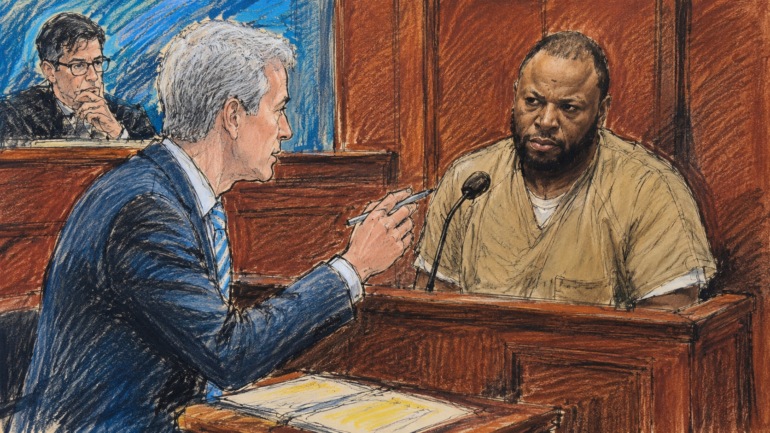
Uncovering lies told for self-gain may be one of the most important moments yet in Lil Durk’s federal murder-for-hire trial. Elite defense attorney Brian Steel did not walk into court with the impossible task of convincing the jury that OTF Jam—born Deandre “Kacey” Hester—was innocent. That was never the point. Jam has already admitted to a life involving serious violence, including armed robberies, kidnapping, and executions. He confessed to three separate homicides—a 2007 Wisconsin armed robbery murder, the execution of “Lil Dean,” and the 2022 Los Angeles shooting of Saviay’a “Lul Pab” Robinson at the center of the case against Lil Durk.
Steel understood that calling Jam a killer does not necessarily mean he is lying about Durk. Instead, Steel put Jam’s story itself on trial, attacking the entire mechanism through which the government wants the jury to believe him.
Subverting a Sacred Title: The “Minister” of 079 MTV
Of all the revelations produced during Steel’s relentless grilling, one term stuck out with jarring hypocrisy: Hester’s official ranking as a “Minister” within the Black Disciples (BDs). Representing Chicago’s MTV 079 set off 79th and Vernon, Hester’s street roots were grounded in high-level gang authority.
Steel latched onto the stark contradiction between what a spiritual minister represents and what the title actually entailed on the streets:
- High-Level Authority: Steel established that “Minister” is not a nominal title, but one of the highest leadership positions within the Black Disciple hierarchy—a term loaded in court with connotations of massive violent leadership.
- A Distortion of Leadership: Instead of providing moral guidance, Hester used his clout to organize gang meetings, orchestrate robberies, and participate in executions.
- Dismantling the “Coercion” Myth: When Hester claimed he was merely following orders during the August 2022 Los Angeles hit, Steel weaponized his rank against him, pressing that as a BD Minister, Hester possessed the authority to hand the gun back and walk away.
By framing Hester not as a reformed man seeking redemption, but as an operative who hijacked concepts of leadership to serve his own survival, Steel systematically stripped away the witness’s moral credibility.
The “Snitch” Note and the Reality of Motive
Steel opened his offensive by turning Hester’s own actions against him, focusing on Exhibit 293—a handwritten note Hester discreetly passed to an arresting officer in 2023:
“I know about murders. I don’t want to talk on camera. I know a lot.”
While the prosecution attempted to frame Hester as a reluctant witness acting out of fear, Steel reframed the note as the calculated opening move of a seasoned system operator. Hester admitted under interrogation that snitching as a Black Disciple carried an “automatic death sentence,” yet he voluntarily handed over information anyway. Steel highlighted the hypocrisy: despite claiming deep loyalty and “love” for Lil Durk, Hester was actively leveraging information about multiple murders to negotiate his own freedom.
Spreading the “Leader” Propaganda and the Bounty Narrative
Throughout cross-examination, Hester repeatedly pushed a single narrative: that OTF is a gang led by Lil Durk, and that every move made was driven by Durk as the “mastermind.” Steel exposed this as a calculated attempt to spread propaganda and minimize Hester’s personal agency.
- Shifting Explanations: Steel forced Hester to address how his story regarding the bounty shifted over time. Hester previously admitted in a studio setting that there was no bounty, only to later claim Durk told him he was “straight for life” or implied a general group bounty on Quando Rondo.
- The “Group Effort” Pivot: When pressed on the inconsistency, Hester pivoted, claiming Durk’s statements were general announcements to the group, suggesting everyone in the circle was supposed to know a hit was requested.
Courtroom Atmosphere, Strategy, and Domestic Distractions
Steel’s high-intensity cross-examination created a tense dynamic in the courtroom. Observers noted Steel’s aggressive, direct tone when confronting Hester—a stark contrast in style that temporarily risked alienated courtroom observers due to perceived condescension. However, Steel quickly pivoted into “Tom Brady mode,” using hard evidence to completely shatter Hester’s moral defense.
- Exposing Fabrication and Gun Ownership: Steel pulled audio proving Hester’s track record of deceptive law enforcement statements. Hester previously lied about a federal gun charge, claiming a firearm with a machine-gun conversion switch was under the driver’s seat of a car that wasn’t his. In reality, Hester was pictured with the gun, sitting in the rear passenger seat, and had attempted to force his cousin to take the charge to avoid his own career armed criminal enhancements.
- Troubling Family Threats and Violent Behavior: Steel dismantled any lingering jury sympathy by bringing up Hester’s extreme behavior toward his own family. Under pressure, Hester was forced to address dropping his sister’s location to be shot up while she was on dialysis, sending text messages threatening to put a bullet in his own niece’s head, and verbally abusing his mother on recorded calls.
Housing Complaints, Keep-Separate Orders, and Law enforcement Note-Taking
Co-counsel Harbaugh joined the attack on Hester’s credibility, exposing key procedural flaws in how Hester’s claims were recorded and handled:
- Facility Transfers: Hester claimed he sought relocation from a sub-standard detention facility due to poor conditions and pending lawsuits. However, Steel exposed that Hester was actively utilizing Keep-Separate (KS) orders not out of fear of violence, but to manage his positioning relative to co-defendants.
- Federal Note-Taking Practices: Defense attorneys highlighted that federal agents were not using formal transcribers during Hester’s initial debriefs. Instead, agents wrote down notes selective to what they preferred, allowing Hester’s unverified claims to shape the entire trajectory of the police investigation.
- Conflicting Homicide Statements: Defense counsel forced the admission that federal notes recorded Hester stating he “wanted to kill everybody after the Quando Rondo shooting” out of fear they would tell on him—exposing that a primary government witness contemplated murdering his associates for the very act of snitching he ultimately committed himself.
The Problem With a Witness Who Wants a “Number”
Steel’s cross-examination repeatedly returned to one unavoidable question: What does OTF Jam stand to gain by testifying? Jam attempted to distinguish between wanting immediate freedom and wanting a reduced sentence, repeatedly stating he just wanted “a number.” But Steel confronted him with statements made during a recorded jail call on May 5, 2023, where Hester spoke to his wife on a monitored line:
- The Expectation: Hester explicitly told his wife he expected to serve only 18 months after testifying for federal authorities.
- The Goal: He promised her he would be home in time to see his newborn child, with his federal time running concurrent to state parole.
When confronted, Hester did not unequivocally deny making the statements, suggesting instead that he was “just giving her a little hope.” Steel made the jury look at the stark equation: three confessed murders in exchange for a target sentence of 18 months. Steel demonstrated that Jam was asking the jury to accept his testimony while holding a powerful personal incentive to make sure the government was satisfied with his answers.
Uncovering the Hidden Line: The Jam and Vonnie Breach
The most critical turning point of the cross-examination arrived when Steel brought to light a major development: Kacey Hester (Jam) and OTF Vonnie had been in direct communication prior to Hester’s official transfer, when they strictly should not have been.

| Defense Strategy | Trial Significance |
| Exposing Back-Channel Communication | Shattered the prosecution’s narrative of isolated, independent witness statements by proving Hester was talking to Vonnie before officially turning state’s witness. |
| Establishing Witness Coordination | Raised critical questions for the jury about whether key witnesses were colluding, trading information, and aligning stories to secure personal immunity or leniency. |
| Challenging Witness Transparency | Provided the jury with a concrete, objective reason to question Jam’s honesty beyond his extensive criminal record. |
If Jam and Vonnie were communicating outside official channels before Hester began cooperating, it raised obvious questions: Were witnesses coordinating? Were accounts being shaped outside the courtroom? And what else was the jury being asked to accept solely on Jam’s word?
Dismantling the Witness’s Word
Throughout his testimony, Hester insisted he was trapped into participating in the Los Angeles hit and claimed he tried to stop it through text messages sent from another person’s phone. When Steel pressed him to produce a single shred of corroborating evidence, Hester was forced to admit no such messages existed in evidence.
“So we have your word. You realize that?… And if your word is not good, then that is not truthful, right?” Steel pressed.
Jam repeatedly asked the court to rely on his word alone regarding:
- His claim that he tried to stop the shooting.
- His account of what other people said and who was involved.
- His claims about what Lil Durk knew and his characterization of Durk as the “mastermind.”
- Unsubstantiated claims regarding weapons held during the incident that were never documented in prior statements or police records.
One of the most revealing moments came when Jam insisted, “I’m just here telling my side of the story.” But Steel had already exposed the flaw in that statement: Jam’s “side of the story” carries an enormous personal stake.
Brian Steel’s Value Is Showing Up in Real Time
There is a reason elite criminal defense attorneys command elite fees. Steel recognized that attacking Jam’s past character alone would not dismantle the government’s case. Instead, he focused the trial on credibility, motive, and consistency.
By uncovering secret jail-call promises of an 18-month release, tearing apart the “Minister” facade, exposing domestic violence threats, highlighting unrecorded agent notes, and exposing unauthorized communications with OTF Vonnie, Steel gave the jury concrete reasons to doubt the prosecution’s star witness. Steel did not need to prove that Jam was a flawed man—Jam had already admitted to that. Steel needed to show that the government is asking the jury to make life-changing decisions based on a witness whose story rests entirely on uncorroborated claims.
If Jam was not fully truthful about his communications with Vonnie, his gun charges, or his motives, the jury is left with the central question that may define the trial: What else are they being asked to take on his word alone?