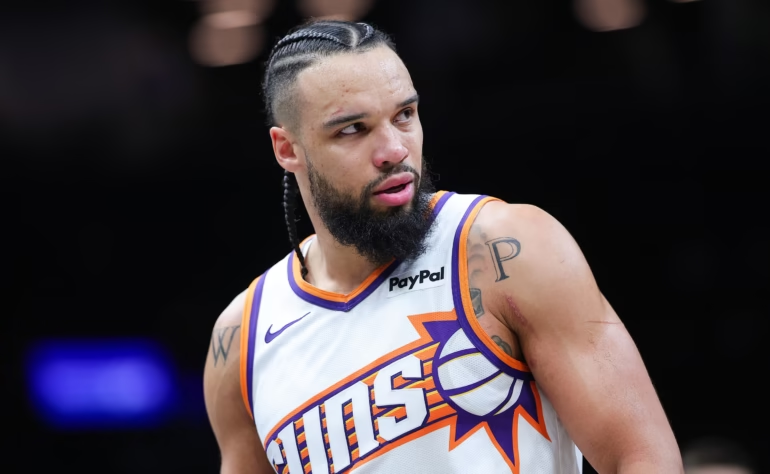
In the cutthroat arena of professional basketball, where narratives are as fiercely contested as possessions, Dillon Brooks has carved out a unique identity. For years, he was known as the tenacious, if occasionally undisciplined, defender for the Memphis Grizzlies, a player whose intensity often bordered on self-destruction. Now, after a controversial playoff series, Brooks has pivoted, adopting a new persona – that of the grizzled traditionalist, lamenting the perceived softness of the modern game and its stars. His recent comments, calling Shai Gilgeous-Alexander ‘a little frail’ and decrying the prevalence of ‘dropping, the falling and the flopping and flailing’ in the playoffs, encapsulate this transformation. But is Brooks genuinely yearning for a bygone era of basketball, or is this a calculated performance, a strategic embrace of an anachronistic archetype to reclaim relevance in a league that often favors flash over fundamental grit?
Brooks’s journey to this point is a study in the evolution of an athlete’s public perception and strategic self-positioning. His early career with the Grizzlies, particularly from his rookie season in 2017, was defined by a raw, aggressive defensive style. He was a promising wing defender, unafraid to guard the opponent’s best player, often taking on the challenge with a swagger that endeared him to fans who appreciated his effort. This was the Brooks who, in his first few seasons, was celebrated for his intensity, even as his offensive efficiency and decision-making were questioned. He embodied a certain ‘old-school’ toughness, a throwback to the lockdown perimeter defenders of previous eras. However, this intensity also led to disciplinary issues and questionable on-court behavior, including a suspension in 2022 for a ‘detrimental conduct’ violation, as reported by ESPN. His playoff outbursts and confrontations, such as his notorious feud with Draymond Green in the 2022 playoffs, further cemented his image as a fiery, albeit volatile, competitor.
The mid-period of Brooks’s career saw these rough edges become more pronounced. His vocal criticisms of opponents, including LeBron James, became a recurring theme. While some saw this as part of his competitive fire, others viewed it as a lack of discipline and an inability to channel his aggression effectively. The narrative began to shift from “tough defender” to “player who crosses the line.” His reputation for physicality also invited scrutiny, and he faced criticism for plays that were deemed dirty, such as kicking out his leg on jump shots, a move that drew ire from players and analysts alike. Yet, through it all, he remained a key figure for the Grizzlies, his defensive prowess undeniable, even if his overall impact was often debated.
The recent turn, crystallized in his comments following Game 2 of the 2023 Western Conference Semifinals against the Oklahoma City Thunder, marks a significant departure. By targeting Shai Gilgeous-Alexander, a player widely regarded as one of the league’s most gifted scorers, and framing him as “frail,” Brooks wasn’t just engaging in typical playoff trash talk. He was actively constructing an argument about the very nature of the game. His invocation of Michael Jordan and a younger LeBron James evokes a golden age of basketball, a time perceived as more physical and less reliant on what he terms “finesse” or “soft” play. This framing is not new in sports commentary, but coming from a player whose own game has often been criticized for its recklessness and lack of refinement, it carries a particular weight and irony. The media, as expected, amplified these comments, turning a soundbite into a talking point that reverberated across sports news outlets like Complex and beyond.
The backlash to Brooks’s statements was immediate and multifaceted. Fans and analysts who value the evolution of the game, appreciating the skill and athleticism displayed by players like Gilgeous-Alexander, pushed back against Brooks’s perceived gatekeeping. They pointed out that basketball, like any sport, evolves, and that the modern game demands a different kind of physicality and skill. Opponents and former players also weighed in, with many defending Gilgeous-Alexander and questioning Brooks’s credibility. Charles Barkley, a figure often associated with a more physical era, even rebuked Brooks’s characterization, suggesting it was misdirected. The discourse surrounding Brooks’s comments highlighted a deeper cultural divide within basketball fandom: a tension between those who champion the perceived ‘toughness’ and simplicity of older eras and those who celebrate the artistry and expanded skill sets of today’s players. This debate, amplified by social media, became a significant part of the playoff narrative, arguably benefiting Brooks by placing him, and his brand of ‘grit,’ back in the spotlight.
Brooks himself has, perhaps inadvertently, offered glimpses into his motivations. While he hasn’t explicitly confessed to a strategic rebrand, his consistent engagement in verbal sparring and his willingness to court controversy suggest a player who understands the power of narrative. His decision to publicly criticize Gilgeous-Alexander, a player on a rising, exciting team, is a move designed to provoke a reaction, to stir the pot, and to insert himself into the broader conversation. In an era where player branding and marketability are paramount, creating a distinct persona, even one that leans into contrarianism, can be a powerful tool for maintaining relevance. As reported by Sports Illustrated, Brooks’s focus on the ‘physicality’ of the game can be interpreted as a strategic attempt to reframe his own aggressive, sometimes reckless, style of play not as a flaw, but as a virtue aligned with a purer, more traditional form of the sport. It’s a way of saying, “I’m not dirty; I’m just playing the *right* way.”

What Brooks’s transformation and the subsequent furor reveal about our current cultural moment is profound. We are living in an age where authenticity is both highly valued and increasingly performed. The lines between genuine belief, strategic positioning, and outright performance are often blurred. In the realm of sports, this plays out in the constant quest for relevance and legacy. For athletes like Brooks, who may not possess the generational talent of a Jordan or LeBron, cultivating a strong, often controversial, persona becomes a way to ensure they remain in the conversation. It’s a battle for attention in a hyper-saturated media ecosystem. Power and influence are no longer solely derived from on-court performance but from the ability to shape narratives, to provoke discourse, and to control one’s public image. Brooks’s embrace of the ‘traditionalist’ mantle is a masterclass in media manipulation, leveraging nostalgia and a perceived decline in toughness to position himself as an arbiter of basketball’s true spirit. This mirrors broader cultural trends where figures often gain traction by articulating anxieties about change or by championing a romanticized past, even if it simplifies complex realities.
Ultimately, Dillon Brooks’s current positioning as the self-appointed guardian of basketball’s ‘man’s game’ is a fascinating, if predictable, evolution. It’s a strategy that plays into a nostalgic sentimentality, a desire among some fans to recapture a perceived simpler, tougher era of sports. However, in a league that continues to innovate and expand its definition of skill and athleticism, the relevance of this old-school critique is debatable. Is Brooks’s performance sustainable? Will his brand of manufactured grit continue to resonate, or will it eventually be drowned out by the very evolution he decries? His legacy, like his current standing, hangs in the balance, a testament to the ever-shifting sands of athletic identity and cultural perception in the modern sports landscape. The question is not whether Brooks is ‘right,’ but rather, what his words signify about the ongoing cultural conversation surrounding progress, tradition, and the evolving definition of what it means to be a modern athlete.