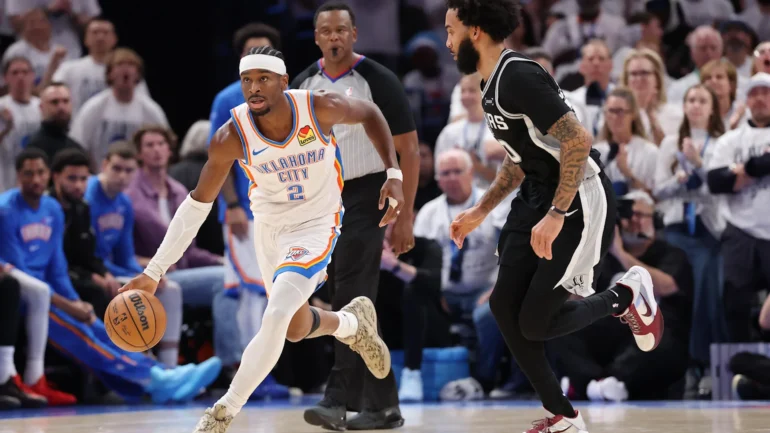
The Oklahoma City Thunder have seized a crucial 3-2 series lead, and at the heart of their offensive surge is the electrifying play of Shai Gilgeous-Alexander. SGA’s ability to dissect defenses, particularly against a formidable presence like Victor Wembanyama, has been the defining narrative of this playoff series. His court vision and decision-making under duress consistently created open looks for his teammates, turning complex defensive schemes into exploitable weaknesses.
The Thunder’s offensive strategy has revolved around exploiting the high pick-and-roll, often involving SGA and a big man like Isaiah Hartenstein. The core principle was to force Wembanyama into difficult decisions. In one recurring sequence, a screen is set, prompting Wembanyama to step up. The initial intention was often for Hartenstein to roll to the basket, drawing the weak-side defender and creating an open lane. However, when Wembanyama initially switched to guard the drive, the Thunder found success by exploiting the lack of rotation from the weak side. As SGA noted, “Nobody rotates over, and SGA finds him for a wide-open dunk.” This demonstrated an early vulnerability in the opposing defense’s ability to react to the roll man.
As the game progressed, OKC refined their approach. They began to run similar sets to the opposite side, consistently forcing Wembanyama to over-commit. When the weak-side defender failed to rotate, players like Alex Caruso capitalized, finding space for open shots. The transcript highlights the evolution: “As SGA gets the screen again, gets Wembanyama to over-commit, we look downhill at the rolling Isaiah Hartenstein, which is going to force that weak side to be like, ‘Okay, this time I have to pick it up.'” This defensive adjustment, however, opened up opportunities for shooters. “Boom. Look at Caruso get over to the opposing openness… And we find him. SGA, beautiful pass, wide-open three.” This adaptability, stemming from SGA’s elite playmaking, allowed the Thunder to consistently generate high-percentage looks.
The game saw moments where the Thunder’s offensive execution led to significant leads, including a 20-point advantage in the third quarter. The tactical breakdown remained consistent: setting the screen, forcing the big man to step over, and leveraging hip-to-hip leverage. This created offensive scrambles, often leaving defenders ball-watching, as seen with Deni Avdija. SGA’s ability to identify these breakdowns and deliver passes for separation, such as the find to Jalen McDaniels for 20 points, underscored the team’s depth even with key players absent.

A significant strategic shift involved moving away from big-man screens to guard-guard screens. This presented a new dilemma: either switch, leading to a favorable matchup for SGA against Wembanyama due to his speed, or continue the double team. If a double team occurred, the Thunder could