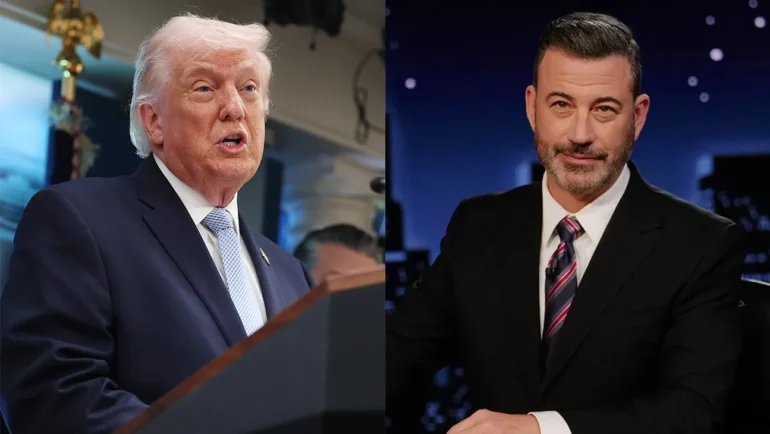
Donald Trump, a figure whose public persona has long been defined by a keen understanding of media dynamics and a willingness to exploit them for maximum impact, has once again inserted himself into a cultural skirmish. This time, the former president has called for the firing of late-night host Jimmy Kimmel over a joke about Melania Trump. The specific quip, which surfaced from a 2009 Kimmel stand-up routine unearthed by Vanity Fair, involved Kimmel making a crude remark about Melania Trump’s past as a model and her relationship with Trump. While the joke itself is undoubtedly vulgar and drew criticism from Trump and his allies, the former president’s vehement reaction and demand for professional retribution reveal far more about the current landscape of celebrity, political influence, and the relentless pursuit of attention than it does about the perceived offense.
This episode, at its core, is not simply about a joke but a calculated move in a larger, ongoing performance. To understand its significance, we must trace the evolution of Trump’s media strategy and the shifting sands of cultural authority. In his earlier days, Trump cultivated an image as a brash businessman and reality television star, a master of self-promotion who reveled in the spotlight and understood the power of controversy to generate buzz. His early public appearances and business ventures were often characterized by a deliberate provocativeness, designed to capture attention and project an aura of success and dominance. Symbolism was key; the gilded towers, the flamboyant lifestyle, the confident pronouncements – all contributed to a brand that was impossible to ignore. He was, in many ways, a product of the era’s burgeoning celebrity culture, where visibility equated to power.
The transition from celebrity to political figure marked a significant shift, but Trump’s core media instincts remained. His 2016 presidential campaign, and indeed his presidency, were characterized by a constant barrage of news cycles, often driven by his own statements and actions. He mastered the art of dominating the media narrative, frequently using social media to bypass traditional gatekeepers and speak directly to his supporters, while simultaneously using perceived slights or criticisms as fuel for his base. Mid-period, as president, moments of ambiguity arose as he navigated the complexities of the office, yet his public persona remained largely intact, often amplified by the very institutions he frequently criticized. His rhetoric often blurred the lines between personal grievance and national interest, a tactic that proved effective in galvanizing support and distracting from other issues. The controversy surrounding his remarks on women, his public spats with critics, and his often-unfiltered commentary became less outliers and more integral to his political brand.
The recent intervention regarding Kimmel’s joke, however, crystallizes a particular narrative: Trump, now out of office but still a dominant force in conservative politics, is leveraging his platform to exert influence beyond traditional political arenas. His demand for Kimmel’s termination, amplified by sympathetic media outlets and online communities, functions as a demonstration of his enduring power to shape public discourse and inflict professional consequences. The backlash against Kimmel, fueled by Trump’s outrage, illustrates how feuds and controversies are weaponized in the modern media ecosystem. This isn’t merely a disagreement; it’s a strategic deployment of outrage designed to punish perceived disrespect and rally a loyal base.
The industry’s response has been largely muted, with late-night hosts often operating within a delicate balance of edgy humor and public scrutiny. While some may privately agree with Trump’s assessment of the joke’s taste, the public nature of his demand and the potential for retribution create a chilling effect. Media framing, too, plays a crucial role. By focusing on Trump’s indignation, the narrative shifts from the content of the joke to the power dynamics between a former president and a comedian. This elevates the stakes, turning a moment of commentary into a test of Trump’s continued cultural and political relevance.
Crucially, Trump’s own words often reveal the underlying motivations. While he frames his demand as a defense of his wife and a condemnation of perceived vulgarity, his history suggests a deeper play for attention and control. His public life has been a masterclass in eliciting reactions, whether positive or negative. The demand for Kimmel’s firing is not an isolated act of chivalry; it is a tactical maneuver. By creating a controversy, Trump inserts himself back into the national conversation, reminding audiences of his presence and his capacity to influence outcomes. This aligns with a broader pattern where public figures, particularly those whose primary currency is attention, engage in provocation to maintain relevance. The desire for an audience, for continued engagement, for the feeling of being *seen* and *heard*, drives these actions. It’s a strategy that has served him well, allowing him to remain a central figure even after leaving the White House, by consistently finding new battlegrounds for cultural combat.

What does this episode reveal about our current cultural moment? It underscores the enduring power of celebrity and political figures to command attention, even through controversial means. The line between authenticity and performance has become increasingly blurred. For figures like Trump, the performance of outrage or indignation is as real in its impact as any policy decision. The pursuit of relevance often trumps legacy; the immediate roar of the crowd, the trending hashtag, the dominant news cycle, are more valuable than nuanced historical consideration. Power, in this context, is less about institutional authority and more about the ability to generate engagement and control narratives. Attention itself has become a form of currency, and figures adept at acquiring it, regardless of the methods, hold significant sway.
Furthermore, this situation highlights how cultural authority is contested. In an era of fragmented media and polarized audiences, traditional arbiters of taste and discourse have lost ground. Instead, influence is wielded through direct appeals to one’s base, often amplified by social media and partisan news networks. Trump’s ability to mobilize outrage over a joke demonstrates how effectively he can leverage perceived slights to reinforce his brand and consolidate support. The fight over Kimmel’s joke is a microcosm of a larger struggle for cultural dominance, where provocations are currency and attention is the ultimate prize.
In conclusion, Donald Trump’s call for Jimmy Kimmel’s dismissal over a decades-old joke is less about the joke itself and more about the enduring strategy of a public figure who has built a career on dominating attention. His current positioning, demanding professional consequences for perceived insults, serves to reassert his influence and remind the public of his capacity to stir controversy. The question remains whether this strategy, so effective in the past, will continue to resonate in a cultural landscape that is constantly evolving. As the media ecosystem fragments and audience attention spans shorten, the effectiveness of such performative outrage may eventually wane. Yet, for now, Trump demonstrates that the power to provoke, to demand, and to command attention, however controversial, still holds significant sway in shaping our cultural discourse.