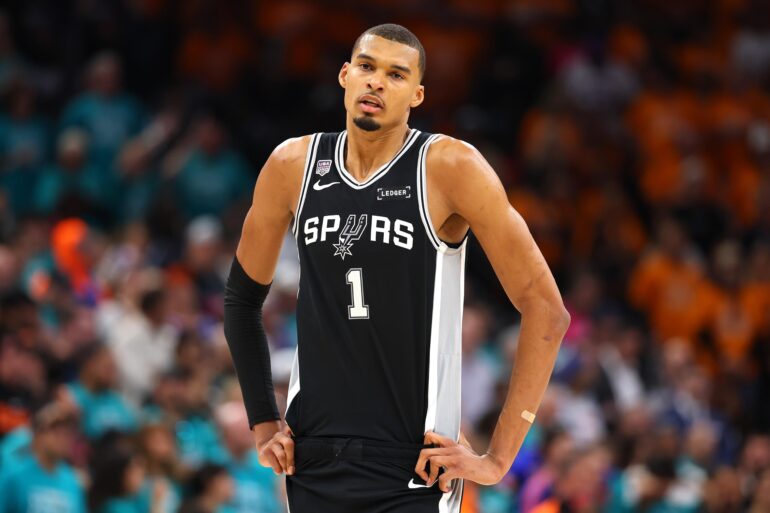
For years, basketball has treated Victor Wembanyama as an inevitability.
The moment he arrived, the conversation wasn’t whether he would become a superstar. It was how many MVPs he would win, how many championships he would collect, and whether the league had ever seen anything like him before. After a historic 2025–26 season that saw him drag the San Antonio Spurs to the NBA Finals at just 22 years old, the talent remains undeniable. At 7-foot-4 with guard skills, elite rim protection, and an offensive ceiling that seems limitless, Wembanyama is still the most unique force the sport has ever produced.
But after the New York Knicks hoisted the trophy on the Spurs’ home floor, a different conversation has emerged. It’s no longer about whether Wembanyama is great. It’s about whether he is ready to be the player everyone already assumes he is.
The Difference Between Talent and Control
Throughout the postseason, Wembanyama produced stretches that reminded everyone why he entered the league surrounded by historic expectations. His 39-point, 15-rebound, 5-block masterpiece in the early rounds was a “stat-line for the gods,” placing him alongside Shaq and Hakeem.
Then came the fourth quarters.
As defenses tightened and possessions became more physical, San Antonio repeatedly struggled to maintain control. The Spurs looked dominant early in the Finals, often jumping to double-digit leads, only to watch them evaporate late. In the decisive Game 5, Wembanyama finished with a strong 19 points, 14 rebounds, and 5 blocks, but the Spurs managed only 90 points as a team in a four-point loss.
Fair or not, franchise players receive both the credit and the blame for those outcomes. The flashes remained spectacular; the consistency did not. Superstars aren’t measured by what they do when everything is flowing—they’re measured by what happens when the game becomes uncomfortable.
Playing Like the Biggest Player on the Floor
Perhaps the most frustrating aspect of Wembanyama’s postseason was how often he drifted away from his greatest physical advantage. At his best, he overwhelms opponents near the basket, changing defensive schemes and collapsing coverage.
Too often, however, he settled for perimeter play. In the final loss to the Knicks, he struggled from deep, shooting just 1-for-6 (16.7%) from three. While his versatility is what makes him special, the issue is balance.
- The Aggressive Wemby: Punishes smaller defenders, forces fouls, and generates easy looks.
- The Passive Wemby: Relies on contested jumpers that allow the defense to breathe.
San Antonio looked at its best when Wembanyama attacked the paint and at its worst when the offense became dependent on difficult perimeter shots. The lesson isn’t that he should stop shooting; it’s that greatness comes from imposing your strengths, not abandoning them to play “finesse” basketball.
Leadership Is the Next Step
The expectations attached to Wembanyama are no longer those of a rising star. They are those of a franchise cornerstone. This means body language, postgame reactions, and public comments carry the weight of an entire organization.
The players who define eras—Michael Jordan, Tim Duncan, LeBron James—were judged by how they responded to the lowest moments. Wembanyama himself admitted after the Finals loss, “This is the biggest lesson of my life… I was not ready to win a ring.”

That level of self-awareness is promising, but the next step is transforming that “lesson” into the mental toughness required to lead a team through a Game 5 slugfest when shots aren’t falling.
The Good News for San Antonio
None of this changes the most important fact: Victor Wembanyama remains the most gifted young player basketball has ever seen. No executive in the league would hesitate to build around him, and the Spurs’ front office has already begun the work—bolstered by the emergence of rookie Dylan Harper and the veteran presence of De’Aaron Fox.
But the postseason exposed something that hype often conceals: potential and accomplishment are not the same thing.
For the first time, the conversation is becoming less about what he might become and more about what he has actually proven. That’s not a bad thing; it’s what happens when a player graduates from prospect to contender.
The question is no longer whether Victor Wembanyama can dominate basketball. The question is whether he can transform extraordinary talent into championship-level consistency. Until he does, the story of the “Alien” remains unfinished.