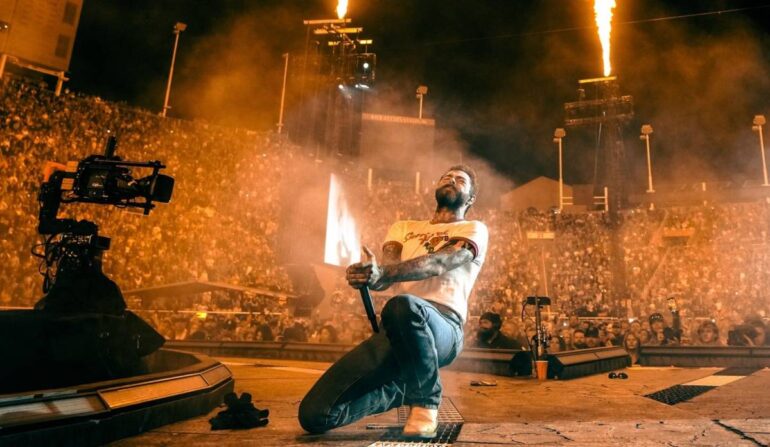
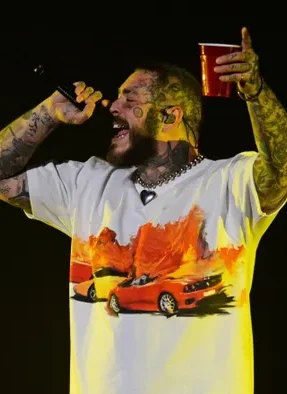
Post Malone performs during the Formula 1 Etihad Airways Abu Dhabi Grand Prix at Yas Marina Circuit. (Photo by Christopher Pike/Getty Images for Lumix, November 2024)
There was a time, not so long ago, when the name Post Malone conjured images of a specific, gritty brand of suburban rebellion. He was the face of the “SoundCloud Rap” era’s commercial peak—a man defined by his Bud Light-stained aesthetic, face tattoos that looked like notebook scrawls, and a genre-blurring sound that felt like it was recorded in a hazy basement rather than a boardroom. He was the ultimate outsider who accidentally became the biggest pop star on the planet by leaning into a curated kind of unpolished chaos.
Contrast that with the image of Post Malone today: standing on a multimillion-dollar stage at the Formula 1 Etihad Airways Abu Dhabi Grand Prix, his silhouette framed by the sharp, aerodynamic lines of the world’s most elite motorsport. The beer is still there, perhaps, but the context has shifted entirely. Malone is no longer the mascot for the disaffected youth; he is the premier ambassador for the “Global Luxury Experience.” His headline sets at F1 circuits from Miami to Saudi Arabia represent a profound transformation. He has moved from the fringes of the counterculture to become the reliable, high-octane engine of the corporate-industrial entertainment complex.
This isn’t just a story about a musician getting richer or a brand getting bigger. It is a reflection of a broader cultural shift where “authenticity” is no longer found in the underground, but in the seamless integration of a personality into the highest tiers of global commerce. Malone’s presence at the F1 finish line is the final crystallization of a new kind of celebrity: the Universal Utility Star.
From the “White Iverson” Court to the Paddock
The timeline of Austin Post’s ascent is a masterclass in strategic adaptability. In 2015, when “White Iverson” exploded, he was a curiosity—a Dallas kid who moved to LA and tapped into a zeitgeist that favored trap beats and melodic vulnerability. He was frequently the subject of debates regarding cultural appropriation, a “tourist” in hip-hop who many predicted would burn out as a one-hit wonder.
By the late 2010s, Malone entered a mid-period characterized by a fascinating ambiguity. Albums like Beerbongs & Bentleys and Hollywood’s Bleeding saw him transition into a dark, moody pop-rock hybrid. He was the sad clown of the streaming era, singing about the emptiness of fame while breaking streaming records previously held by The Beatles. During this era, his public identity was tethered to a “dirtbag-chic” relatability. He was the guy you could imagine playing beer pong with, even as he bought a multi-million dollar survivalist bunker in Utah.
However, the last three years have signaled a definitive pivot. The Recent “Country Posty” era, marked by his collaboration with Morgan Wallen on “I Had Some Help” and his full-length country debut F-1 Trillion, isn’t just a genre shift; it’s a demographic expansion. By aligning himself with Country music—America’s most loyal and lucrative domestic market—and Formula 1—the world’s most prestigious international sporting brand—Malone has successfully de-risked his brand. He has traded the volatile energy of hip-hop for the institutional stability of heritage genres and global luxury sports.
The Conflict of the “Golden Retriever” Energy
This evolution has not occurred without friction. To the purists who championed him as a disruptive force in the 2010s, Malone’s current trajectory feels like a surrender to the middle-of-the-road. In the circles of cultural criticism, there is a recurring tension: is Post Malone a genuine polymath, or is he the ultimate “industry plant” whose greatest talent is his lack of an edge?
The backlash often centers on the idea that Malone’s brand of “niceness”—often described as “Golden Retriever energy”—is a perfect camouflage for corporate assimilation. When he performs at an F1 event, he isn’t there to challenge the audience or provide a counterpoint to the spectacle; he is part of the hospitality package. Industry peers, however, see it differently. Figures across genres—from Ozzy Osbourne to Taylor Swift—have sought him out because he functions as a bridge. He is the rare artist who carries the credibility of the “alternative” while remaining fundamentally “safe” for the widest possible audience.
Media framing has followed suit. Where early coverage was skeptical and often mocking of his appearance, current profiles in outlets like The New York Times treat him as a savvy craftsman. He has moved from being a punchline to being a “pillar” of the modern music economy.
The Strategy of the Pivot
Malone himself has been surprisingly candid about his motivations, often couching his pivots in the language of personal happiness and creative freedom—which, in the modern media ecosystem, is also a highly effective business strategy. In interviews, he has admitted to the exhaustion of the “pop star” treadmill, famously telling Howard Stern that his move to Utah and his shift toward more traditional sounds was a matter of survival.
“I just want to make music that I love,” is the standard refrain. But beneath the “aw-shucks” exterior is a keen understanding of relevance. In an era where the shelf life of a rapper is increasingly short, Malone’s expansion into Country and F1-adjacent spaces is an act of career preservation. He is choosing “legacy” over “hype.” By becoming the face of events like the Las Vegas Grand Prix, he is positioning himself as an entertainer in the vein of a modern-day Jimmy Buffett or Garth Brooks—artists whose brands are so integrated into the fabric of “leisure” that they become immune to the whims of the Billboard charts.
Relevance, Luxury, and the Death of the Outsider
The “Post Malone at F1” phenomenon reveals a jarring truth about our current cultural moment: the barrier between the “rebel” and the “corporation” has completely dissolved.

In previous decades, a rock star or a rapper performing at a high-society racing event would have been seen as a “sell-out” moment. Today, it is seen as a “level-up.” Formula 1, particularly since its acquisition by Liberty Media and the success of Netflix’s Drive to Survive, has transformed from a niche European sport into a lifestyle juggernaut that combines tech, fashion, and music. It is the pinnacle of the “Experience Economy.”
Malone’s participation signals that cultural authority is no longer gained by standing against the system, but by becoming its most likable representative. In a fractured media landscape, where attention is the most valuable currency, “likability” is the ultimate power. Malone has mastered the art of being everywhere without being overbearing. He is the soundtrack to the VIP lounge and the dive bar simultaneously.
This reflects a broader trend where celebrity is curated not for mystery, but for utility. We don’t want our stars to be untouchable icons; we want them to be versatile avatars who can fit into a Super Bowl ad, a Nashville honky-tonk, or a Monaco paddock with equal ease. Post Malone is the first true superstar of this “Post-Genre, Post-Niche” era.
The Last Lap
As the engines cool at the Yas Marina Circuit and the crowds disperse, the question remains: does this strategy of total assimilation carry a long-term cost?
By becoming the “everyman” for the elite, Post Malone risks losing the very thing that made him compelling in the first place—the sense that he was a beautiful, chaotic accident. When your identity is so perfectly aligned with the needs of a global sporting franchise or a corporate sponsor, the art can begin to feel like an afterthought to the “activation.”
However, looking at the trajectory of his career, it seems Malone has calculated that the era of the “uncompromising artist” is over, replaced by the era of the “Universal Brand.” Whether he is singing a trap ballad or a country duet, he is now an essential part of the modern spectacle. He has successfully navigated the turn from “post-everything” to “the everything man.” In the high-speed world of 2024 culture, Post Malone isn’t just watching the race; he’s the one holding the checkered flag.