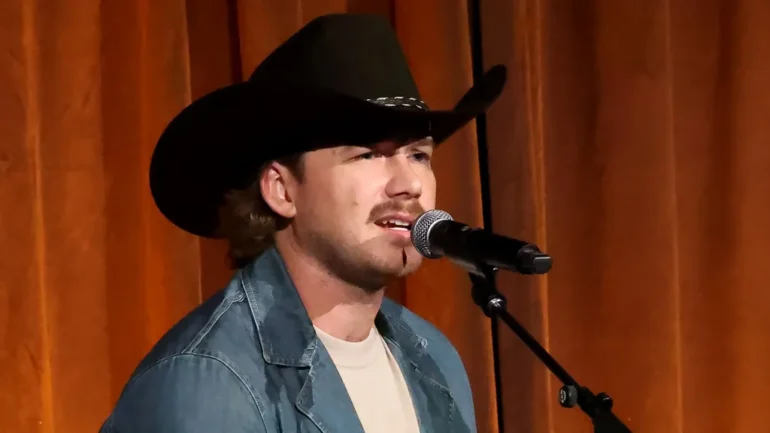
Morgan Wallen tour begins April 10, 2026.
Who is Morgan Wallen?
There was a time, not long ago, when the “outlaw” in country music was defined by a specific kind of distance from the center. To be an outlier like Waylon Jennings or Willie Nelson was to exist in a state of friction with the Nashville establishment—a literal and figurative exile from the polished gears of the Music Row machine. Today, however, the most successful artist in the genre, Morgan Wallen, has achieved the impossible: he has successfully industrialised the rebel archetype.
The tension defining Wallen’s current era is no longer about whether he belongs in the room, but rather how he manages to look like he’s breaking the windows while he’s actually holding the keys to the building. As he prepares for his massive 2026 stadium run, the contrast is stark. He is simultaneously the most “canceled” man in music and its most indispensable commercial asset. This evolution from a scruffy The Voice contestant to a monolithic force of nature reveals a shift in the American psyche where “authenticity” is no longer measured by moral purity, but by the perceived resilience of a brand under fire.
Wallens’ Career was uplifting.
Wallen’s trajectory is a case study in the modern “fail-upward” mechanics of digital-era stardom. His early reputation was built on the back of a curated Southern Everyman persona—the mullet, the sleeveless flannel, and a voice that possessed just enough gravel to sound “unrefined” by pop standards. After a respectable but unremarkable stint on NBC’s The Voice in 2014, he was positioned by Big Loud Records as a bridge between the “bro-country” era and a more soulful, traditionalist resurgence.
The mid-period of his career was defined by a series of high-profile contradictions. In 2020, Wallen was disinvited from Saturday Night Live after videos surfaced of him maskless and partying during the height of the pandemic—a moment that briefly painted him as a liability. However, the true crystallization of his narrative occurred in February 2021, when a video emerged of Wallen using a racial slur outside his home.
While the industry’s immediate reaction was a swift removal from radio and streaming playlists, the public perception took a paradoxical turn. His album sales didn’t just survive; they exploded. The recent events of 2024 and 2025—including his arrest for throwing a chair off a Nashville rooftop and his record-breaking collaboration with Post Malone on “I Had Some Help”—have solidified a new reality: Wallen is now a “protected” cultural entity, shielded by a fanbase that views his transgressions as badges of relatability.
The challenges he had to face.
The backlash against Wallen has never truly subsided; it has simply become part of the product. The industry response was initially a “moral” excision, with the CMA and ACM Awards scrubbing his name from ballots. Yet, as his numbers grew too large to ignore, a quiet reintegration began. Peer reactions have been telling; while some contemporaries remained silent, others like Jelly Roll and Lainey Wilson have occupied a similar space of “redemption-core,” though none have faced the same level of acute controversy.
Media framing has struggled to keep pace. Outlets like VICE and The New York Times have framed Wallen’s dominance as a symptom of a deep-seated cultural divide, suggesting that his success is a “spite-buy” from an audience tired of perceived coastal elitism. This framing has, ironically, granted Wallen more credibility within his core demographic. To his fans, the pushback from traditional media isn’t a critique of his character—it’s an attack on their shared values, turning every ticket purchase into a political act
Morgan was not a quitter.
Wallen himself has been careful with his public acknowledgments, often leaning into a narrative of “working on himself” while acknowledging the strategic necessity of his visibility. In a widely cited interview with Good Morning America, he admitted to being “on a bender” and “ignorant,” but he also implicitly acknowledged the power of his platform.
More recently, during his 2024 stadium tour, Wallen has used his stage as a place for controlled provocation. By walking out with celebrities like Theo Von or Deion Sanders, he signals that his motivation isn’t to be a “good” celebrity in the Hollywood sense, but a relevant one in the cultural ecosystem. He is operating with a clear understanding that in the modern media landscape, negative attention is still attention, and control over one’s narrative is best maintained by leaning into the “damaged goods” label rather than trying to erase it.

He was one of a kind.
Zooming out, the “Morgan Wallen Phenomenon” reveals a profound transformation in how cultural authority is contested. We are moving past the era of the “curated icon” and into the era of the “resilient anti-hero.” Wallen’s dominance suggests that for a large swath of the public, authenticity is now synonymous with fallibility. In an age of airbrushed TikTok perfection, Wallen’s messy personal life—the arrests, the slurs, the public apologies—serves as a strange kind of proof that he is “real.”
This situation highlights a conflict between relevance and legacy. Wallen possesses immense relevance, fueled by a data-driven understanding of what his audience wants (namely, trap-infused country beats and lyrics about small-town heartache). However, his legacy is being built on a foundation of friction. In the modern media ecosystem, power is no longer granted by gatekeepers like Billboard or the Recording Academy; it is seized through direct-to-consumer loyalty. Wallen’s career is the blueprint for how an artist can bypass the traditional “prestige” route and build a fortress of influence that is immune to the usual levers of social consequence.
Furthermore, the collaboration with Post Malone on “I Had Some Help” represents the final stage of this industrialization. It is a fusion of two “outsiders” who have become the ultimate insiders. It signals that the “country” label is no longer a geographic or sonic restriction, but a vibe—a specific kind of rugged, white, working-class aesthetic that can be exported globally regardless of the controversy attached to the vessel.
What to hope for on Wallen’s Tour 2026!
As Morgan Wallen looks toward 2026, he stands at a crossroads that few artists ever reach. He has proven that he can survive almost anything, but the question remains: does his brand of rebellion carry weight if it is no longer being fought from the outside?
When the “outlaw” is the one filling the NFL stadiums and topping the global charts, the very definition of the term begins to dissolve. Wallen has successfully navigated the shift from a person to a proxy—a vessel for his audience’s own feelings of defiance and cultural displacement. But in a landscape that moves at the speed of a viral clip, the strategy of “provocation for relevance” has diminishing returns. For now, the Wallen machine is humming at peak efficiency, but as the cultural landscape shifts again toward a new search for genuine connection, he may find that the most difficult thing to industrialize is the very thing he started with: a soul that feels like it hasn’t been bought and sold a dozen times over.